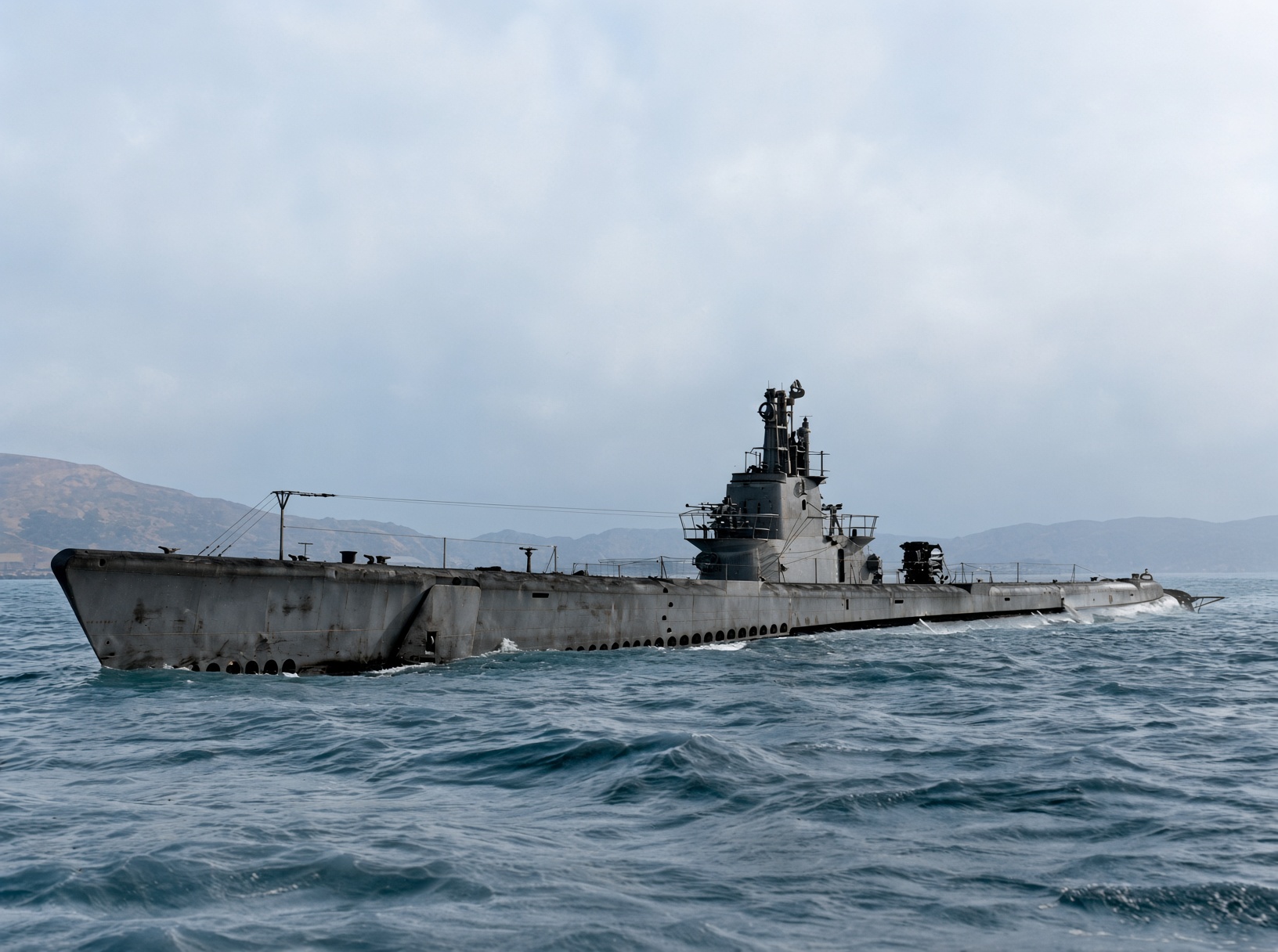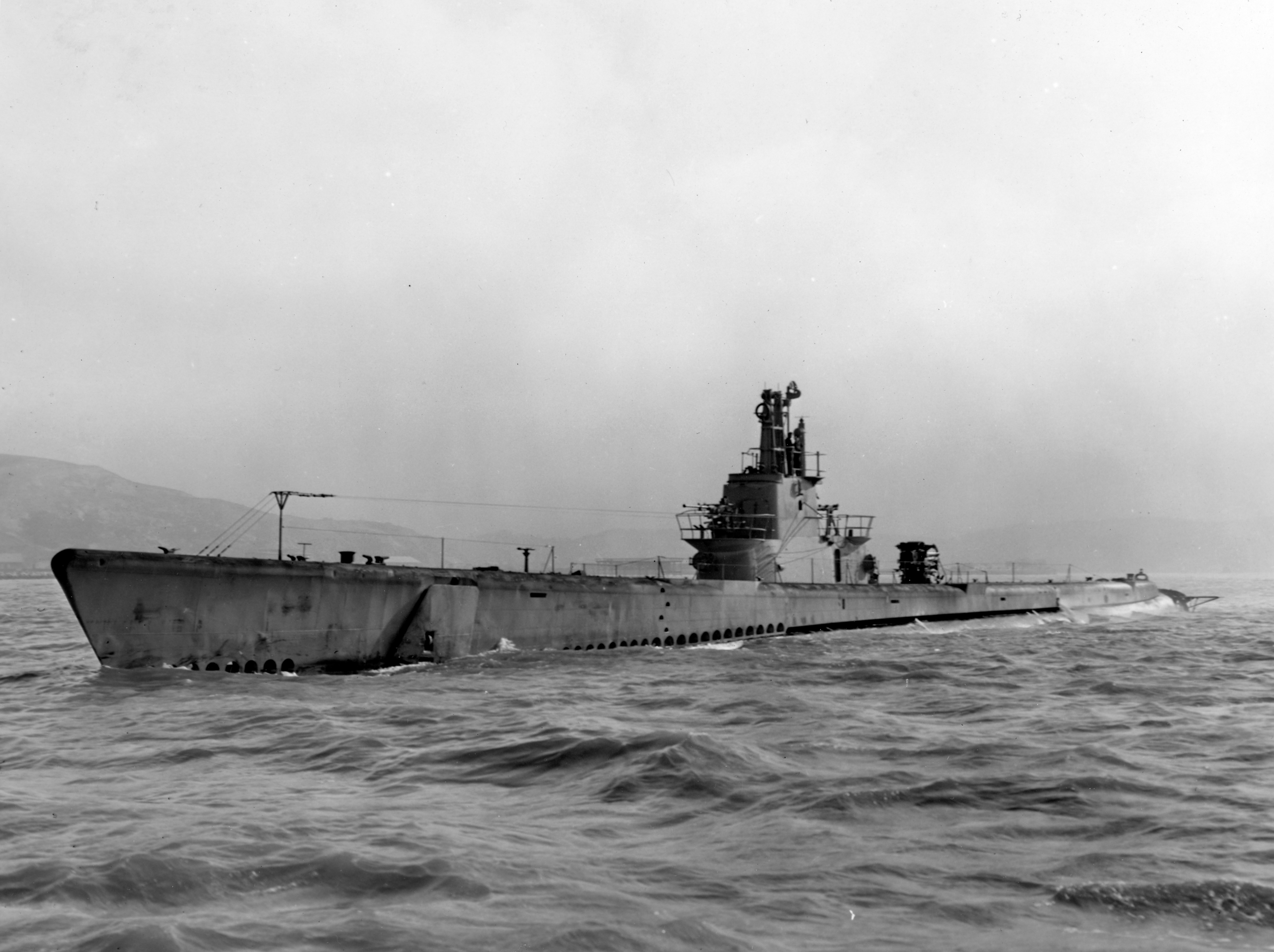
Barb is named for a kingfish of the Atlantic coast. She was a Gato-class submarine, SS-220, built by Electric Boat at Groton. The sponsor at her launch on 2 April 1942 was Mrs. Charles A. Dunn, wife of Rear Admiral Dunn. Lieutenant Commander J. R. Waterman commissioned her on 8 July 1942 and took her to the Atlantic Fleet. From 20 October 1942 to 2 August 1945 she made twelve war patrols.
The first was scouting, before the landings in North Africa and during them. Through July 1943 she worked from Roseneath, Scotland, against Axis blockade runners. The fifth patrol ended on 1 July 1943. She reached New London on 24 July, had a short overhaul, and arrived at Pearl Harbor in September.
The Pacific is where the score was made. From March 1944 to August 1945 she made seven patrols. Official credit for those patrols is seventeen enemy vessels, 96,628 tons, including the escort carrier Unyo and a frigate. Eugene Fluckey took command in late April 1944 and kept her through the last five patrols, into August 1945. The crew called him Lucky.
Southeast of Hong Kong on 17 September 1944 she found convoy HI-74 after it left Seletar. Just after midnight she hit Unyo with two torpedoes on the starboard side, one in the steering compartment and one in the engine room. The same salvo also hit a tanker. The two hits on the carrier killed twenty-six men. Unyo went dead in the water. For a while she looked as if she could be saved. The sea then gave way against the shored bulkheads. She was abandoned about 0730 and sank by the stern at 0755, near 19 degrees 10 minutes north, 116 degrees 35 minutes east. Her captain went down with her. The escorts took off hundreds of men. Barb was not damaged.
The eleventh patrol ran from 19 December 1944 to 15 February 1945, in the Formosa Strait and the East China Sea, along the China coast from Shanghai to Kam Kit. The Navy credited that patrol with four Japanese merchant ships and a number of small craft. On 8 January she fought a convoy for two hours at night and sank a large ammunition ship. What she had left after that were the torpedoes still in the tubes.
On the night of 22–23 January 1945 Fluckey took her into Namkwan Harbor. The Medal of Honor citation calls the anchorage Mamkwan. It is the lower reach of the Nankuan Chiang. More than thirty Japanese ships lay there. The harbor was shallow, rocky, mined, and badly surveyed. Getting back out meant a full hour at speed through that water. He went in on the surface, past the escorts. At one point the depth was five fathoms, about thirty feet, and she drew about seventeen feet. At 3,000 yards he fired the last bow torpedoes, swung her, and fired four from the stern. The crew counted eight hits on six ships. One was an ammunition ship. She blew up, and the shells in her went off across the harbor.
He brought her out on the surface, through rocks and water that might be mined, with the escorts astern, and cleared at high speed. Four days later she sank a large freighter. The Medal of Honor was for the patrol, from the fight on 8 January through Namkwan to that freighter, and the boat received the Presidential Unit Citation. The count from the harbor ran high, as wartime submarine counts often did. Postwar Japanese records confirm fewer ships sunk than the crew believed, and they do not settle which ones.
After that patrol she went home for a yard overhaul, and the yard fitted 5-inch rocket launchers. The twelfth patrol began on 8 June 1945, north of Hokkaido and east of Karafuto, the Japanese half of Sakhalin. She was the first submarine in the war to use rockets successfully against targets ashore. She fired them into Shari, Shikuka, Kashaiko, and Shiritori, and she bombarded Kaihyo To with her guns. The patrol account says about half of that town was destroyed.
On the night of 22–23 July she put eight men ashore on Karafuto. The railroad ran close to the beach. They landed from about 950 yards out. Fluckey picked the eight from every division, and he took only unmarried men. They set a charge under the track, made to go off under the next train. He later wrote that the train was sixteen cars. It was the only time a crew from an American submarine fought on the ground on the Japanese home islands. For the patrol she received the Navy Unit Commendation.
She was still afloat at the surrender. On 9 March 1946 she went into commission in reserve, and on 12 February 1947 she was decommissioned at New London. She recommissioned on 3 December 1951 and operated with the Atlantic Fleet out of Key West. On 5 February 1954 she went out of commission for a Guppy conversion and recommissioned on 3 August 1954. On 13 December 1954 she was decommissioned again and loaned to Italy as Enrico Tazzoli. She was struck on 15 October 1972. For the war she carried the Presidential Unit Citation, the Navy Unit Commendation, and eight battle stars.