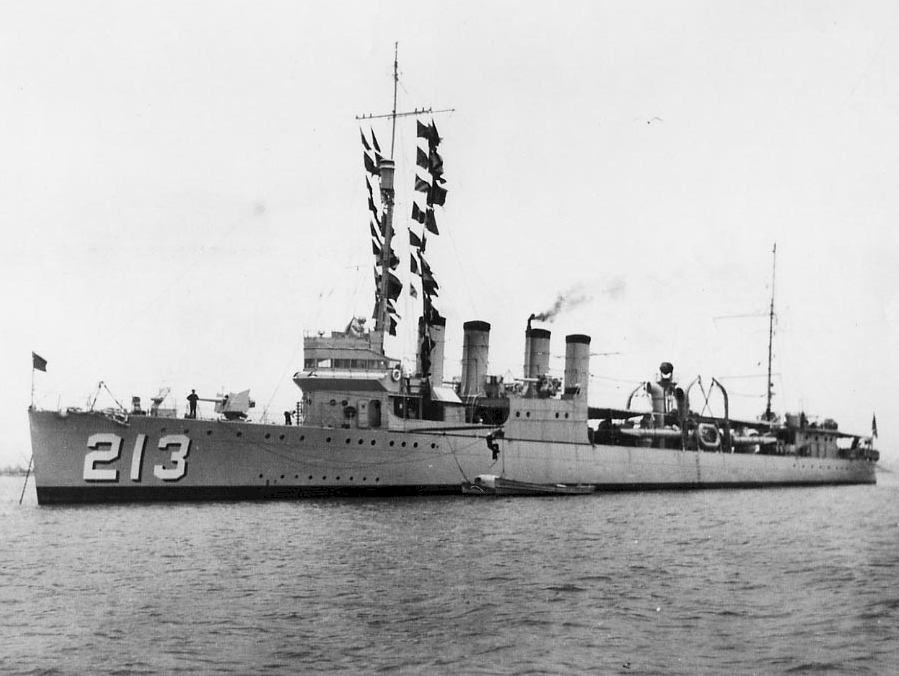
Barker was a Clemson-class destroyer, DD-213, named for Rear Admiral Albert S. Barker. William Cramp and Sons laid her down at Philadelphia on 30 April 1919, launched her on 11 September 1919, and commissioned her on 27 December 1919. Mrs. Albert S. Barker, the admiral's widow, sponsored the launch. Lieutenant Commander Charles A. Windsor was her first commanding officer. She served in Turkish waters, on the Asiatic Station, off Nicaragua in January 1927, and with the naval forces in Europe, and she was back in the Far East for the years before this war. She was in Destroyer Division 58 with Stewart, Parrott, and Bulmer.
She was not in the night attack at Balikpapan on 24 January 1942. Boise had grounded on an uncharted pinnacle in Sape Strait, and Barker turned back with her. Bulmer stayed with Marblehead, which had burned out a turbine, and met the division after the fight.
On 4 February she was in the force Rear Admiral Karel Doorman took into the Bali Sea, his flag in De Ruyter. With them were Tromp, Piet Hein, Banckert, Van Ghent, Houston, Marblehead, Stewart, John D. Edwards, and Bulmer. Lieutenant Commander Adolph Jerome Miller had Barker. Aircraft found the ships about 0955, near 07°28' S, 115°37' E. A bomb hit the roof of Houston's after 8-inch turret. Marblehead was hit and was straddled, and she was sent home for repairs. The raid was called off. The hits are not credited to one aircraft. Houston went on toward Tjilatjap with only two turrets that would train, which is how she still fought when she was lost.
On 15 February, north of Gaspar Strait, after Van Ghent was lost on a reef in Stolze Strait, five waves of aircraft attacked from about 1150 until about 1745. Near misses shook Barker and Bulmer in the machinery spaces. Hobart took splinter damage. The ships went on to Tandjong Priok with De Ruyter, Tromp, Exeter, and Hobart.
In March she and Bulmer escorted the transport Mount Vernon out of Fremantle with the Australian cruiser Adelaide, and parted from her on the afternoon of 7 March. Later that month they took Westpoint out the same way and parted from her before dawn on 27 March. She then went to the Atlantic. On 10 June 1943 she and Bulmer were off Casco Bay with the battleship Iowa. Miller still had Barker. On 13 July, in a hunter-killer group built around the escort carrier Core, aircraft from Core sank the submarine U-487 and Barker took 33 survivors aboard.
She reached Philadelphia on 4 June 1945, was decommissioned on 18 July, was struck on 13 August, and was sold on 30 November 1945 and broken up. She received two battle stars.