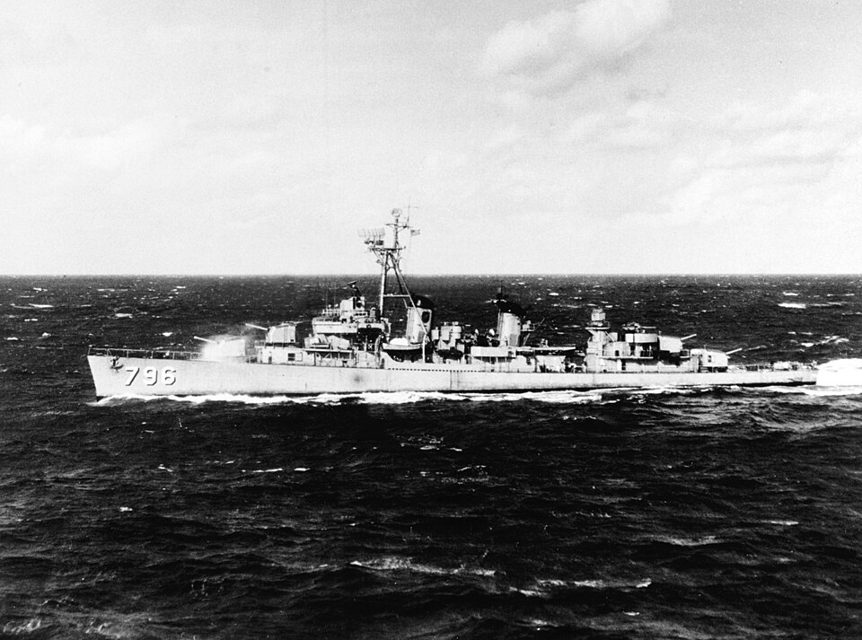
USS Benham (DD-796) was a Fletcher-class destroyer, the third Navy ship named for Rear Admiral Andrew E. K. Benham, who lived from 1832 to 1905. Bethlehem Steel's yard on Staten Island, New York, put her in the water on 30 August 1943. Mrs. Harold Benham, whose husband was a grandson of the admiral, sponsored the hull. The ship was commissioned on 20 December 1943, and Erle Van Emburgh Dennett was her captain from that day until 12 May 1944.
She fitted out at New York and ran her first shakedown in Long Island Sound. Early in January 1944 she headed southeast toward Bermuda. On 14 January she entered Kingston, Jamaica, and spent four weeks practicing shore bombardment, hunting submarines, and escorting carriers. New York had her again on 13 February. After the yard period that followed, she reached Norfolk on 28 February, joined the destroyer tender Piedmont, and took that ship through the Panama Canal. The two arrived at Pearl Harbor on 27 March.
At Pearl the crew drilled for destroyer duty ahead of Operation Forager, the invasion planned for the Marianas: screening carriers, antiaircraft gunnery, and antisubmarine work. On the night of 24 April a screening exercise ended in a collision with Uhlmann that badly damaged Benham's bow. Forager had first claim on the yards, so the repairs dragged, and she was fit for duty again only on 14 May. On 29 May she joined Task Group 52.11 with the escort carriers Kitkun Bay and Gambier Bay and the destroyers Laws and Morrison. The group sailed for Eniwetok and arrived about a week later. On 15 June it moved to Saipan, where Benham screened the two carriers as their planes struck Japanese troops ashore.
Word of a large Japanese fleet coming out of the Philippines toward the Marianas sent the fast carriers west. Those ships had been flying support for the troops on the ground, and on 19 and 20 June they won the Battle of the Philippine Sea. Close air support for the men already ashore then rested with the seven escort carriers of Task Group 52.1. The first Japanese counterattack around Saipan came on the night of 15 June, three small raids against that group, and the raiders stayed clear of Benham. At dusk on 17 June about a dozen Aichi D3A dive bombers, the type called Val, went for the escort carriers. Benham joined the antiaircraft barrage, two of the attackers were shot down, and she came through unhurt. More raids closed on the 18th, and combat-air-patrol fighters drove them off. She kept that station until 2 July, then shifted to Task Group 52.12 for screening and fire support while the last fighting on Saipan was cleaned up. The island was secured on 10 July. Benham reached Eniwetok on 16 July.
She filled magazines and storerooms and escorted assault troops from Eniwetok to Tinian, arriving off the island on 19 July. For the next four days she stayed with the transports at sea while other warships shelled Japanese forces on shore. After the landings on 24 July, the rest of the month was gunfire: targets around the town of Sunharon in daylight, defensive fire over Marine battalions at night, and evening runs in close for interdiction shoots and enemy gun positions. On 6 August she moved to Guam and spent four days bombarding the last Japanese holdouts on the northeast end of the island. Guam was declared secure on 10 August. Benham then ran east to Eniwetok and moored to a tender for repairs.
Before the invasion of the Philippines, fast carriers were ordered to strike Japanese air strength in the Bonins, the Palaus, Yap, and Mindanao. On 28 August Benham sailed west with Task Group 38.2 for a heavy raid on the Palaus. In the group were Intrepid, Hancock, Bunker Hill, Cabot, and Independence, along with two battleships and four cruisers, plus seventeen destroyers in addition to Benham. She screened the carriers over the Palaus from 6 to 8 September and during attacks on airfields near Sarangani Bay, on Mindanao, on 9 and 10 September. Back in the Palaus on 15 September, she screened again while aircraft supported the landings on Peleliu and Angaur. Strikes on Luzon airfields from 21 to 24 September closed that series. The task force entered Ulithi on 29 September to rearm and refuel.
Task Group 38.2 put to sea on 6 October and joined the three other carrier groups of Task Force 38. The whole force shaped a northwesterly course for strikes on the Ryukyu Islands, Formosa, and the Philippines. On 10 October Benham screened Bunker Hill while planes hit Okinawa and the lesser islands of the Ryukyus. A raid on Aparri, in the Philippines, followed on 11 October as a diversion. On 12 October a much larger blow opened against Japanese air power on Formosa. The attacks disabled a large share of the defending aircraft, yet after dark Mitsubishi G4M Betty bombers from Kyushu harassed the ships. Across two nights Benham's gun crews shared in nine planes shot down, with a tenth counted probable. The force then eased east, covering the cruiser Canberra as she retired after a Japanese torpedo had left her badly damaged. From 15 October the carriers struck Japanese installations in the Philippines, attacks meant to open the way for the landing, and they continued until 20 October, the day the first troops went ashore on Leyte.
On 24 October Benham left the main body and escorted Bunker Hill to Manus, in the Admiralty Islands, where the carrier was to be repaired. The Battle for Leyte Gulf, fought in and around the Philippines on 24 and 25 October, took place while she was on that passage. Manus gave her a short refit. She then went to Saipan and rejoined the carriers for operations early in November. Off Luzon on 11 November she took a place in the screen while their planes supported the ground fighting on Leyte. That work lasted until 22 November, when the fast carriers went back into Ulithi. Benham survived the war. On 15 December 1960 the United States loaned her to Peru.