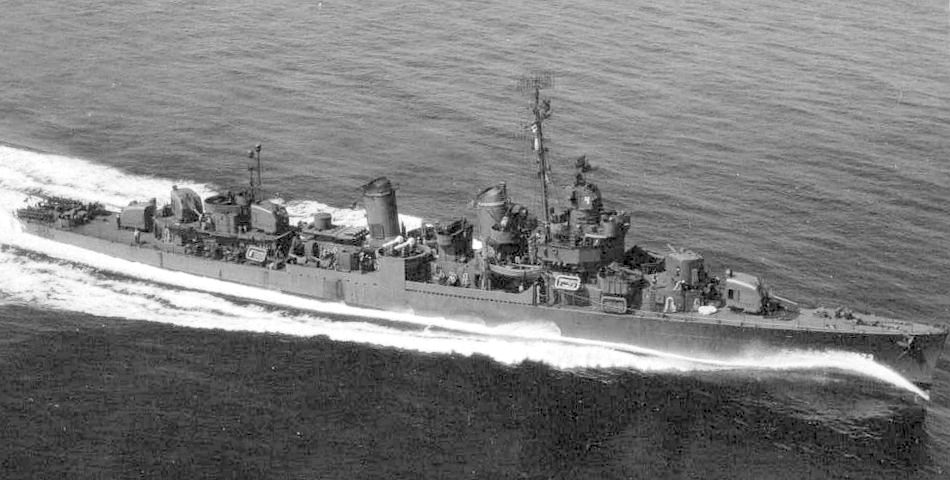
USS Bennett (DD-473) was a Fletcher-class destroyer in the United States Navy. Her name honored Floyd Bennett, a naval aviator who lived from 1890 to 1928. In 1926 he and Richard E. Byrd flew a course aimed at the North Pole, and whether that flight reached the pole is disputed. The hull entered the water on 16 April 1942 at Boston Navy Yard. Mrs. Floyd Bennett, the aviator's widow, sponsored her. Commissioning came on 9 February 1943, with Edmund Battelle Taylor in command.
Pearl Harbor received her on 31 May, and Hawaiian patrols filled the two months that followed. She then took a convoy as far as Efate, in the New Hebrides. From 27 August through 28 October she guarded planes and patrolled out of Efate. On 4 November she shifted to the Solomon Islands, where patrol and convoy duty ran on until 5 April 1944. That Solomon service covered the Cape Torokina landings of 1 November 1943 along Bougainville's western coast, the Green Island landings of 15 February 1944, shelling of Japan's base at Kavieng on New Ireland on 18 February, and shelling of Rabaul on New Britain on 29 February.
Bennett next went north for Saipan, on hand from 14 June through 1 July, and for Guam from 2 August through 16 August. Taylor was relieved on 31 July 1944 by Philip Frederick Hauck, who stayed in command until 5 November 1944. Before August ended she had come back into the Central Pacific and, from 6 September through 25 September, supported the Peleliu assault in the Palaus. Upkeep then drew her to San Francisco, reached on 25 October 1944. Jasper Newton McDonald became captain on 5 November 1944.
She was at Pearl Harbor again on 24 December and remained in Hawaiian waters through the month that followed. Steaming west, she joined the Iwo Jima invasion and operated there from 19 February through 5 March 1945. On 1 March a dud bomb left her slightly damaged. On 1 April Bennett was among the ships committed to the Okinawa invasion. At 08:50 on 7 April a Japanese naval kamikaze struck, wrecking the engine room forward and silencing every electrical circuit. Seven sailors died of their wounds, and fourteen others lived through serious injuries.
She still made the small base at Kerama Retto on her own engines. The next day the fleet tug Yuma (ATF-94) towed her toward Saipan. Emergency patching there let her continue to the navy yard at Puget Sound, where yard work occupied May through August 1945. In August the ship reported to Adak in the Aleutian Islands. From 28 August through 26 September she made a single run to Petropavlovsk, on the Kamchatka Peninsula, carrying weather personnel. At San Diego she passed into commissioned reserve on 21 December 1945, and on 18 April 1946 she left active commission for the reserve.
Bennett survived the war. On 15 December 1959 the United States transferred her to Brazil, which renamed her Paraíba. She was stricken on 1 August 1973. The Brazilian Navy later struck the ship, and the hull was scrapped in 1978. For her World War II service she received nine battle stars and a unit commendation from the Navy.