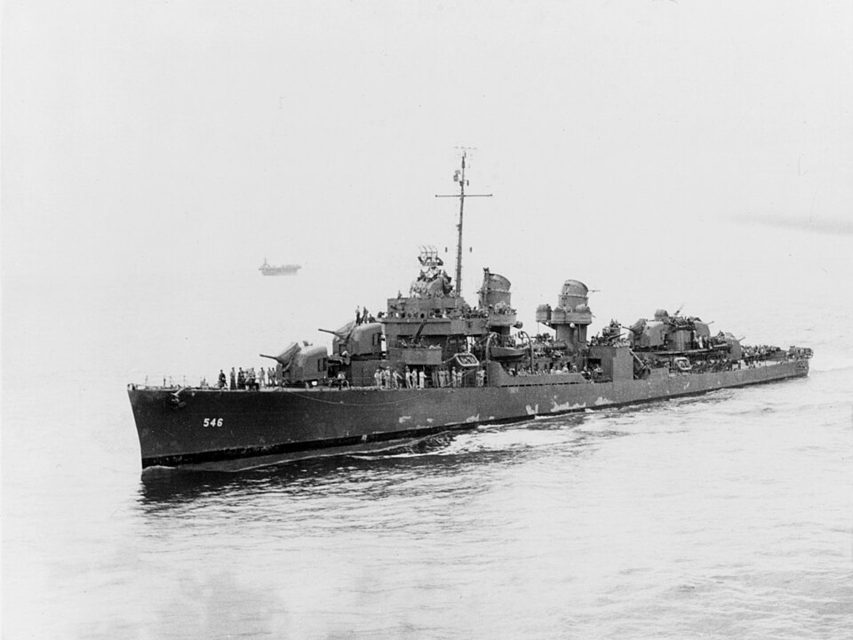
USS Brown (DD-546) was a Fletcher-class destroyer. On 21 February 1943 the hull went down the ways at Bethlehem Steel in San Pedro, California. Sponsorship belonged to Mrs. Claude O. Kell, Captain Kell's wife. Commissioning came on 10 July 1943, and Thomas Henry Copeman was her captain from that day.
Departure from Pearl Harbor came on 10 November 1943, with Brown sailing in Task Force 50 toward the forward area. Carrier escort filled the months that followed. She covered the Gilbert Islands landings from 21 November to 6 December 1943, then raids on Kavieng in New Ireland from 25 December 1943 to 4 January 1944. The Marshall Islands followed from 29 January to 7 February, Truk on 16 and 17 February, and Palau, Yap, and Woleai from 30 March to 2 April. Hollandia, on New Guinea, was taken between 21 and 28 April while she screened the attack. Truk was hit again on 29 April, Satawan was bombarded on 30 April, and Ponape was raided on 1 May.
Marcus Island was struck on 19 and 20 May, and Wake Island on 23 May. Through 1–26 June she screened strikes for the Saipan assault. On 19 and 20 June, in the Battle of the Philippine Sea, four American aviators were picked up. Iwo Jima took a bombardment on 4 July. Guam and Tinian were assaulted from 12 July to 6 August, with Yap hit on 26–28 July and Chichi Jima on 4 and 5 August. From 6 to 15 September her raids reached Palau, Mindanao, Talaud, and Morotai while the southern Palaus and Ulithi were captured. Later blows fell on Luzon and the Visayas from 21 to 24 September, and on Okinawa, Formosa, and Luzon from 10 to 19 October. She was in the Battle for Leyte Gulf on 26 October, raided Manila and the Visayas on 6 November, and on 15 and 16 December struck the northern and central Philippines as Mindoro was seized.
A typhoon caught Task Force 88 on 17 and 18 December. Strikes set for Luzon were dropped so the force could search out men from three destroyers that had disappeared. On 21 December, eighteen survivors from Hull and six from Monaghan were taken aboard. Brown continued to Ulithi, where orders turned her toward Seattle, Washington, for overhaul. Copeman's command ended on 13 January 1945, and Robert Rutherford Craighill became captain that day. Yard work finished on 1 March 1945, and the destroyer was ready to sail.
She called briefly at Pearl Harbor, then went west for the Okinawa operation of 1 April to 30 June 1945. As a radar picket in that campaign she earned the Navy Unit Commendation. She joined the Third Fleet's attacks on Japan from 30 June to 15 July and shared in sweeping mines southwest of Okinawa. After the fighting ended, her Japan occupation duty ran through 28 October 1945. The next port was Naval Station San Diego, reached on 17 November 1945. On 1 August 1946 she went into reserve there, out of commission.
The Navy commissioned her again on 27 October 1950. Hard shakedown training off the West Coast came first. In March 1951 she reported to Naval Forces, Far East, and from then until September worked in Task Forces 77 and 95. Twice she joined the siege at Wonsan harbor, and during 1951 North Korean shore batteries fired on her. She was back in California that October. A western Pacific cruise from July 1952 to January 1953 put her on the Formosan Patrol. Four more Far East deployments followed, with stretches of duty along the West Coast between them. American service ended when she was decommissioned on 9 February 1962.
On 27 September 1962 the United States turned her over to the Hellenic Navy. Renamed Navarinon and numbered D63, she stayed in Greek service until 1981, when she was stricken and sold for scrap. Her awards were a Navy Unit Commendation for the Okinawa operation, thirteen battle stars from the Second World War, and two battle stars from the Korean War.