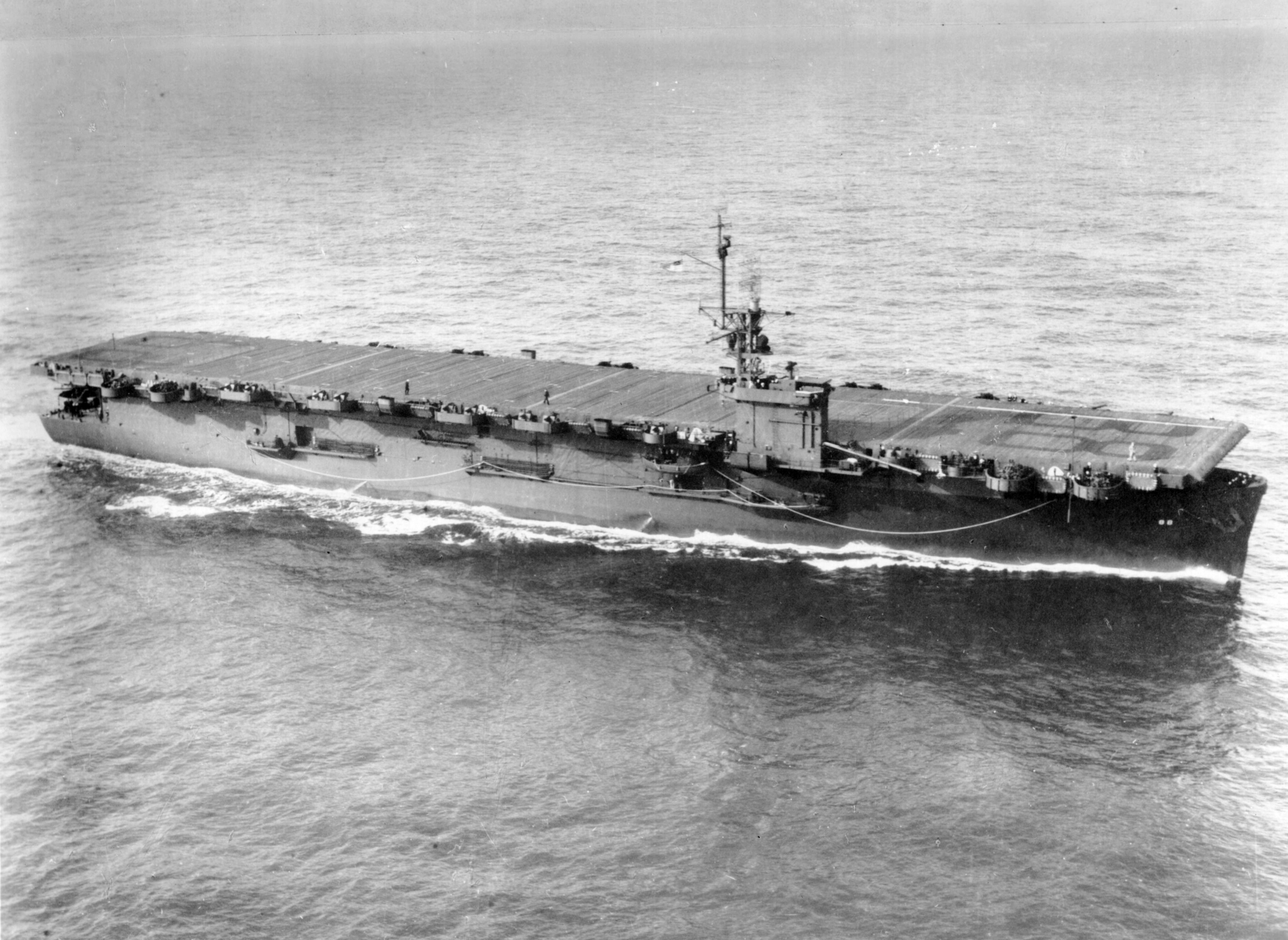
The night of 11-12 October 1942, off Cape Esperance on Guadalcanal, Rear Admiral Norman Scott's cruisers and destroyers met a Japanese force under Rear Admiral Aritomo Goto that was trying to land reinforcements. The escort carrier named for that night had been Tananek Bay until 6 November 1943. Kaiser at Vancouver launched her on 3 March 1944. Mrs. W. M. McDade sponsored her. The Navy took her over on 9 April 1944, and Captain R. W. Bockius commissioned her the same day.
Assigned to the Pacific Fleet, she made two voyages from the west coast to South Pacific bases between 26 May and 20 September 1944, taking new aircraft out and bringing damaged ones home. Loaded with combat-ready aircraft, she left San Francisco on 5 October and joined Task Group 30.8 on 2 November, in support of Third Fleet strikes on Leyte and Luzon. Replacement aircraft left her deck for the operating carriers. From Ulithi and Guam through January she supplied Task Force 38 for strikes on Formosa and the China coast.
In February she returned to the west coast, loaded again, and carried the aircraft to Guam. That was the first of a series of voyages that put aircraft into the western Pacific for the raids on Iwo Jima, Okinawa, and the home islands. At the close of the war she sailed from San Diego to Pearl Harbor and was back at San Francisco on 11 September 1945 with aircraft and passengers. She kept at those voyages until she was decommissioned, in reserve, at Bremerton on 22 August 1946. She received two battle stars.
She was recommissioned on 5 August 1950 and went to the Military Sea Transportation Service as an aircraft transport. Over nine years she carried aircraft to Japan during the Korean War, supported the atomic tests at Eniwetok, and made two voyages to Bangkok for the Royal Thai Air Force. In 1952 she went to Hong Kong to take out Chinese Nationalist aircraft. Redesignated CVU-88 on 12 June 1955, she crossed the Atlantic in 1956 with aircraft for Italy, France, and Portugal, and later that year carried aircraft to Pakistan. She was decommissioned on 15 January 1959 and sold on 14 May 1959.