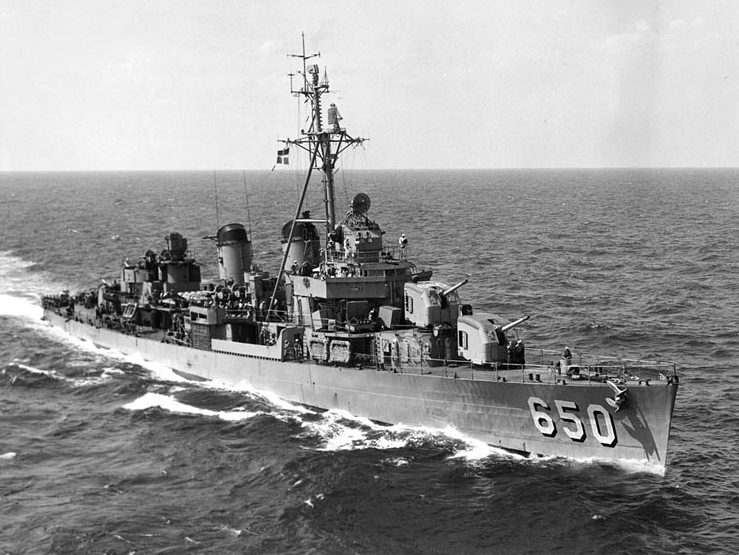
USS Caperton (DD-650) was a Fletcher-class destroyer. She was launched on 22 May 1943 and commissioned on 30 July 1943 under Wallace Joseph Miller. Her wartime duty ran with the fast carrier groups across the Pacific, and for the Second World War the Navy awarded her ten battle stars.
She departed Boston on 8 October 1943 and arrived at Pearl Harbor on 6 November. On 28 and 29 November she put explosives ashore at Funafuti in the Ellice Islands, patrolled through the Gilbert Islands operation until 8 January 1944, and then returned to Pearl Harbor. There she became an escort for the Fast Carrier Task Force, which operated as Task Force 58 with the Fifth Fleet and later as Task Force 38 with the Third Fleet. On 30 January 1944 her guns joined the shelling of Kwajalein. Based at Majuro, she covered February air attacks on Truk and on Saipan. On 15 March she left Espiritu Santo to protect the air operations around the Emirau landing, and late that month she was with the carriers for raids aimed at Palau and Yap and at Woleai and Ulithi.
April kept her with the same force. She screened the air attacks that prepared the Hollandia invasion, was present for another raid on Truk, and took part in the bombardment of Satawan and of Ponape. On 6 June 1944 she sailed from Majuro for the Marianas. On 19 and 20 June the operation reached the Battle of the Philippine Sea, and from the carrier screen she met Japanese air attacks with antiaircraft fire. She next covered the strikes that prepared the return to Guam, closing the shore to serve as lifeguard for downed pilots. On 25 June, while shore batteries fired on her, she sank a cargo ship lying inside Apra Harbor. She remained in the Marianas through July and late in the month screened raids on Yap and Palau. George Kennedy Carmichael relieved Miller on 27 August 1944.
On 30 August 1944 Caperton left Eniwetok to join Task Force 38 for the bombardments and air strikes ahead of the return to the Philippines. Carrier planes ranged over the Palaus and Mindanao and on through the Visayas to Luzon, while the ships' guns were turned against Peleliu and Angaur and against Ngesebus. She replenished at Ulithi and went back to screening strikes whose aim was to pin down Japanese strength at Okinawa and on Formosa ahead of the landings at Leyte. In the three-day air battle off Formosa, Canberra and Houston were hit by aerial torpedoes. Caperton screened the damaged cruisers toward safety and stayed with them while they were held out to draw Japanese surface ships into battle. After the cruisers had been moved beyond the reach of enemy aircraft, she returned to Task Force 38 for the Battle of Leyte Gulf. Aircraft from the carriers in her group dealt the remaining losses to the Japanese Center Force. She went north with other ships after the retiring enemy, and the chase ended with those ships still unseen.
Support of the Philippine invasion kept her at sea from Ulithi. Reno was torpedoed on 4 November 1944, and Caperton took the cruiser's injured and other survivors aboard. A typhoon struck on 18 December and she came through it, then moved on to air strikes against Formosa and Luzon, against Cam Ranh Bay, and against Hong Kong, Canton, and Okinawa. An overhaul on the west coast followed. Through May and June 1945 she served on radar picket off Okinawa, where Japanese suicide attacks made the duty among the most dangerous of the war. She completed that tour unhurt, alert for her own protection and for the radar warnings the fleet required. On 29 June 1945 she rejoined Task Force 38. Will Park Starnes took command on 12 July 1945. The last wartime cruises, under his command, were carrier raids on the home islands of Japan, and they continued until the fighting stopped.
She spent several months on occupation duty at Tokyo, returned to the east coast, and was decommissioned at Charleston, South Carolina, on 6 July 1946. On 6 April 1951 the Navy placed her back in commission while enlarging the fleet for the Korean War. Newport was her home port. She stayed in local waters until autumn 1952, then sailed to northern Europe for NATO Operation Mainbrace. Exercises in the Caribbean early in 1953 prepared her for Asian duty. On 27 April she left Newport, transited the Panama Canal, and reached Yokosuka, Japan, on 2 June for service with Task Forces 77 and 95. With Task Force 77 she screened air strikes against Chinese and North Korean forces. With Task Force 95 she took part in the blockade and bombardment of the Korean coast, and she afterward continued hunter-killer work off that peninsula. On 9 October she began the long trip home, calling in the Philippines and at Singapore, then at Colombo, Suez, Cannes, and Lisbon, and she entered Newport on 21 May 1954 after circling the globe. The Korean War cruise brought her one battle star.
In 1954 she spent five months operating with NATO forces in northern European waters. In 1955 she called at Guayaquil, Ecuador, on a goodwill cruise, in a stretch otherwise given to training and nearby operations. During the Suez Crisis of November 1956 she patrolled in the Atlantic. On 21 January 1957 she sailed to join the Sixth Fleet in the Mediterranean and, during the Jordan crisis, operated with the carrier force in the eastern Mediterranean. She returned to Newport in June. From 3 September to 27 November she joined Exercise Strikeback, a NATO exercise held across the North Atlantic and into the Mediterranean. East-coast and Caribbean duty, another Sixth Fleet deployment that included ports on the Red Sea and in the Persian Gulf, and combined operations with Canadian forces carried her through 1959. On 27 April 1960 the Navy laid her up in reserve at Norfolk, Virginia. She had survived the war, and in the 1980s she was sunk as a target.