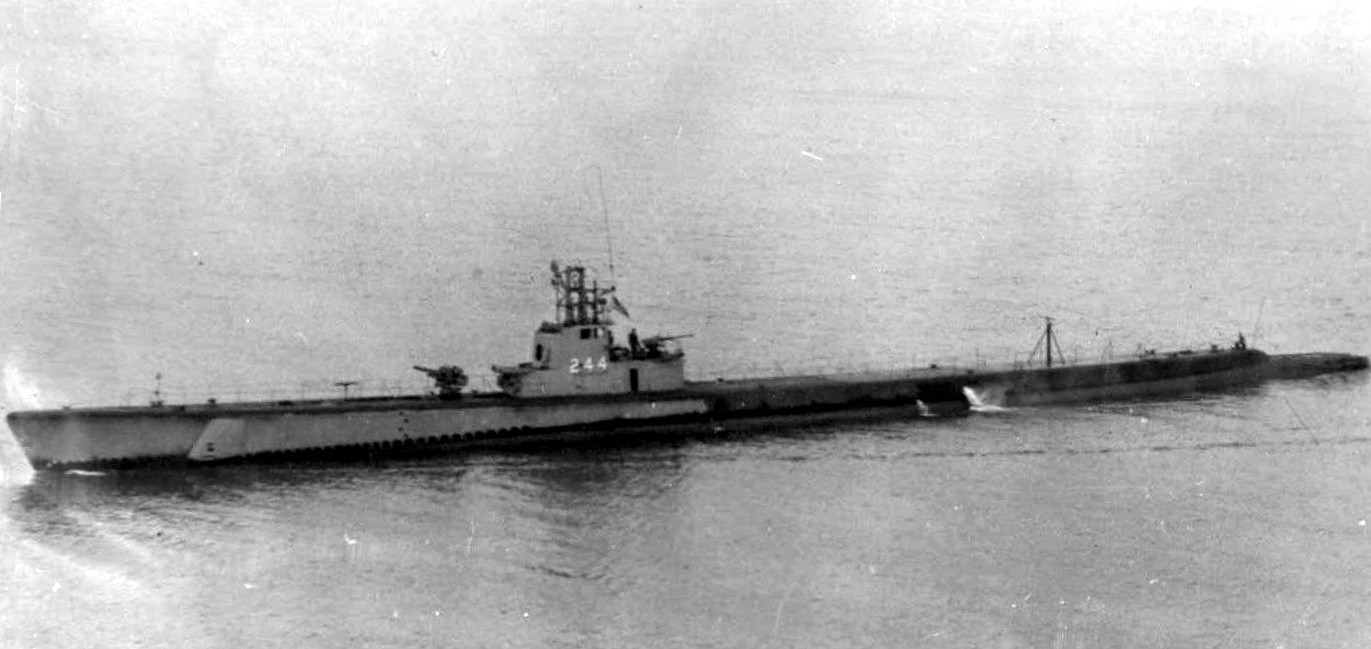
Cavalla is the other half of the morning of 19 June 1944. Albacore (SS-218) hit Taiho that morning. Cavalla, on her first war patrol, sank Shokaku the same day. She spent the rest of the war as a fleet boat, and she is still afloat, a museum at Galveston.
Electric Boat at Groton laid her down on 4 March 1943, launched her on 14 November 1943, and commissioned her on 29 February 1944. The sponsor was Mrs. M. Comstock, wife of Commodore Merrill Comstock. Lieutenant Commander Herman J. Kossler was her first commanding officer. He later became a rear admiral. She was a late Gato, with ten 21-inch tubes and a 3-inch deck gun. The name is the fish, not a person. She left New London on 11 April 1944, reached Pearl Harbor on 9 May, and sailed on her first patrol on 31 May.
Her station was the eastern Philippines. On 17 June, still on the way, she ran under a large Japanese force, Ozawa's Mobile Fleet heading for the Marianas. Kossler tracked it for hours and sent the contact report: fifteen or more combatant ships, with course and speed. That report helped put Task Force 58 in front of the Japanese air strikes. On the morning of the 19th she found Shokaku recovering aircraft. Shokaku was a Pearl Harbor veteran, sister of Zuikaku, and one of the two best carriers Japan still had. Kossler fired at close range. The Navy's account says six torpedoes and three hits. The boat's own later telling is five fired and four hits. Either way, the hits were enough. Gasoline vapor from ruptured tanks finished her, the same failure that killed Taiho a few hours later. She went down at 11 degrees 50 minutes north, 137 degrees 57 minutes east, with more than 1,200 of her crew.
Three destroyers, Urakaze among them, depth-charged Cavalla hard. The damage was light. She got clear and finished the patrol. The contact report and the carrier earned her the Presidential Unit Citation.
The second patrol, in September 1944, was with a wolfpack in the Philippine Sea, supporting the Peleliu landings. There were no notable sinkings. The third patrol is the other successful one. On 25 November 1944 she met two Japanese destroyers and made a night surface attack that blew up Shimotsuki at 2 degrees 21 minutes north, 107 degrees 20 minutes east, in the South China Sea. The second destroyer counterattacked. Cavalla stayed on the surface and ran. On 5 January 1945, still on that patrol, she sank two converted net tenders, Kanko Maru and Shunsen Maru, in another night surface attack at 5 degrees south, 112 degrees 20 minutes east.
The fourth and fifth patrols were in the South China Sea and the Java Sea, with little shipping left. On 21 May 1945, a month into the fifth, she found the British submarine Terrapin, depth-charged, unable to dive, and unable to make full speed. Cavalla escorted her on the surface into Fremantle, arriving on 27 May. On the sixth patrol she was lifeguarding off Japan when the cease-fire order came on 15 August. A few minutes later a Japanese plane bombed her. The pilot had not gotten the word. She entered Tokyo Bay with the fleet on 31 August, stayed for the surrender signing on 2 September, and left the next day for New London, arriving on 6 October 1945. She went into reserve on 16 March 1946. Wartime credit is 34,180 tons. The first and third patrols were scored as successful. She received four battle stars on top of the Presidential Unit Citation.
She was recommissioned on 10 April 1951 and worked with Submarine Squadron 8 in the Caribbean and off Nova Scotia. On 3 September 1952 she went back to Electric Boat for conversion to a hunter-killer boat, and she was reclassified SSK-244 on 18 February 1953. The conversion gave her the curved bow for a large sonar, removed two bow tubes, and replaced the wartime conning tower with the streamlined sail she still has. She recommissioned on 15 July 1953, joined Submarine Squadron 10, and on 1 January 1954 moved to Submarine Development Group 2. She made several NATO cruises to Europe and was at Norfolk for the International Naval Review of 11 and 12 June 1957. Her classification went back to SS-244 on 15 August 1959.
In November 1961 she was sent to Puerto Rico to feed electrical power, through a cable, to the nuclear submarine Thresher, whose diesel generator had failed with the reactor shut down. Cavalla's power let Thresher restart. Thresher was lost on post-overhaul trials on 10 April 1963. Cavalla became an auxiliary submarine, AGSS-244, in July 1963. That designation is the same hull, not a second boat. She was decommissioned on 3 June 1968, used as a pierside trainer at Houston, and struck on 30 December 1969. On 21 January 1971 the Navy transferred her to the Texas Submarine Veterans of World War II. She sits at Seawolf Park on Pelican Island, Galveston, and has been on the National Register of Historic Places since 2008. Hurricane Ike damaged the park in 2008. The boat was restored and is still there.