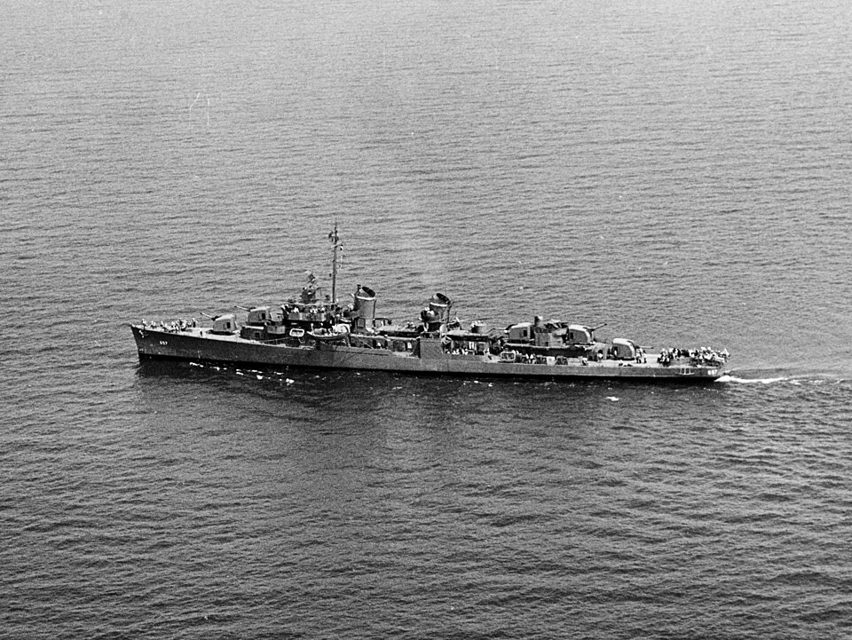
USS Charles J. Badger (DD-657) was a Fletcher-class destroyer. She was launched on 3 April 1943 and commissioned on 23 July 1943, with William Goodwin Cooper in command.
She reached San Francisco on 30 November 1943 to take up Pacific duty and on 17 December reported at Adak, Alaska. Patrol and escort duty around the Aleutians ran until August 1944 and helped conceal American plans for the western islands of that chain. From February through June she also shelled targets in the Kuril Islands. John Henderson Cotten relieved Cooper on 18 April 1944. On 8 August she left northern waters for San Francisco and Pearl Harbor and there joined a convoy preparing for an assault.
That convoy sailed on 14 October 1944 for the campaign in the Philippines. She screened the transports that put troops ashore at Dulag, on Leyte, on 20 October. As the Battle for Leyte Gulf drew near, she covered unloaded transports withdrawing toward New Guinea, then brought reinforcements back to Leyte. In December she was in Huon Gulf, New Guinea, practicing the Lingayen landings, and she got underway on 27 December. On 8 January 1945, as the formation entered Lingayen Gulf, Japanese kamikazes struck, and one aircraft hit Kitkun Bay. Two days afterward she escorted Kitkun Bay to San Pedro and then went on patrol.
After a stay at Ulithi she returned to Leyte to practice the seizure of Kerama Retto, the landing set ahead of the assault on Okinawa. On 26 March 1945 she was on hand to protect that landing. The operation surprised the Japanese. Suicide aircraft attacked during it, and Charles J. Badger claimed a kamikaze. When the Okinawa landings opened she took station on the southern side of the beaches. On 7 April she went north with a force ordered to meet Japan's last large surface group, the battleship Yamato and the cruiser Yahagi with eight destroyers. Carrier aircraft sank Yamato, Yahagi, and four of those destroyers were all that remained afloat, while the surface ships were still closing.
Before sunrise on 9 April, from her gunfire-support berth off Okinawa at 26°18' N, 127°39' E, a Japanese Army Maru-ni suicide boat set a depth charge off close alongside. The blast disabled her engines and let in a heavy flow of water. Her crew held the flooding down, and a tug towed her into Kerama Retto. Makeshift repairs carried her on to Bremerton, Washington, for overhaul, and she arrived on 1 August 1945. Cotten left the ship on 26 August. John Dandridge Henley Kane commanded until 22 September 1945, when David Lombard Harris took over. She had survived the war. On 21 May 1946 the Navy decommissioned her and laid her up in reserve at Long Beach, California. Five battle stars marked her World War II service.
She was recommissioned on 10 September 1951 and in February 1952 reached a new home port at Newport, Rhode Island. From Newport she worked the Atlantic seaboard and the Caribbean, training herself and supporting the drills of other ships. Between 9 June and 23 July 1953 she made her first Atlantic crossing, calling at Portsmouth, England, in company with a pair of carriers and a fellow destroyer. On 7 December she cleared Newport to begin a voyage around the world. About two months of it were spent patrolling off Korea and in the Taiwan Strait. She escorted transports from Inchon to Taiwan with prisoners of war who had chosen Nationalist China, and she drilled off Japan until 22 May 1954. The voyage then continued with calls at Hong Kong and Singapore, at Colombo, Aden, and Port Said, and at Naples, Villefranche-sur-Mer, and Lisbon. She passed the Suez Canal and the Mediterranean and entered Newport on 17 July 1954.
Two tours with the Sixth Fleet in the Mediterranean followed, one early in 1956 and the second from late 1956 into early 1957. On the later tour the Suez Crisis kept her at sea on patrol. On 20 December 1957 she was decommissioned and berthed in reserve at Boston, Massachusetts. Her name left the Naval Vessel Register on 1 February 1974, and on 10 May 1974 she was sold to Chile for parts.