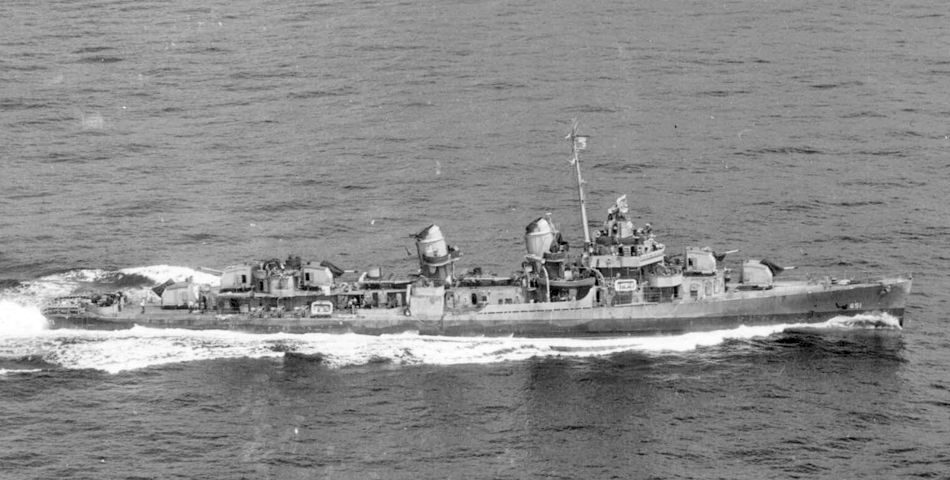
USS Cogswell (DD-651) was a Fletcher-class destroyer. Commissioned on 17 August 1943, she went to war under Captain Harold Thomas Deutermann. She survived the fighting, later served again in the Cold War, and on 1 October 1969 was transferred to Turkey.
She reached Pearl Harbor on 9 December 1943 and trained there before joining the screen of the fast carriers in Task Force 58 for the Marshall Islands operation. That duty kept her at sea from 16 January until she entered Majuro on 12 February 1944, and along the way she shelled Gugewe Island. She stayed with the carriers when they struck Truk on 16 and 17 February and hit bases in the Marianas on 21 and 22 February. From Majuro she moved to Espiritu Santo and screened carriers covering the taking of Emirau between 20 and 25 March, then strikes on Palau, Yap, and Woleai from 30 March through 1 April. She was back in Majuro on 6 April. A week later she sortied for the Hollandia landings of 21–24 April and for carrier attacks on Truk, Satawan, and Ponape as April closed.
Stores at Majuro occupied her from 4 May until 6 June. She then screened carriers for the landings in the Marianas. On 16 June she left the screen briefly to bombard Guam, then returned in time to guard the force through the air Battle of the Philippine Sea on 19 and 20 June. Further screening covered raids on Palau, Ulithi, and Yap, and afterward on Iwo Jima and Chichi Jima, across 25 July to 5 August. In the last of those raids her guns helped sink several ships of a Japanese convoy that carrier aircraft had already mauled. Eniwetok was her replenishment stop from 11 August through 30 August.
She was at sea again from 30 August to 27 September 1944, in the carrier screen while strikes fell on the Palaus and the Philippines as Peleliu was invaded. On 6 October she left Ulithi for air strikes against Okinawa and Formosa ahead of the Leyte landings. On 9 October a submarine dove to 250 feet as Cogswell closed and stayed silent when challenged by sonar recognition signals. Cogswell dropped depth charges set to burst at 150 feet, then broke off the attack once the submarine answered. The boat was USS Flying Fish (SS-229). Flying Fish and her crew came through unharmed. In the Formosa air battle of 12–14 October, Cogswell put up antiaircraft fire for the force. She afterward covered the damaged heavy cruiser Canberra and light cruiser Houston as they withdrew toward safety, then rejoined for strikes on Luzon and the Visayans. She remained in the screen for the Battle of Surigao Strait, a phase within the Battle of Leyte Gulf, and reached Ulithi again on 30 October.
At Ulithi, Alan Shepard, who would later become an astronaut, reported aboard as gunnery officer. Two days later the destroyer sailed once more for the Philippines. Command passed that same 31 October from Deutermann to Captain Robert Elmore Lockwood. After a submarine torpedo damaged the light cruiser Reno, Cogswell guarded Reno on the passage back to Ulithi. She then returned to screening strikes on Luzon, the landings on Mindoro, and attacks along Formosa and the China coast that held down Japanese bases before and during the invasion of Lingayen Gulf. On 24 January 1945 she screened the carrier Ticonderoga, hit in an air attack, into Ulithi, and from there went on to the United States West Coast for overhaul. Captain Reuben Noel Perley took command on 7 April 1945.
Overhaul finished, she crossed the Pacific while guarding convoys and arrived off Okinawa on 27 May 1945. Radar-picket duty there lasted until 26 June. Three days after that tour she rejoined carrier Task Force 38 for the final run of raids on the Japanese home islands, which continued to the end of the war. She entered Sagami Wan on 27 August and moved into Tokyo Bay on 2 September for the surrender ceremonies. The Navy gave her the honor of being the first American ship into Tokyo Bay ahead of the surrender. Occupation work in Japanese waters, and escort runs to Korean ports, kept her in the Far East until 5 December, when the ship sailed from Yokosuka for San Diego, Boston, and Charleston, South Carolina. At Charleston she was decommissioned and placed in reserve on 30 April 1946. Nine battle stars recognized her World War II service.
The Navy recommissioned Cogswell on 7 January 1951. She served in the Atlantic Fleet with Newport, Rhode Island, as home port. From 26 August 1952 into February 1953 she visited northern European ports during NATO operations, then continued to the Mediterranean for duty with the 6th Fleet. On 10 August 1953 she left Newport for the Panama Canal, service off Korea, and patrols in the Taiwan Straits. Still steaming west, she passed the Suez Canal and completed a voyage around the world on 10 March 1954. San Diego became her base on 15 December 1954, when she joined the Pacific Fleet. Through 1963 she alternated 7th Fleet cruises in the Far East with operations along the coast. On the 1955 cruise she took part in evacuating the Tachen Islands. Far East duty returned in 1956 and in each year after that through 1960. In 1957 she visited Australia and the Fiji Islands. In 1958 she joined nuclear tests at Johnston Island and patrolled the Taiwan Straits while Chinese Communist forces resumed shelling the offshore islands and threatened to assault them.
Cogswell made four deployments to Southeast Asia during the Vietnam War. After the last of them she was decommissioned on 1 October 1969 and given to the Turkish Navy. She served there as TCG Ismit (D 342) until 1981. When that service ended, the hull was scrapped.