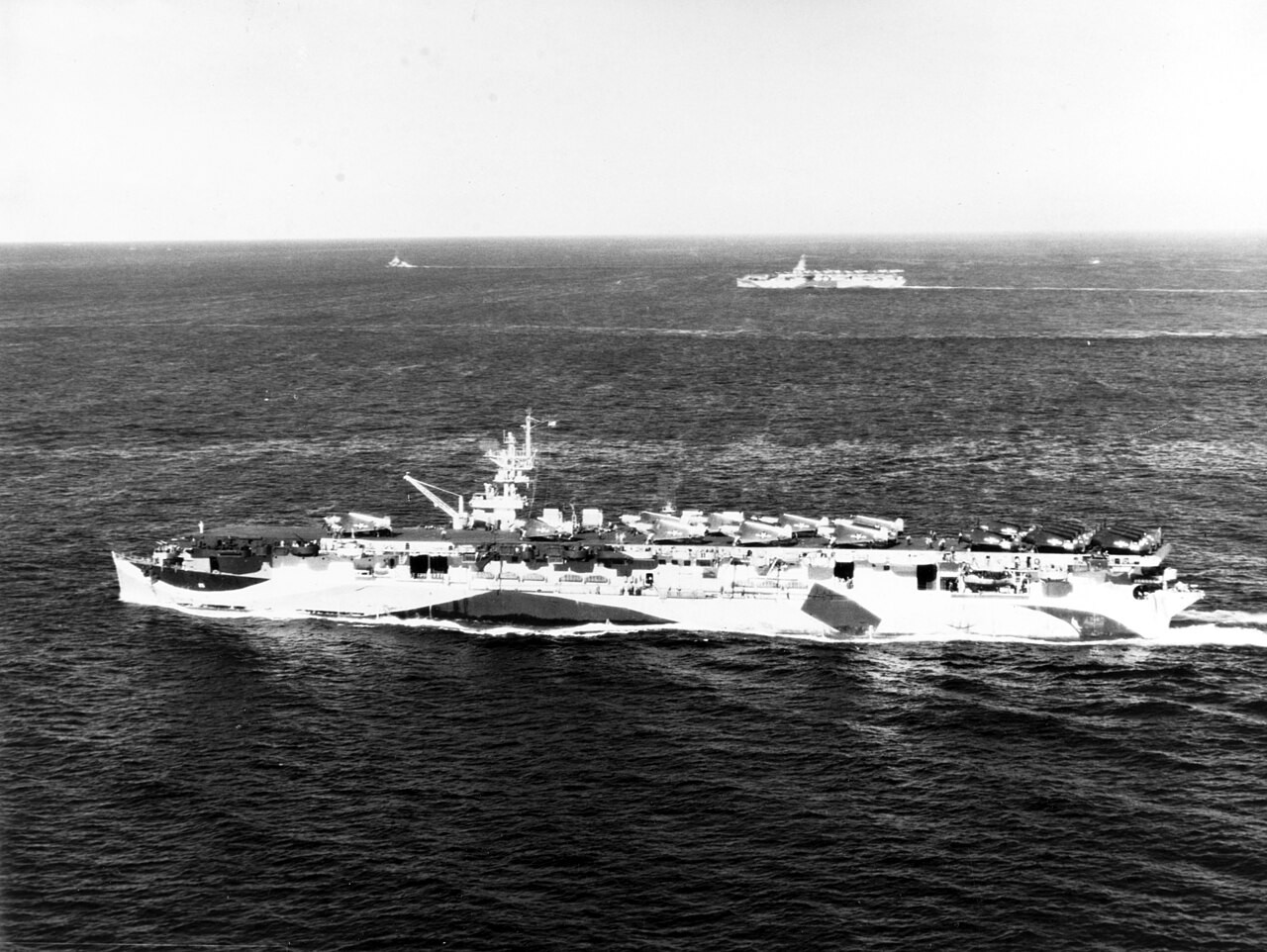
Two ships have carried the name, both for the battle of 17 January 1781, when Daniel Morgan broke Banastre Tarleton's force near Cowpens, South Carolina, and opened the road to the siege at Yorktown. The ship that fought in the Pacific is the light carrier. The cruiser came later and took the name and the nickname with her. The carrier was the Mighty Moo.
She was laid down on 17 November 1941 at New York Shipbuilding in Camden as Huntington (CL-77), a Cleveland-class light cruiser. After Pearl Harbor the Navy wanted flight decks more than 6-inch guns, and in March 1942 the hull was ordered completed as a carrier. A drugstore owner in Cowpens, George Dean Martin, had written Franklin Roosevelt to ask that a carrier carry the battle's name. Carriers were being named for battles and for famous ships, and the name held. She went into the water on 17 January 1943, the 162nd anniversary of the fight. The sponsor was Margaret Bradford Spruance, daughter of Vice Admiral William F. Halsey Jr. Captain R. P. McConnell commissioned her on 28 May 1943. She went to sea as CV-25 and was reclassified CVL-25 on 15 July 1943.
Cowpens (CVL-25) was an Independence-class ship: a cruiser hull, a flight deck, and a hangar one deck high. She was small, wet, and top-heavy from the overhang of that deck, and she was fast enough to stay with the Essexes. The guns were anti-aircraft only. The air group was about thirty aircraft, fighters and torpedo planes, and later fighter-bombers.
She left Philadelphia on 29 August 1943 and reached Pearl Harbor on 19 September. The early weeks were clumsy. She fouled an anti-submarine net at Norfolk on the way out. On 18 October, on patrol near Hawaii, the destroyer Abbot (DD-629) rammed her. The carrier's damage was slight. Abbot needed three months at Pearl.
Her first strike was Wake, on 5 and 6 October 1943, with Task Force 14. She sailed again on 10 November for the Gilberts: Mille and Makin from 19 to 24 November, then Kwajalein and Wotje on 4 December. She was back at Pearl on 9 December. From 16 January 1944 she was in Task Force 58 for the Marshalls. Her aircraft hit Kwajalein and Eniwetok in the last three days of January, ahead of the landings on the 31st. From Majuro she struck Truk on 16 and 17 February and the Marianas on 21 and 22 February, and she returned to Pearl on 4 March.
The next cruise began at Majuro again. Palau, Yap, Ulithi, and Woleai, 30 March to 1 April. Hollandia, 21 to 28 April. Truk, Satawan, and Ponape, 29 April to 1 May. She was back at Majuro on 14 May. The Marianas kept her out from 6 June to 10 July: strikes in support of the Saipan assault, and raids on Iwo Jima, Pagan, Rota, and Guam. On 19 and 20 June she was in the Battle of the Philippine Sea. Her fighters took a share of the one-day slaughter of Japanese carrier aircraft that finished the Imperial Navy's trained air groups. That day is not pinned to a tally of her own.
A short overhaul at Pearl put her back with the fast carriers at Eniwetok on 17 August. She flew pre-invasion strikes on the Palaus from 29 August, covered the Morotai landings from 13 to 17 September, and struck Luzon from 21 to 24 September. From 10 to 14 October she was in the raids meant to neutralize Okinawa and Formosa. When the heavy cruiser Canberra (CA-70) and the light cruiser Houston (CL-81) were torpedoed off Formosa, her aircraft covered their withdrawal. She was back with her task group on 20 October. She was headed for Ulithi when the Japanese fleet came out. Recalled, she flew combat air patrol on 25 and 26 October over the ships chasing what was left of the southern force after Surigao Strait. Through December her aircraft hit Luzon again and again.
Captain George Harbord DeBaun had her from 24 November 1944. On 18 December, east of the Philippines, Halsey's Third Fleet ran into Typhoon Cobra. The wind was over 120 knots. The flight-deck overhang made her top-heavy, and she rolled as much as 45 degrees, close to the angle at which that hull would have gone over. At 10:51 a Hellcat broke its lashings, tumbled onto the catwalk, and started a fire. The men on the hoses had to lash themselves to the deck. In the work of pushing the burning fighter over the side, the air officer, Lieutenant Commander Robert Price, went overboard and was lost. She lost other aircraft and gear. The crew kept the fire from running and the ship from taking structural damage. She reached Ulithi on 21 December. In the same storm Monterey (CVL-26) lost her hangar to fire. Hull (DD-350), the destroyer Spence, and Monaghan (DD-354) capsized.
She was at sea from 30 December to 26 January for the Lingayen Gulf landings. In January her aircraft hit Formosa, Luzon, the Indochina coast, the Hong Kong-Canton area, and Okinawa. She left Ulithi on 10 February for Iwo Jima, struck the Tokyo area, supported the landings from 19 to 22 February, and hit Okinawa again on 1 March. Then she went to San Francisco for overhaul and to Pearl for training. She was not with the fast carriers for the landings on Okinawa in April. A photograph shows her off Mare Island on 12 May 1945. She sailed on 13 June, struck Wake on 20 June, and rejoined Task Force 58 from San Pedro Bay, Leyte, on 1 July. From then until 15 August her aircraft worked Tokyo, Kure, and targets on Hokkaido and Honshu: airfields, shipping, and what was left of the Japanese fleet in harbor.
A National Park Service tally for her twenty-two and a half months in the Pacific gives 10,634 flights, 2,452 action sorties, 108 enemy aircraft destroyed in the air and 198 on the ground, 657 tons of bombs, 3,063 rockets, and 39 merchant ships. Those figures are that tally, not a set of single-ship credits. She received the Navy Unit Commendation and twelve battle stars.
She was the first light carrier into Tokyo Bay, on 27 August 1945. The occupation landings began on the 30th. Her aircraft photographed airfields and shipping, found prisoner camps, and dropped supplies. Men from the ship were among the first Americans ashore on the home islands. They opened Yokosuka airfield for Allied use and took part in freeing a camp near Niigata. From the ship, the crew watched the surrender signed aboard Missouri (BB-63) on 2 September. DeBaun was still in command. He was relieved on 10 September.
From 8 November 1945 to 28 January 1946 she made two Magic Carpet voyages to Pearl Harbor, Guam, and Okinawa and brought veterans home. She was placed in commission in reserve at Mare Island on 3 December 1946 and decommissioned on 13 January 1947. Still in reserve, she was reclassified as an aircraft transport, AVT-1, on 15 May 1959. She was stricken on 1 November 1959 and sold for scrap on 1 October 1960. Cowpens, South Carolina, has held a Mighty Moo festival for the ship's veterans since 1977.
The name went next to a Ticonderoga-class cruiser, CG-63, the seventeenth of that class. Bath Iron Works laid her down on 23 December 1987. Lucy Mustin sponsored the launch on 11 March 1989, and the ship commissioned at Charleston on 9 March 1991. Her motto was Victoria Libertatis Vindex, victory vindicates liberty. She kept the nickname Mighty Moo. She was decommissioned at San Diego on 28 August 2024, stricken two days later, and towed to the inactive-ship facility at Pearl Harbor. That cruiser is not this ship.