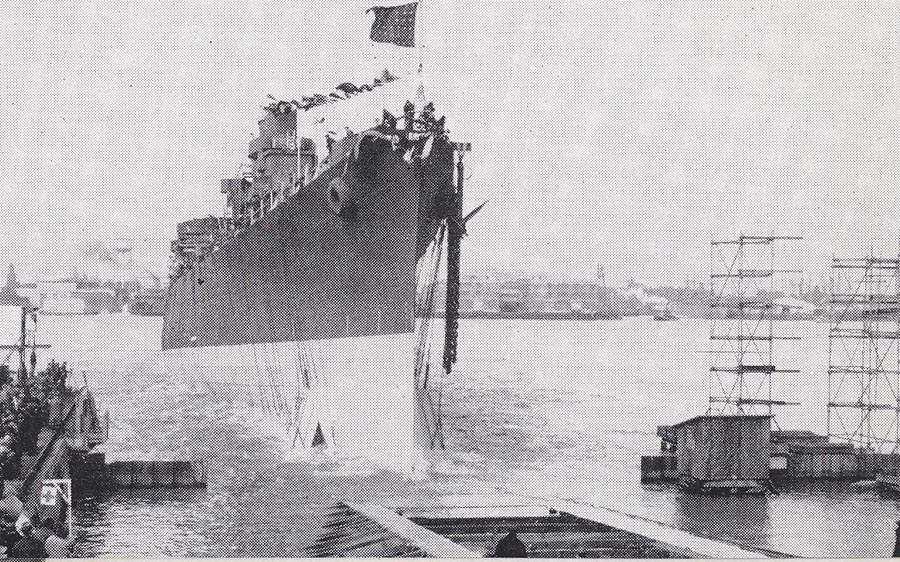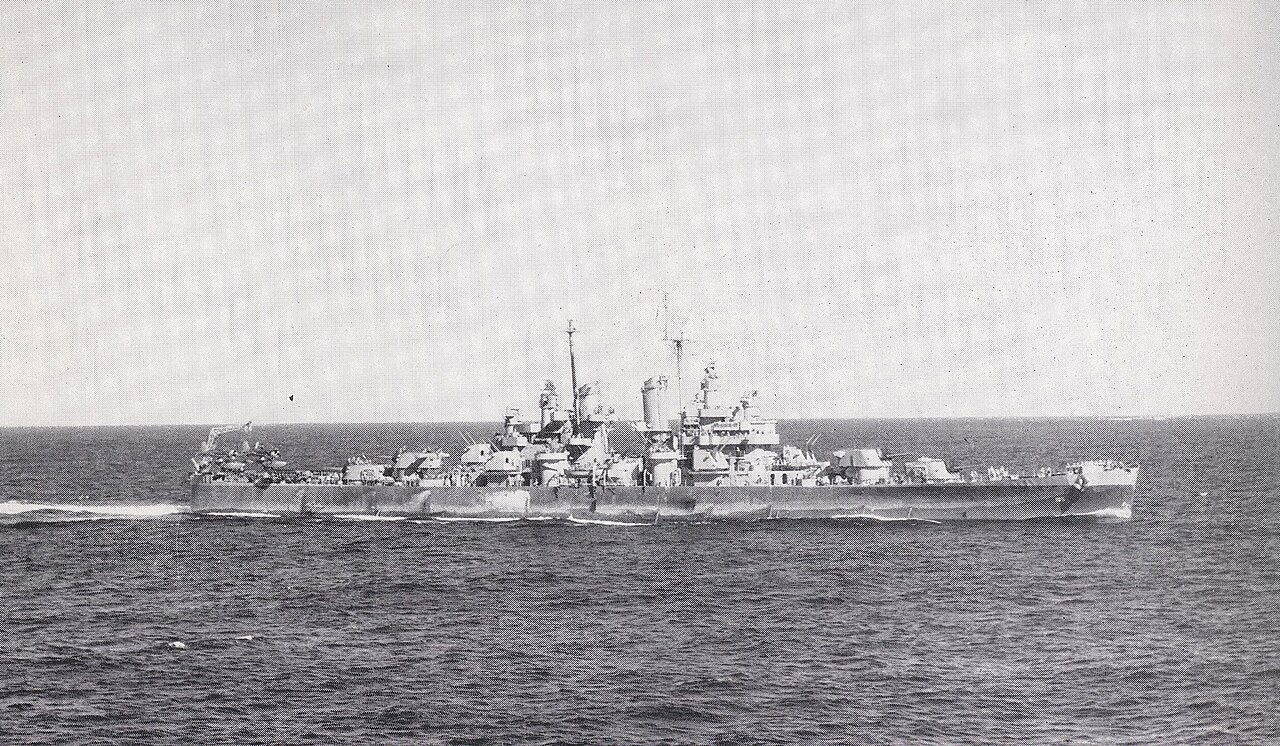
Dayton (CL-105) was named for the city in Ohio. The New York Shipbuilding Corporation laid her down at Camden, New Jersey, on 8 March 1943 and launched her on 19 March 1944. The sponsor was Mrs. Ruth H. Rueger, who had already lost one son, Machinist's Mate Second Class Robert W. Rueger, when the carrier Wasp (CV-7) was sunk on 15 September 1942. The Navy commissioned Dayton at the Philadelphia Navy Yard on 7 January 1945, with Captain Paul W. Steinhagen in command. The DANFS line gives 10,000 tons, a length of 610 feet 1 inch, a beam of 66 feet 6 inches, a mean draft of 20 feet, 33 knots, a complement of 992, twelve 6-inch guns, twelve 5-inch guns, twenty-eight 40 mm guns, ten 20 mm guns, and four aircraft.
She lay at Philadelphia through most of January for fitting out. On 5 February she went down the Delaware to take on ammunition at Fort Mifflin, and by 9 February she was in Chesapeake Bay for structural tests and gunnery. Sister ship Amsterdam (CL-101) operated nearby during part of that work. Shakedown then took her to the Gulf of Paria and to Guantanamo Bay. On 29 April a reported submarine off Cuba turned out to be false. She and the destroyer Southerland steamed for the Panama Canal, entered Cristobal on 2 May, and cleared Balboa on 3 May. Dayton anchored at Pearl Harbor on the evening of 15 May 1945. After more gunnery off Oahu she sailed on 3 June with Task Unit 12.5.5, passed Eniwetok on 9 June, and entered Ulithi on 13 June. The formation reached San Pedro Bay, Leyte, at noon on 16 June. On 1 July, attached to Task Group 38.1 and Cruiser Division 18, she sortied for the last strikes on Japan.
On 10 July the carriers launched against airfields around Tokyo. At 1325 two enemy dive bombers attacked the formation. The combat air patrol splashed both. On 12 July Dayton sighted a torpedo wake running slowly near the surface, near the end of its run, and the group turned away. On the night of 14 July she and Atlanta (CL-104) were ordered out of Task Group 38.1 to join Task Unit 34.8.2, Rear Admiral Oscar C. Badger in Iowa, with Missouri and Wisconsin. They joined at 0150 on 15 July. Off Muroran, on Hokkaido, Dayton took station on the south flank of the battleships. Both of her paravanes carried away at 26 and 27 knots. The battleships fired. The cruisers were back with the carriers that evening. On the night of 17 July she and Atlanta (CL-104) joined the battleships again, this time streaming the higher-speed paravane planes. At 0006 on 18 July, in range of the Tokyo area, Dayton opened fire on electronic installations ashore. HMS King George V bombarded in the same vicinity. All ships ceased firing at 0011. Poor weather blocked any observation of the result, and no enemy ship or aircraft closed the formation. She screened the carriers through the later strikes on Kure, Kobe, and the Tokyo and Nagoya area. She was still with the force off Honshu when Japan accepted the surrender terms. Dayton entered Tokyo Bay on 10 September 1945 and anchored at 1025, with Admiral William F. Halsey in South Dakota. She stayed on occupation duty, with one training cruise out of the bay, until 7 November, then sailed for San Pedro and entered Los Angeles harbor on 19 November.
NavSource relieves Captain Paul William Steinhagen on 21 December 1945, at Terminal Island, and gives the ship to Captain Clinton Alonzo Misson, whose final rank on that list is rear admiral. Misson had her until 18 January 1947. On 24 January 1946 Dayton sailed from San Pedro under orders to return to the occupation force, reached Pearl Harbor on 30 January, and was then transferred to the Atlantic Fleet. On 7 February she headed east through the Panama Canal, trained at Guantanamo Bay, and went to Norfolk. On 3 February 1947 she sailed from Norfolk for the Mediterranean, exercised off Malta, and made a diplomatic call at Istanbul. She served as flagship for Admiral Richard L. Conolly, Commander, Naval Forces, Mediterranean. Captain James Merrill Fernald had her from 18 January 1947 until Captain Edward Robison Durgin relieved him on 3 September 1947. She returned to Boston on 30 November 1947. After local operations from Newport she made a second Mediterranean cruise from 9 February to 26 June 1948 and came back to Boston. Captain William Vincent O'Regan had her from 6 July 1948 until 9 December 1948. Captain Alvin Franklin Richardson, whose final rank on the NavSource list is rear admiral, relieved him and had the ship through the decommissioning. Dayton was decommissioned into reserve at Boston on 1 March 1949. A DANFS caption shows her laid up at the Philadelphia Naval Shipyard on 24 August 1961, in a row with Huntington (CL-107) and South Dakota. She was stricken on 1 September 1961 and sold for scrap on 6 April 1962. She earned one battle star for the Third Fleet campaign against Japan from 10 July to 15 August 1945, and the Navy Occupation Medal with the Asia clasp for September through November 1945. She was not sunk.
A note on sources. The narrative follows the 2026 Naval History and Heritage Command Dictionary of American Naval Fighting Ships entry for Dayton (CL-105). That text is one long block built from the deck log, and the line "Gregory N. Stern," dated 22 July 2026, is the page credit, not a commanding officer. The commanding-officer table on the same page agrees with NavSource: Steinhagen from 7 January 1945, Misson from 21 December 1945, Fernald from 18 January 1947, Durgin from 3 September 1947, O'Regan from 6 July 1948, and Richardson from 9 December 1948 through the decommissioning on 1 March 1949. One sentence in the January 1946 dry-dock passage says Capt. James M. Fernald relieved Capt. Clinton A. Mission on 18 January 1946. The table, and NavSource, date that relief to 18 January 1947, and the command lines follow NavSource. The same dry-dock sentences print the surname Mission. The table and NavSource print Misson, and that is the spelling used above. The narrative calls Richardson a commander. NavSource lists him as a captain whose final rank was rear admiral, and the command line says Captain. The Navy Department Library biography of Fernald says he transferred to Dayton in January 1947 and was still in command when relieved of active duty pending retirement on 30 June 1949. NavSource relieves him on 3 September 1947. DANFS gives a beam of 66 feet 6 inches, a mean draft of 20 feet, 33 knots, and a complement of 992. NavSource gives a beam of 66 feet 4 inches, a maximum draft of 25 feet, 32.5 knots, and a crew of 1,255. The gun battery and the four aircraft agree. DANFS is followed. A digitized copy of the page prints Yokohoma for a liberty port. HyperWar's short entry agrees on the launch, the commissioning, Pearl Harbor on 15 May, San Pedro Bay on 16 June, the 1 July sortie, Tokyo Bay on 10 September, San Pedro on 19 November, the Mediterranean cruises, and the 1 March 1949 decommissioning. Its data line prints the length as "1. 610'1"" and the second battery as "12 6"", and it names the sponsor Mrs. H. Rueger. It also says the name Dayton was assigned to CL-78 on 28 December 1940 and that hull became Monterey (CVL-26) on 31 March 1942. The 2026 DANFS text does not say that, and it is not used above. HyperWar's bracketed remark that the commissioning day was very snowy is not in DANFS. No battle on the existing list matches the July and August 1945 strikes. She was in the Atlantic, the Caribbean, and then on the way to Pearl Harbor during the fighting at Iwo Jima and the April landings on Okinawa. The one battle star is the Third Fleet campaign against Japan, which is not a separate slug. She fired on the beach near Tokyo on 18 July and was not sunk.