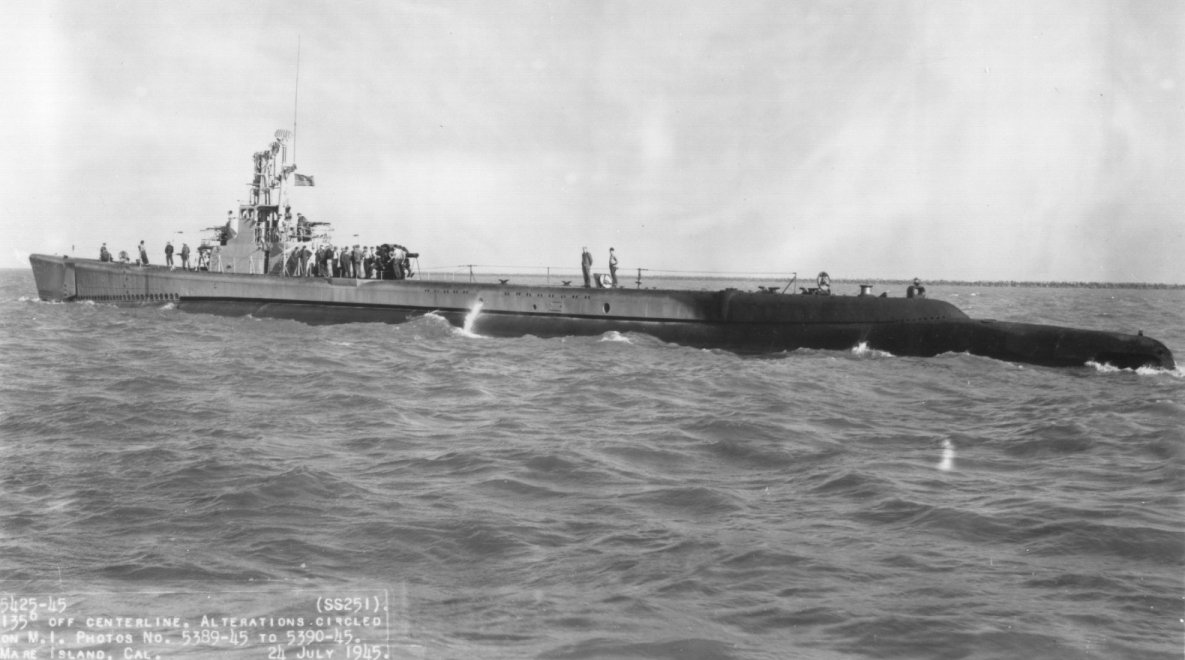
Flounder was a Gato-class submarine, SS-251, named for the fish. Electric Boat at Groton laid her down on 5 December 1942, launched her on 22 August 1943, and the Navy commissioned her on 29 November 1943. The Dictionary of American Naval Fighting Ships names the sponsor Mrs. Astrid H. McClellan. A Groton yard paper calls her Mrs. Charles McClellan. Carl Arthur Johnson had her from commissioning. The Dictionary prints Commander C. A. Johnson. uboat.net gives the full name and carries him through 9 May 1944.
The Dictionary has her at Milne Bay, from New London, on 5 March 1944, and out eleven days later for the Palaus. uboat.net has the arrival on 6 March and the departure on 17 March. She was back at Milne Bay on 9 May. That patrol sank nothing.
James Edward Stevens had her from 3 June 1944 until 1 May 1945. uboat.net's command table calls him a temporary commander. Its patrol lines call him a lieutenant commander on the second and third patrols and a commander from the fourth. The second patrol left Manus on 3 June for the Philippine Sea. On 17 June she sank the Japanese ship Nihonkai Maru, south of Mindanao. uboat.net prints 2,684 tons and the place 06°36' N, 127°55' E. The Dictionary's figure for Japanese shipping is 2,681 tons, and that short account does not print the ship's name. She reached Brisbane on 12 July. She made six war patrols. The second and the fourth were the ones marked successful. Two battle stars.
The third patrol left Brisbane on 1 August 1944 and ended there on 4 October. It sank nothing. The fourth left Brisbane on 27 October, with two other submarines, for the South China Sea. On 10 November, north of Lombok Strait, she met a submarine. The contact was first taken for a small sailboat, and then the conning tower showed. She fired four torpedoes. One hit was seen, and a second was felt. Half an hour later the periscope showed an empty sea. The boat was the German submarine U-537. The place kept for that loss is 7°13' S, 115°17' E, in the Java Sea east of Surabaya, at 0026. All 58 men were lost.
On 21 November uboat.net says she torpedoed the army cargo ship Gyosan Maru, 5,698 tons, at 10°36' N, 115°08' E, and that Guavina (SS-362) finished that ship. The Joint Army-Navy Assessment Committee shares the loss between the two boats. Another accounting spells the name Gyozan and says Bashaw (SS-241) may have hit her earlier that day. No one boat is credited alone. She reached Fremantle on 13 December.
The fifth patrol left Fremantle on 7 January 1945, came back on 12 January for a fathometer, and sailed again on 14 January. On 22 February one of her own torpedoes ran wild and passed close aboard. The patrol reports, as the Submarine Force Museum quotes them, put a meeting with Hoe (SS-258) on the afternoon of 24 February. Flounder was at 65 feet. The hull shuddered, then shook again, and water came in along a cable until the valve was shut. She came up to an empty sea and thought she had sunk a Japanese submarine. Hoe's report has her at 60 feet. She thought she had hit a rock, and she broached. The pressure hull was not holed. uboat.net prints the meeting as 23 February, 66 feet down. Neither boat was seriously hurt, and each left without knowing the other was there. Flounder reached Subic Bay on 26 February. The Dictionary has her preparing there for the next patrol from 25 February to 15 March.
The sixth patrol was south of Hainan. On 29 March she found a large convoy. Aircraft attacked it before the submarines fired. She ended the patrol at Saipan on 22 April and went to Mare Island. NavSource has the overhaul from 14 May to 6 August 1945. The photograph is from 24 July, in that yard period. She was headed for Pearl Harbor on the day the fighting stopped. Orders turned her to the east coast, and she reached New York on 18 September. She lay idle at Portsmouth and at New London. On 12 February 1947 she was decommissioned into reserve at New London. NavSource records a sale on 22 December 1959 to Western Contracting of Sioux City, the price printed as $68,000, and removal on 2 February 1960. uboat.net dates the sale 1 June 1959.