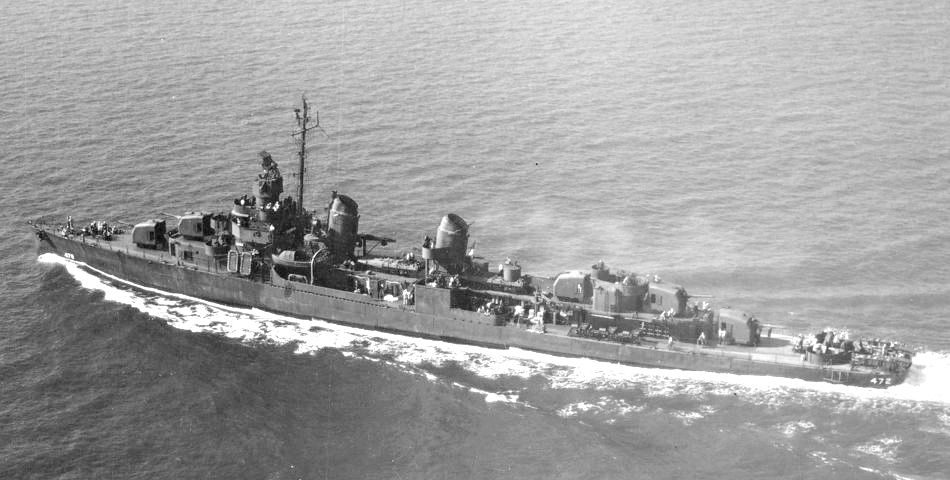
USS Guest (DD-472) was a Fletcher-class destroyer. She was launched on 20 February 1942 and commissioned on 15 December 1942, and Henry Crommelin took command that day.
Shakedown carried her to Guantanamo Bay, after which she cruised to Trinidad with the light carrier Independence. From 28 April to 31 May 1943 she escorted a convoy from New York to Casablanca and back to Boston. On 20 July she left Boston, trained for a short spell off Hawaii, and on 28 August joined the Third Fleet at Efate in the New Hebrides. She made an offensive sweep toward the Santa Cruz Islands, ran escorts into Nouméa in New Caledonia, and on 28 October sailed from Efate for the Bougainville invasion.
On 1 November she guarded transports at the first landings and helped shoot down two enemy bombers. Over the following months she escorted troop and supply ships between Guadalcanal and Cape Torokina, and twice turned back bombers and torpedo planes that struck at those convoys. On 4 December 1943 her guns silenced Japanese coastal batteries at Motupene Point, and on 25 January 1944 she shelled the Saba River sector.
On 31 January 1944 she covered transports putting Marine Raiders ashore on Green Island. The next morning, as the Raiders came back aboard, she dropped depth charges in two attacks on a submarine going deep. Hudson (DD-475) pressed that contact and finished the 1,400-ton Japanese submarine I-171. Guest screened the Green Islands landings again on 15 February, bombarded Kavieng on New Ireland on 25 February, and on 17 March fired into the Sanba River area of Bougainville and took off the crew of PT-63. That same day, in a mix-up of identity near Choseul Island in the Solomons, gunfire from Guest sank the motor torpedo boat PT-283. On 30 April, east of Nemto Island, her five-inch battery destroyed the grounded Japanese freighter Meisyo Maru.
After amphibious practice in the New Hebrides, she sailed from Roi in the Marshalls on 10 June 1944 for the capture of the Marianas. On 15 June her guns fired ahead of the troops going onto Saipan. She then helped beat off four heavy air raids against the fast carriers of Admiral Marc Mitscher in the Battle of the Philippine Sea, bombarded Guam before the assault, and gave close support when forces landed there on 21 July. She stayed on bombardment and patrol until 9 August, then headed for further landing drills in the Solomons.
She left Purvis Bay on 6 September 1944 with the western fire-support force of Rear Admiral Jesse Oldendorf and on 12 September shelled Angaur in the Palaus. The next day she picked up seven officers and forty-five men from Perry (DMS-17) after that ship hit a mine and sank off Angaur. Guest cleared the area on 25 September and entered San Francisco Bay on 25 October for overhaul.
Refit gave way to practice cruises around Hawaii. On 27 January 1945 she sailed with a task group that staged through the Marianas for Iwo Jima, and on 19 February her five-inch guns hammered the island as the assault opened. She kept up that support until 28 February, then joined the escort carriers screening from San Pedro Bay in the Philippines. On 27 March she left that bay to guard those carriers while they covered the Okinawa landings. Detached on 9 May, she took an antiaircraft station in the western transport area. On the night of 25 May a kamikaze clipped her mast, fell into the water alongside to port, and damaged the stack. She held that station until 1 July 1945.
She then screened escort carriers by way of Ulithi and the Marshalls toward Adak, Alaska, and on to Ominato, Japan. After guarding flight operations along the coast of Honshū she returned via Adak and reached the Puget Sound Naval Shipyard on 15 November 1945. Guest was decommissioned at San Diego on 4 June 1946 and stayed in reserve until 5 June 1959, when she went on loan to Brazil and served as Pará (D27). Struck in 1979, she was used in 1982 and 1983 as a target for guns, torpedoes, and Exocet MM 38 missiles, including shots from the frigate Niterói. On 23 February 1983 the Brazilian submarine Ceará (S 14) sank her with two torpedoes in the Atlantic, about eighty nautical miles south of the Cabo Frio lighthouse. She received eight battle stars for her wartime service.