Ships
- USS Guest (DD-472) Captain from 15 December 1942
Henry Crommelin (11 August 1904 – 2 March 1971) was a United States Navy officer from Montgomery, Alabama. He was the second of the five Crommelin brothers, all of whom graduated from the Naval Academy, and the only one of them who never flew. His eyesight kept him out of aviation, so he spent his career on surface ships, most of it on destroyers. In the Second World War he commissioned and commanded two new destroyers in the Atlantic, the Fitch and the Guest, and took part in the landings in French Morocco. In the Pacific he led a destroyer division into the lagoon at Tarawa ahead of the Marine assault waves, which earned him the Silver Star. He won the Bronze Star at Guam, and late in 1944 he commanded a destroyer squadron. After the war he commanded the heavy cruiser Des Moines, became a rear admiral in 1952, and later commanded a battleship division and the naval base at Newport, Rhode Island. He retired in 1959 and was advanced to vice admiral on the strength of his combat awards. He died at his home near Wetumpka, Alabama, in 1971, having outlived two of his younger brothers by more than a quarter of a century. Some later accounts give his full name as Henry Claiborne Crommelin. The Navy's own registers list him simply as Henry Crommelin.
Henry Crommelin was born in Montgomery on 11 August 1904. His father was John Geraerdt Crommelin. Accounts give his mother's maiden name differently: a family history calls her Katharine Gunter, and the Encyclopedia of Alabama calls her Katherine Vasser. He was the second son. His older brother, John Geraerdt Crommelin Jr., was born in 1902. The younger boys came later: Charles Laurence in 1909, Richard Gunter in 1917, and Quentin Claiborne in 1918. There were also three sisters, Elizabeth, Katherine, and Lucie. The family kept a house in Montgomery and a plantation called Harrogate Springs on the Coosa River near Wetumpka, in Elmore County. The plantation stayed at the center of family life long after the brothers had scattered across the fleet.
In January 1944 Time magazine told the brothers' origin story in a single sentence. Mr. and Mrs. John Crommelin, it said, had decided on their plantation that Southern boys needed discipline. They sent the eldest to the Naval Academy as an experiment. "The experiment worked, so one by one the other boys — Henry, Charles, Richard, Quentin — were launched in John's wake." The story has the polish of a family legend told to a reporter, and it should be read that way. Still, the outcome it describes is plain in the record. John graduated from Annapolis in 1923 and Henry in 1925. Charles followed in 1931, Richard in 1938, and Quentin in 1941.
According to the family's biographical sketch, Henry went to grade school and high school in Montgomery and spent a year at the University of Alabama in Tuscaloosa before his appointment to the Academy. The Register of Commissioned Officers gives 16 August 1921 as the date he entered the naval service, credited to Alabama.
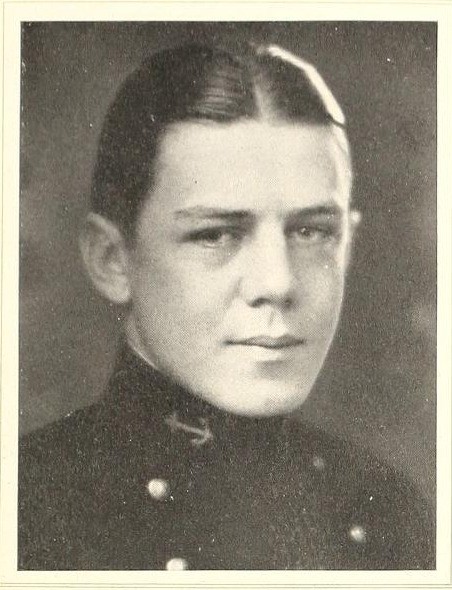
The 1925 Lucky Bag, the Academy yearbook, gives a rare look at Henry Crommelin before the Navy made him into an officer. "HENRY, the boy with the winning smile and soft, drawling voice came to us from Alabama," his classmates wrote. They called him "the same big, bouncing boy that he was when he arrived." They added that his quiet face was misleading: "such is not the case, however, as is evidenced by the cruises and by the fact that he is one of Spike Webb's most blood-thirsty proteges." Spike Webb was the Academy's boxing coach. The entry also describes a natural student: "Always savvy, he seems to know everything beforehand and the acquisition of the elusive 3.4 has come without the usual brain-wrecking study." Under the conventions of the time, a 3.4 average marked a star man. His classmates teased that he had stayed loyal to "the Alabama girl, that is, collectively speaking." The entry lists class boxing. The family sketch adds four years of class football and three years on the varsity boxing squad. The same yearbook's roster of the midshipman regiment names "Crommelin, H." as company commander of the Fourth Company in one of the year's command details. That responsibility went to midshipmen whom the officers trusted to lead their peers.
He graduated with distinction. The family sketch puts him eighteenth in a class of 453, and the memorial at Wetumpka calls him "a star man academically." He was commissioned ensign on 4 June 1925.
The Navy Directory traces his early years closely. In 1925 and 1926 he was an ensign in the battleship Tennessee. In 1927 he was assistant communication officer on the staff of the Commander in Chief, Battle Fleet, in the California. Then came the destroyer Bruce, where he made lieutenant (junior grade); by 1930 the directory lists him as her engineer officer. In 1931 he was in the destroyer Schenck. The family sketch says he was chief engineer of both ships. In 1932 he was aide on the staff of the commander of Training Squadron One, Base Force, in the Antares. In 1933 he was in charge of the Scouting Force camera party on the same staff, in the Utah. By then John was a naval aviator at Pensacola. Henry could not follow him, and Time's 1944 article says plainly that "his eyes had kept him out of aviation." Every assignment that followed came out of that limit.
From September 1933 to June 1936, according to the family sketch, he served at the Naval Academy. The 1934 Lucky Bag lists "Lt. (j.g.) Crommelin" as assistant to the Executive Officer and pictures him with the Quarter-Deck Society, the midshipmen's public-speaking club. These Annapolis years also changed his private life. On 4 April 1933 the Navy airship Akron went down off the New Jersey coast, and Lieutenant (junior grade) Cyrus T. Clendening was among the dead. He left a young widow, born Sally Huntress, and a daughter, Diane, born in 1932. According to research gathered for the Naval Academy's Virtual Memorial Hall, Sally later married Lieutenant Henry Crommelin in the Naval Academy chapel. The exact date of the wedding has not been found. Their son, Henry Jr., was born in Annapolis on 8 August 1935, and a daughter, Sally, followed. So Henry married into a household that the Navy's dangers had already struck once. Nothing in the surviving sources records how he or his wife spoke about that.
In 1936 he went west to the battleship Pennsylvania, which was then the flagship of the United States Fleet. The directories list him aboard through 1938. The family sketch says he was aide and flag lieutenant on the staff of the Commander, United States Fleet. The Wetumpka memorial describes him as aide to Commander Battle Force. The 1939 directory lists him as executive officer of the destroyer Preston. He became a lieutenant commander on 1 July 1939. In January 1940 he came east to the Bureau of Navigation in Washington, the office that assigned officers across the Navy, which was renamed the Bureau of Naval Personnel in 1942. The 1940 and 1941 directories list him there. His older brother John was serving across town in the Bureau of Aeronautics at the same time.
In January 1942 Henry Crommelin left Washington for the Boston Navy Yard, where the new destroyer Fitch was fitting out. She was commissioned on 3 February 1942 with Lieutenant Commander H. Crommelin in command. For a destroyerman of his generation, a first command at the start of a war on a brand-new ship meant that the crew he trained would carry his imprint into combat. The Fitch spent her first months in the Atlantic. From July to August 1942 she escorted the carrier Ranger to a point off the Gold Coast of Africa, where the carrier flew Army aircraft off to Accra. In late October she sailed from Bermuda with the invasion force for North Africa, screening Ranger and two escort carriers. On 8 November she took part in the landings at Fedhala, in French Morocco, and then guarded the carriers while they flew Army planes to the captured airfield at Port Lyautey. She returned to Norfolk on 24 November. Ship-listing compilations end his command on 28 November 1942. That date is consistent with the official histories but is not itself drawn from an official record.
Less than three weeks later he did it again. The destroyer Guest, also built at Boston, was commissioned on 15 December 1942 with Commander Henry Crommelin in command. The wartime register gives 1 August 1942 as the date of his temporary rank as commander. After shakedown at Guantánamo Bay, the Guest went to Trinidad with the new light carrier Independence. From 28 April to 31 May 1943 she escorted a convoy from New York to Casablanca and back to Boston. On 20 July she left Boston for the Pacific. Compilations of commanding officers date his relief to 18 August 1943, before the ship reached the South Pacific and her later battles. Her record at Bougainville and afterward belongs to the men who followed him.
The family sketch says that in August 1943 he became commander of Destroyer Division Fifty. A division of four destroyers was part of a squadron, and its commander rode one of his ships as flagship, giving orders to captains who were, in rank, almost his peers. Some sources describe his Tarawa command as "Destroyer Squadron 50," among them the text of the Silver Star citation as transcribed online and the Encyclopedia of Alabama. Others call it Destroyer Division 50: the family sketch, the Wetumpka memorial, and a modern compilation of destroyer organizations. The organizational evidence places Division Fifty, with the Ringgold, Dashiell, Schroeder, and Sigsbee, inside Destroyer Squadron Twenty-Five.
At Tarawa in November 1943 he had a more specific job. The Amphibians Came to Conquer, Vice Admiral George C. Dyer's history of Admiral Richmond Kelly Turner's amphibious forces, gives the organization of Rear Admiral Harry W. Hill's Southern Attack Force. In it, Task Unit 53.4.4, Fire Support Section Four, consisted of two destroyers: Ringgold, under Commander Thomas F. Conley Jr., and Dashiell, under Commander John B. McLean. The unit was commanded by "Commander Henry Crommelin (1925)." The plan sent these two ships through the reef passage into the lagoon itself. There they would give close fire support on the lagoon side of Betio, where the Marines would land and where the shallow water left room for little else.
On the morning of 20 November the minesweepers Pursuit and Requisite swept the channel. According to the official ship history, Requisite then led both destroyers into the lagoon while Pursuit laid marker buoys, and shells fell around them as they went in. The Ringgold, Crommelin's flagship, was hit twice. Both shells were duds, but one knocked out her port engine. The family sketch says that a Japanese five-inch shell struck a torpedo tube and failed to explode. The Silver Star citation, issued by the Commander in Chief, Pacific, under a serial dated 14 May 1944, says that "just before entering the lagoon, his Division Leader was hit three times by five-inch shells." The accounts disagree on how many shells hit the ship. They agree that the shells did not explode, and that the destroyers kept going in.
The citation describes the work that followed. His ships "succeeded in silencing several enemy batteries and effectively carried out all assigned and requested fire support tasks from inside the lagoon." It also notes that "the uncharted waters of the lagoon contained many coral heads and reefs." A destroyer moving at speed among coral heads, under fire from shore guns at close range, could be lost as easily to a misjudged turn as to the enemy. The judgment that mattered was his and that of the two captains under him.
Dyer's history also shows the limits on what any commander inside the lagoon could do. At 0855, with the first assault wave still offshore and running late, Admiral Hill ordered all ships to cease fire. He feared that firing through the heavy smoke would endanger the troops. Ringgold logged the cease-fire at 0855 and resumed firing at "about 0925." Dashiell stayed silent except for three minutes of counter-battery fire ordered from the flagship. Dashiell's gunnery officer later wrote angrily that the order had come "because apparently the Commanding Officers of Fire Support [section] could not be depended upon to make a clear estimate of the situation when they were only 1500 yards from the scene of action and the controlling authority was over the horizon." Ringgold logged the first troops ashore at 0905. Crommelin himself left no recorded comment on that pause. Still, the episode shows what his position was: close enough to see the beach clearly, and bound by orders from a flagship that could not.
Dashiell's official history records three days of firing from inside the lagoon at shore batteries, strong points, and an ammunition dump. The family sketch says four days. Ammunition had to be brought in to the two ships before the first day was over. In January 1944 Time put the scene in its own breezy terms: "Henry, aboard his destroyer in the same engagement, stood in to Tarawa's lagoon firing at almost point-blank range on Jap shore batteries. Direct hits on his ship did not discourage Henry, who blazed away with even more enthusiasm." The words belong to the magazine, not to him or to any witness.
The same week brought one of the family's narrowest escapes. On 24 November, off Makin to the north, a Japanese submarine torpedoed the escort carrier Liscome Bay, and John Crommelin, serving on her as chief of staff, was badly burned. He survived. Admiral Mullinnix, who was embarked in her, did not. Around the same time, Charles Crommelin, the third brother, was flying a strafing attack over the Marshalls when antiaircraft fire shattered his cockpit. He brought his fighter back aboard with more than two hundred fragments of glass and metal in his face and body. In a single campaign three of the five brothers were in action, and two of them were wounded. Henry's Silver Star citation credits his leadership with contributing "materially to the capture of Bititu and the occupation of Tarawa."
The war in the central Pacific moved on, and Division Fifty moved with it. At Guam in July 1944 he again commanded the division from the Ringgold. According to the family sketch, his Bronze Star cited "heroic achievement as commander Destroyer Division Fifty while embarked aboard the USS Ringgold during operations against enemy Japanese forces on Guam, Marianas Islands from July 21–July 25, 1944." On the day of the landing he also served as boat control officer at one of the southern beaches. The family text spells it "Agot Beach," apparently meaning Agat. There, the citation says, he "skillfully directed the timely dispatch of assault waves on D-Day." The Encyclopedia of Alabama says the medal carried the Combat "V" for valor. The job was less dramatic than Tarawa and just as exacting: getting each wave of boats away on schedule toward a defended shore, knowing that delay meant men caught in the open on the reef.
In August 1944 he moved up to command Destroyer Squadron Twenty-Five. Postwar registers date his temporary rank of captain to 20 July 1943. That date appears to be a back-dated date of rank, since he was still called commander in accounts of Tarawa and in Time in early 1944. A tribute to the destroyer John Rodgers printed in the Congressional Record lists "Captain Henry Crommelin" among the squadron commanders who rode her as flagship. The family sketch says the squadron took part in the Battle of Leyte Gulf during his command. A modern compilation of task force organization places the squadron's flagship and three of its destroyers in the screen of a Leyte attack group. That placement has not been traced to an official order of battle. He left the squadron on 30 December 1944 and went home to two years in the Officer Distribution Division of the Bureau of Naval Personnel, the office he had left for the Fitch three years earlier.
So when the family's heaviest losses came, Henry was ashore in Washington. Charles, who had returned to combat after his wounds and was commanding a carrier air group, went missing near Okinawa in late March 1945. Richard, commanding a fighter squadron from the new Yorktown, was killed in a midair collision on 14 July 1945, a month before Japan surrendered. The sources do not record how Henry took the news or what he said. They show only that, of the five brothers, the one whose eyes had kept him out of the cockpit survived the war unwounded, while two who flew did not.
After the war he went back to destroyers, this time on staffs. From December 1946 to November 1948 he was chief of staff and aide to Commander Destroyers, U.S. Atlantic Fleet. The Encyclopedia of Alabama names that commander as Rear Admiral William K. Phillips. Next came Guantánamo Bay, where he was chief of staff to the commander of the Naval Operating Base and commanding officer of the naval station. These years overlapped the public crisis of 1949, when his brother John, a captain in Washington, publicly attacked the defense establishment over naval aviation and was relieved, reprimanded, and in time furloughed. The sources examined here assign that episode to John alone and record nothing of Henry's part in it or his opinion of it.
In October 1950 he took command of the heavy cruiser Des Moines in the Atlantic Fleet. She served for a time with the Sixth Fleet in the Mediterranean. According to the family sketch, in December 1950 she steamed up the Adriatic to Rijeka and became the first American warship to visit Yugoslavia since the war. Ship-listing compilations end his command on 1 September 1951. From October 1951 he served on the staff of the Commander in Chief, Pacific, at Pearl Harbor. He was promoted to rear admiral with date of rank 1 July 1952, and the registers of the following years list him in that grade. He went back to Washington as an Assistant Chief of Naval Personnel. His last sea command, from 3 January 1956 to June 1957, was Battleship Division Two, which the Wetumpka memorial calls "the last active battleship division." His final post was Commander, Naval Base, Newport, Rhode Island. A family photograph shows him escorting President Eisenhower there in 1957. In March 1958 he presided at the commissioning of the destroyer Mullinnix, named for the admiral who had died in the Liscome Bay sinking that John survived.
A submariner's memoir adds one more possible glimpse, which should be treated with caution. Writing in 1992 about the early operations of the nuclear submarine Seawolf, Captain R. B. Laning recalled a series of torpedo evaluations off Key West in which "Captain Henry Crommelin, a great destroyer officer, was in charge." In Laning's account, Crommelin was pleased with the results but worried that "his report would be lost in the shuffle and nothing would happen." Laning wrote that this pushed him to send his own message urging production of the Mark 37 torpedo. By the Seawolf's time, though, the registers list Henry Crommelin as a rear admiral, not a captain. The recollection fits his reputation as a destroyerman, but whether Laning had the rank wrong or meant someone else cannot be settled from these sources.
Henry Crommelin retired on 1 November 1959. According to the family sketch, he was advanced to vice admiral on retirement on the basis of his combat awards. That made him the highest-ranking of the brothers, although John had been the more famous. He and Sally returned to Alabama, first to Montgomery and then to Wetumpka, where the memorial says he lived at a house called Sugarberry Hill, near the river country where he grew up. In May 1970 a memorial to the five brothers was dedicated at the USS Alabama Battleship Memorial Park in Mobile, so he lived to see the family's war turned into a monument. Henry Crommelin Jr. had been commissioned an ensign by 1958, and the registers of 1958 and 1959 list him just below his father.
According to the Encyclopedia of Alabama, he died of cancer at his Elmore County home on 2 March 1971, in his sixty-seventh year. He was buried with full military honors in Section 5 of Arlington National Cemetery. Sally Huntress Crommelin, who had lost one naval husband and then shared nearly four decades with another, died in 1983 and lies beside him. In 1979 the Navy named a guided-missile frigate Crommelin (FFG-37) for the brothers. One ship-history compilation says she was named for Henry, Charles, and Richard. She served for more than thirty years before she was decommissioned in 2012.
His record shows a steady career rather than a spectacular one. Kept out of the air by his eyes, he learned engines, staffs, and ship handling and became good enough at them to lead destroyers into a lagoon where they had little room to maneuver. His older brother's public crusade and his younger brothers' deaths in the air made the family famous. Henry's war was fought in the narrow passage into Tarawa's lagoon and among the assault boats off Guam, in work whose success depended on judgment, timing, and other men's lives.