Ships
- USS McCawley (AP-10) Flag, not her captain, 7 August 1942
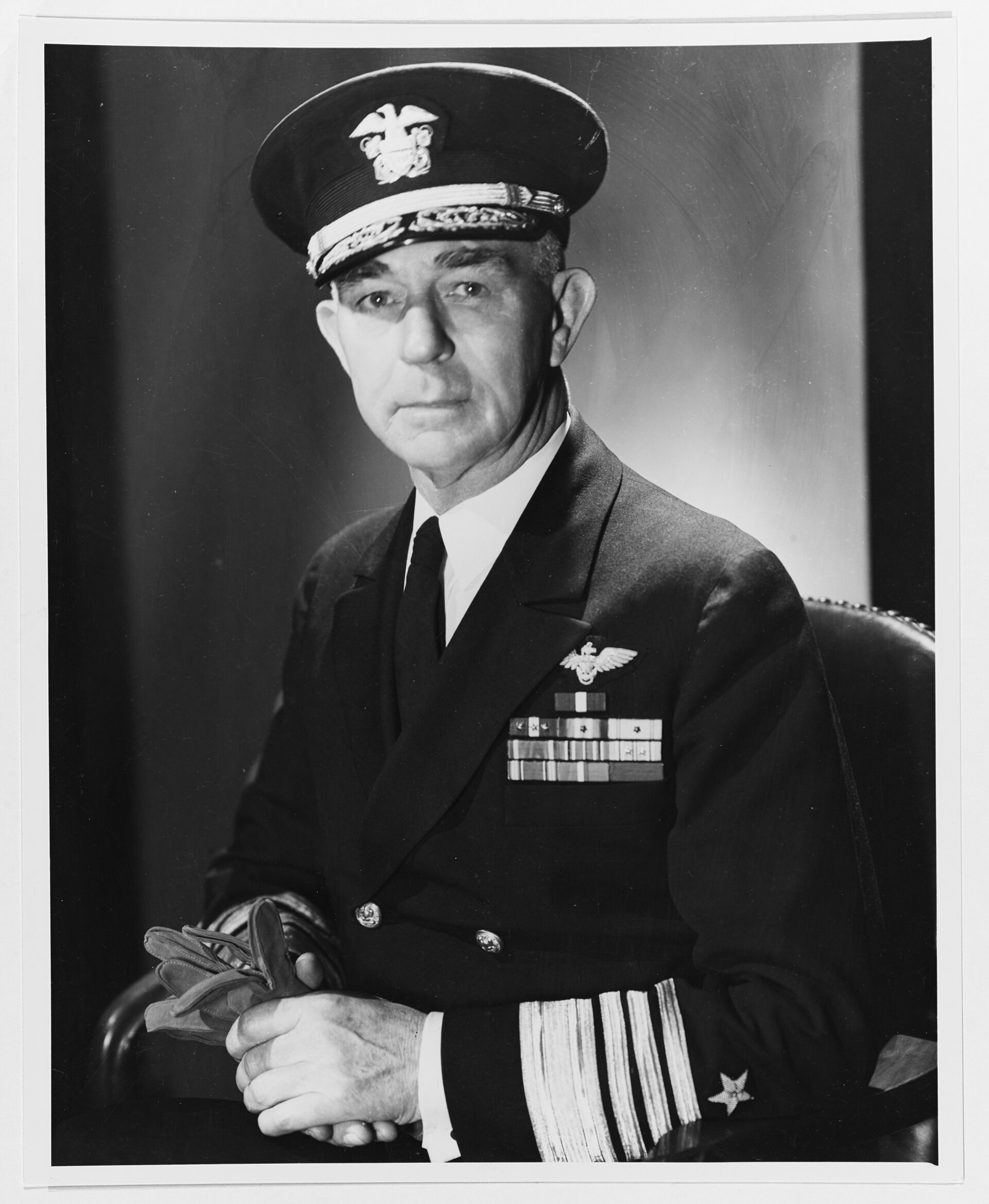
Vice Admiral Richmond Kelly Turner was born in Portland, Oregon, on 27 May 1885 and spent most of his boyhood in Stockton, California. A California appointment sent him to the Naval Academy in 1904. He stood fifth in a class of 201 and graduated with distinction in June 1908, then completed the two years at sea the law then required before he was commissioned ensign in June 1910. Cruisers, a torpedo boat, and destroyers filled those early years, and in 1913, as a lieutenant junior grade, he held a short command of the destroyer Stewart. In the First World War he served in the battleships Pennsylvania, Michigan, and Mississippi. Gunnery became his specialty. After the armistice he worked as an ordnance officer at the Naval Gun Factory, then as gunnery officer of California and as fleet gunnery officer on the staff of the Scouting Fleet, and he commanded the destroyer Mervine.
In 1927 he went to Pensacola for flight training and was designated a naval aviator on 30 August. He later commanded the aircraft squadrons of the Asiatic Fleet, advised the General Board, and served as executive officer of the carrier Saratoga. Promoted to captain, he spent 1935 to 1938 at the Naval War College as a student and then on the staff. Command of the heavy cruiser Astoria followed, and in 1939 he took her on a diplomatic visit to Japan. In October 1940 he became director of the War Plans Division in the Office of the Chief of Naval Operations. Late in 1941 he was made a rear admiral and, that December, took additional duty as assistant chief of staff to Admiral Ernest J. King, Commander in Chief of the United States Fleet. He remained in Washington through the first six months of the Pacific war, deep in the plans for how the fleet would take islands back.
On 18 June 1942 he was sent to the South Pacific as commander of the amphibious force. He commanded that force at the Guadalcanal landings on 7 August 1942. His flag was in the transport McCawley, off Beach Red. He was not her captain. Charlie P. McFeaters had the ship. From her he put Major General Alexander A. Vandegrift's 1st Marine Division ashore on Guadalcanal and Tulagi, with a Royal Navy screen under Rear Admiral Victor Crutchley and the carriers of Vice Admiral Frank Jack Fletcher farther out. It was the first large American amphibious assault of the Pacific war. The next night a Japanese cruiser force broke the Allied screen off Savo Island and sank four heavy cruisers. Turner cleared the transports on 9 August, then kept a supply line running into Guadalcanal for the rest of the campaign, which closed in February 1943.
People who served with him found a quick mind and a rough manner. His own staff called him Terrible Turner. On the Japanese side he became known as the Alligator, a name for landings that kept coming ashore and staying. Admiral Chester W. Nimitz, who had taken him for the assault command at King's urging, valued the same sharp temper that made him hard to sit with in a planning room. Through 1942 and 1943 he and Vandegrift, and later other troop commanders, turned a thin doctrine of ship-to-shore movement into a working system of transports, gunfire, boats, and troops.
McCawley stayed his flagship as the advance moved up the Solomons. On 30 June 1943 she opened the New Georgia campaign by landing troops on Rendova. That afternoon, as the ships withdrew through Blanche Channel, a Japanese aerial torpedo hit her engine room, killed fifteen of her crew, and left her dead in the water. Turner and his staff shifted to the destroyer Farenholt. Salvage parties stayed with the transport until she was clearly going, and they were taken off. After dark, American motor torpedo boats, patrolling a channel they had been told was empty of friendly ships, torpedoed her, and she sank in about half a minute. In August 1943 he left the South Pacific amphibious command and took the Fifth Amphibious Force under Admiral Raymond A. Spruance for the drive across the Central Pacific.
That force assaulted Tarawa in November 1943 and Kwajalein, Roi, and Namur in the Marshalls early in 1944. The boats lost on Tarawa's reef convinced him that swimmers and demolition men had to go in ahead of the landing waves and clear obstacles. The teams raised for that work, the underwater demolition teams, went on to every major landing he commanded afterward. He was promoted to vice admiral on 7 March 1944. That summer, as commander of the Joint Expeditionary Force, he directed the assaults that took Saipan, Guam, and Tinian. The Navy Cross and a succession of Distinguished Service Medals marked those campaigns.
For Iwo Jima in February 1945 and for Okinawa from 1 April he flew his flag in the command ship Eldorado and again commanded the Joint Expeditionary Force. At Okinawa the amphibious forces under him numbered in the hundreds of thousands and put the Tenth Army ashore while Japanese aircraft kept attacking the ships offshore. He was promoted to admiral on 24 May 1945. The plans for an invasion of Japan assigned him the amphibious command. After the surrender he served on the Navy's General Board and as the Navy representative on the United Nations Military Staff Committee. He retired in July 1947. His wife, Harriet Sterling, whom he had married in 1910, died shortly before he did. He died in Monterey, California, on 12 February 1961, and was buried at Golden Gate National Cemetery in San Bruno. A guided-missile frigate, later reclassified a cruiser, was named for him.