Ships
- USS Yorktown (CV-5) Flag, not her captain, Coral Sea and Midway
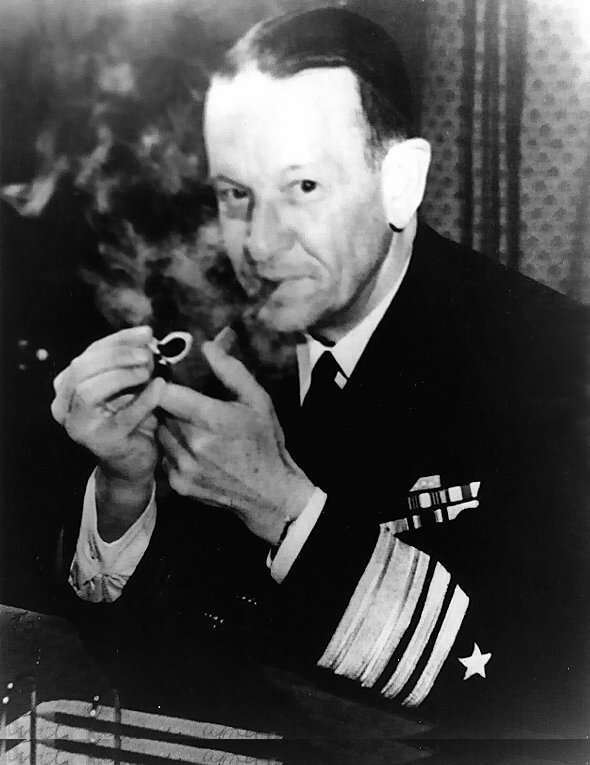
Frank Jack Fletcher was born in Marshalltown, Iowa, on 29 April 1885. Appointed to the Naval Academy from Iowa in 1902, he graduated on 12 February 1906 and, after two years at sea, was commissioned an ensign on 13 February 1908. In the Pacific war he flew his flag as a rear admiral in Yorktown (CV-5) at the Coral Sea and at Midway. Her own captain remained in command of the ship.
Early duty took him to the battleships Rhode Island, Ohio, and Maine, then to destroyers of the Asiatic Fleet, where he commanded Dale and later Chauncey. He joined Florida in 1912. At Veracruz, on 21 and 22 April 1914, Lieutenant Fletcher took charge of the steamer Esperanza under fire and brought off more than 350 refugees. The Medal of Honor followed. His uncle, Frank Friday Fletcher, received the same decoration for that landing.
In the First World War he was gunnery officer of Kearsarge, then commanding officer of the destroyer Benham on patrol and convoy duty in European waters, service for which he received the Navy Cross. Between the wars he held Asiatic commands, finished the senior course at the Naval War College in 1930, served as chief of staff to the Atlantic Fleet and as aide to Secretary of the Navy Claude A. Swanson, and commanded the battleship New Mexico. Promoted to rear admiral in the late 1930s, he led cruiser divisions in the Pacific from 1939. Yorktown had already served under a peacetime captain, Ernest D. McWhorter, who left her in June 1939. Fletcher never held her command.
After Pearl Harbor he took a task force built around Saratoga toward Wake Island. The relief was recalled before he arrived, and the island fell. On 1 January 1942 he received Task Force 17 with his flag in Yorktown. That winter and spring she raided the Gilbert and Marshall Islands and joined the carrier strike on Japanese shipping at Lae and Salamaua. He learned carrier operations in those weeks while Captain Elliott Buckmaster fought the ship.
In May 1942 he was senior officer at the Battle of the Coral Sea, flag still in Yorktown, with Lexington in company. American aircraft sank the carrier Shoho and damaged Shokaku. Lexington was lost. One bomb hit Yorktown. She was not sunk there. She reached Pearl Harbor, and the yard put her back to sea in a few days.
At Midway in June he was again the senior task force commander afloat, flag in Yorktown. Rear Admiral Raymond A. Spruance, in place of the ill William F. Halsey, had Enterprise and Hornet. On 4 June the American carriers destroyed four Japanese carriers. Aircraft left Yorktown dead in the water, and Fletcher moved his flag to the cruiser Astoria. The submarine I-168 finished Yorktown on 7 June. She was lost in that fight, which is why Midway closes her story under his flag. The Navy Distinguished Service Medal recognized his conduct at the Coral Sea and at Midway.
By the Guadalcanal landings of 7 and 8 August 1942 he was a vice admiral. He commanded the carriers covering the Marines at Guadalcanal and Tulagi, with his flag in Saratoga, and later that month fought the Battle of the Eastern Solomons, in which the Japanese carrier Ryujo was sunk. On 31 August the submarine I-26 torpedoed Saratoga and Fletcher was wounded. His sea command of carriers ended with that cruise. From November 1942 he led the Thirteenth Naval District and the Northwestern Sea Frontier from Seattle, and from 1943 the North Pacific Force. Ships under that command bombarded the Kurils, and in September 1945 he took the North Pacific Force into northern Japan for the occupation. He joined the General Board in December 1945, chaired it from May 1946, and retired in 1947 as an admiral. Frank Jack Fletcher died on 25 April 1973 and was buried at Arlington National Cemetery.