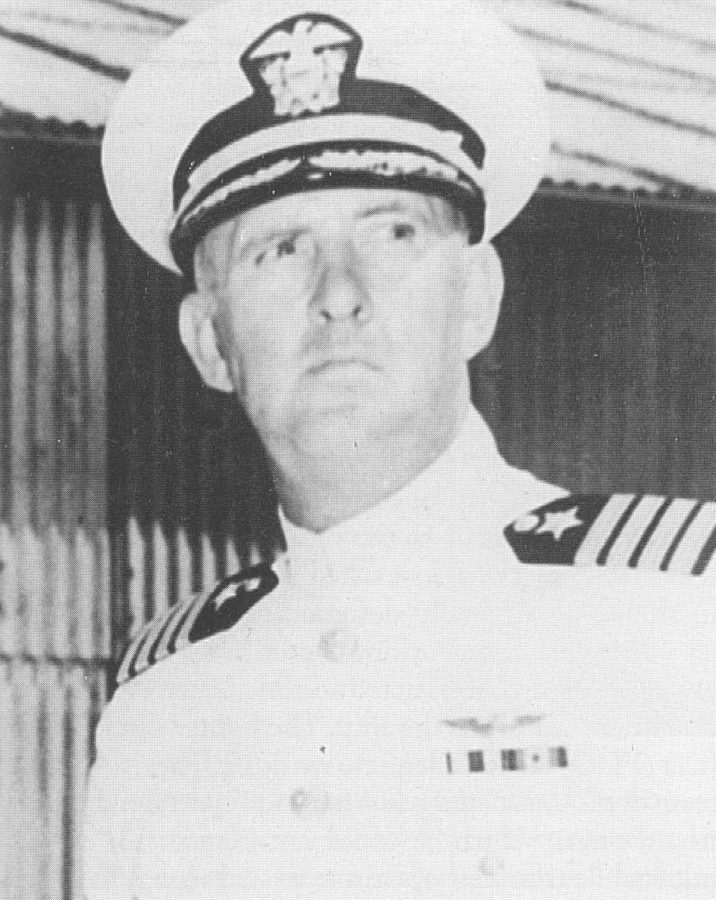
Ships
- USS Farragut (DD-348) Captain, 18 June 1934 – 20 June 1936
He is not that Buchanan, and he is not Bullen. The registers, the Navy Directory, the Lucky Bag, the Dictionary of American Naval Fighting Ships, and his own report of the loss of Yorktown support one officer of that name. What follows is the life those books will carry. Where they stop, the blank stays in the sentence.
Origins
The Register of Commissioned and Warrant Officers of 1 July 1945 puts a birth date on his own line, not in a ditto: 19 October 1889. The same line gives his date of entry into the naval service as 25 June 1908. The register does not print a town beside the day.
The Lucky Bag of 1912, the yearbook of his class, heads the sketch Elliott Buckmaster, University, Virginia, and the nickname "Buck." University is the place a midshipman claimed. It is not a proved birthplace. A decorations compilation, the Hall of Valor, prints the same birth day and adds a home the register does not: Columbus, Ohio. It also prints a death, 10 October 1976. Columbus is what one compilation says. It is not a line in the Navy Register, and no birth record was opened to test it. It is not used here as where he was born or where he lived.
Nothing read here names a father, a mother, a brother, or a sister. Nothing names a wife or a child. Other compilations name parents, a marriage, and a grave beside a woman. Those pages were not a register, a directory, a yearbook, or a newspaper that could be opened. They are not narrated. The absence is a blank, not a conclusion that he died without a family.
Formation
He entered on 25 June 1908. He is in the Lucky Bag of the class of 1912. The page gives him an epigraph, "For what he has, he gives; what thinks, he shows," and a line of activities: Buzzard, Expert Pistol Shot, Tennis Team (3), Baseball Numerals. The optical text is clear enough on those words to use. What "Buzzard" meant on that line was not chased into a key.
His classmates wanted a portrait of a man who was hard to fool and hard to rattle. They called him, familiarly, "Good old Buck," and "the Foxy Grandpa of our number." He came from Virginia, they wrote, "but combines with the amiable characteristics of the Southerner all the shrewdness of the Yankee." You had to be "going some to 'hang one' on Buck." He was tall and of vigorous build, and he had shown he could handle the gloves. He was "a hard, consistent worker," and since plebe year he had been "slowly but surely forging to the front." He was "not much on theoretical stuff," and "when it comes to the practical part of things" he was "always thoroughly at home." He was "somewhat conservative in his views and generally loath to accept new ideas." In argument he liked to trip a man on a secondary issue, "and if you don't watch yourself he will do it — and very successfully, too." His favorite pastime, they said, was "leading out Big Brown's goat," and in that he had no rival. He was "ordinarily not much of a talker," but when he went in for fussing he could perform "remarkable conversational feats verging closely on the frivolous." His temper they called as steadfast as the Rock of Gibraltar. The optical text reads "Hock." No obstacle discouraged him. "When it comes to doing things for other people Buck is a regular prince; and if you need anyone to stand with you in trouble and fight with you shoulder to shoulder — why, look him up. He's your man."
That is classmate prose, written to be remembered. The thing that can be checked is thinner. He was a Virginia midshipman in the class of 1912. They thought him practical, slow to take up a new idea, even-tempered, and useful when someone else was in trouble. The sea would eventually ask him to take up a new idea anyway. The yearbook does not say he wanted that.
The register of 1 January 1913 lists him an ensign. On the duty list his station is Wyoming, and the date of present duty or leave on his line is 14 July 1912. Wyoming was the battleship, then shaking down. He is on her officer list in that register, an ensign among ensigns, not her captain. The 14 July date is the duty date the book prints. It is not used here as the day he was commissioned. The commissioning day was not recovered as a clean figure of his own.
On 1 January 1915 the Navy and Marine Corps list still has him an ensign, now in USS New Jersey. She was a battleship of the second line. Captain Joseph L. Jayne commanded her. Commander William H. Standley was on the same officer list. Buckmaster was an ensign aboard, not in command. The occupation of Veracruz had been fought in April 1914, between the Wyoming snapshot and this one. A decorations compilation later prints a Navy and Marine Corps Medal "in lieu of Letter of Commendation by Secretary of the Navy dated 13 July 1914," and styles him, in that entry, a rear admiral, with an action date of 1914. The letter itself was not found. The register of 1 July 1945, which marks his two Distinguished Service Medals, does not mark a Navy and Marine Corps Medal on his line. Veracruz is not narrated. Being on New Jersey in January 1915 does not say where he was in April 1914.
The next clean appearance is the Navy Directory of 1 January 1924. He is a lieutenant commander, commanding the receiving ship at Boston. On 1 April 1928 he is a lieutenant commander at the navy yard, Portsmouth, New Hampshire, aide to the commandant. On 1 April 1931 the alphabetical entry lists him a lieutenant commander, engineer, in USS Arizona. The ship page in that volume is garbled. It may say the order was pending. It is not clean enough to narrate as a cruise, and it is not narrated as one. On 1 October 1933 he is a commander at the Boston Navy Yard, shop superintendent.
The Directory records orders, not cruises. What the snapshots show is a surface officer who had already held a small command, the receiving ship, and who had been put to yard work and to engineering. He was forty-three. His birthday that month was still eighteen days off.
On 1 April 1934 the Directory lists Commander Elliott Buckmaster commanding USS Farragut, and the ship page says she was not yet commissioned. The Dictionary of American Naval Fighting Ships, in the transcription read here, says the third Farragut (DD-348) was launched 16 March 1934 by Bethlehem Shipbuilding at Quincy, Massachusetts, sponsored by Mrs. James Roosevelt, and commissioned 18 June 1934, Commander E. Buckmaster in command. Other summaries print the launch as 15 March. The log was not opened.
DANFS says that because it had been almost fourteen years since a new destroyer was commissioned, Farragut gave her early service to development work, out of Norfolk, to the Caribbean and along the east coast. On 26 March 1935 she embarked President Franklin D. Roosevelt at Jacksonville and carried him the next day to a rendezvous with a private yacht. She escorted the yacht on a cruise in the Bahamas. On 7 April the President embarked again, for passage to Jacksonville, and left the ship on 8 April. She sailed at once for San Diego and arrived 19 April 1935 to join Destroyer Squadron 2d as flagship. The wording means the ship was the squadron's flagship. It does not say Buckmaster commanded the squadron. He was her commanding officer. DANFS does not repeat his name in the paragraph about the President. The directories do the joining. On 1 January 1935 he is still commander, commanding Farragut. On 1 January 1936 a badly read page still places him in Farragut. The March and April days of 1935 fall inside that command.
A ship-photograph list repeats that day and names a relief. That list is not a log, and the day is not used. The Directory of 1 April 1936 is too scrambled to trust. His name, "comdr," "comdg," "naval air sta Pensacola," and "uss Farragut" sit on top of one another in broken columns. It is not narrated as a command of the air station.
On 1 January 1937 the Directory is clean. He is a commander, under instruction, Naval Air Station, Pensacola, Florida. On 1 April 1937 he is still there, still under instruction. He had turned forty-seven the previous October. The yearbook had called him loath to accept new ideas. The Directory does not say he asked for flight school, or that the Navy sent him, or what it cost him to sit in a training squadron at that age. It says he was under instruction. By 1 July 1945 the register will mark him qualified as a naval aviator, heavier than air. The day of the designation was not on the line.
On 1 January 1938 he is a commander, executive officer of the Fleet Air Base, Coco Solo, Canal Zone. The station list prints "exec (ord)" beside the name. The abbreviation is left as printed. On 1 January 1939 he is a commander, executive officer of USS Lexington. Captain J. H. Hoover commanded her. Buckmaster was not her captain.
By 1 November 1940 he is a captain, commanding the Naval Air Station, Pearl Harbor, Territory of Hawaii. The promotion to captain falls between the January 1939 directory and that November page. A long ditto chain in the 1945 register can be walked back to a permanent captain's date of 1 July 1939. The date is not printed on his own line. It is not used. What is used is the rank the Directory prints on a dated page: commander in January 1939, captain in November 1940.
On 1 April 1941 the Directory lists Captain Elliott Buckmaster commanding USS Yorktown. Commander A. W. Radford is the executive officer on the ship page. The registers and his own report do.
War years
DANFS has Yorktown leave Pearl Harbor on 20 April 1941, nineteen days after a directory that still has him in command, in company with Warrington, Somers, and Jouett, bound for the Atlantic. She passed the Panama Canal on the night of 6 and 7 May and reached Bermuda on the 12th. From then until the United States entered the war she made four patrols in the Atlantic, from Newfoundland to Bermuda. The ship's history does not put his name on those sailings. No relief is recorded in the books that were opened. The patrols are the ship's. They are not narrated here as a cruise of his own beyond the fact that he was her captain on the first of April and still her captain when he wrote, a year later, as commanding officer.
He wrote that report on 18 June 1942, to the Commander-in-Chief of the Pacific Fleet, via Commander Task Force Seventeen. The subject is the action of 4 June and 6 June. The first sentence is the condition of the evidence. "This report of action is compiled entirely from memory of officers in the ship and Air Group who had intimate knowledge of the various events as they took place." Approximate times, he warned, might be somewhat in error. The logs and the secret files were later secured in safes that went down with the ship, except for the task-force dispatch files, which the salvage party carried off. What he could still say, he said from memory.
In that report he lists the ship's war as the crew's war, and he writes as the man who had been on her for it: the attack on the Marshall and Gilbert Islands on 31 January 1942; the attack on Salamaua and Lae on 10 March 1942; three attacks at Tulagi on 4 May; the attack on enemy carriers off Misima on 7 May; a night action against aircraft on 7 May; the Coral Sea on 8 May; the battle north of Midway on 4 June; and the salvage party on 6 June, "up until the time the ship was fatally wounded by submarine torpedoes." A deck log for each of those days was not opened. The report is his list. It is not a cruise reprinted from a log.
The Coral Sea is the action the Navy's medal language and the ship's history both put under his hand, and they do not count the same torpedoes. DANFS says that on 8 May, skillfully maneuvered by Captain Elliott Buckmaster, Yorktown dodged eight torpedoes, and then, attacked by dive bombers, evaded all but one bomb. That bomb penetrated the flight deck and exploded below, killing or seriously injuring sixty-six men. Damage-control parties got the fires under control. She could still operate aircraft. The Distinguished Service Medal citation, as printed by the Hall of Valor from a compilation of Commander-in-Chief, Pacific, Serial 2050, covers 4 May to 8 May 1942 and calls him captain, commanding Yorktown. It says the squadrons under him attacked and destroyed nine enemy ships and numerous aircraft at Tulagi on 4 May, and that the attacks of 7 and 8 May resulted in the sinking of one Japanese carrier, one cruiser, and the severe damaging or sinking of another carrier. On 8 May, it says, he "so skillfully maneuvered his ship as to successfully avoid nine torpedoes and all but one bomb." Eight in the ship's history, nine in the citation. The citation is the Navy's language for the medal. It is not a log of hulls, and the nine ships are not narrated here as a count that was reconciled. The register of 1 July 1945 confirms that two Navy Distinguished Service Medals were recorded on him. It does not reprint the citation.
He came back from that damage into a second battle with the same ship. His report of Midway begins on the morning of 4 June. Yorktown was in Task Force Seventeen under Rear Admiral Frank Jack Fletcher. Word had come that enemy forces, including two carriers, were northwest of Midway. At dawn he sent ten scout bombers out on a security search. They returned about 0830 with nothing. From 1030 to 1050 he launched an attack group, seventeen scout bombers, twelve torpedo planes, and six fighters, about an hour and fifteen minutes after Enterprise and Hornet had launched. He held seventeen scout bombers back. He thought it highly probable that two more carriers had not yet been found.
The attack group went. His report, drawing on the squadron accounts he attached in substance, has the torpedo planes hit by Zero fighters on the way in. Lieutenant Commander L. E. Massey, commanding Torpedo Squadron Three, was shot down in flames as he turned toward the carrier. Of twelve torpedo planes, the report says, only two were known to have left the vicinity of the battle. The dive bombers, Lieutenant Commander M. F. Leslie's Bombing Squadron Three, dived on a large carrier whose deck was covered with planes spotted aft. The first bomb, the report says, exploded among those planes. The squadron claimed direct hits and near misses, and two pilots shifted to a light cruiser and two to a battleship. All seventeen of the bombers were back by 1315, undamaged. The torpedo crews were not.
While Yorktown was fueling fighters, about 1359, radar picked up an attack coming in from about 250 degrees, forty-six miles out, climbing. He had an auxiliary gasoline tank on the stern, about eight thousand gallons, dropped over the side. Fuel lines were drained and filled with carbon dioxide. The fighters intercepted fifteen to twenty miles out. "Planes were seen flying in every direction, and many were falling in flames." Seven bombers got through. They released at about five hundred feet. Three hits. One bomb, from a plane already out of control, tumbled and struck just abaft number 2 elevator, a hole about ten by ten feet, repaired in about twenty-five minutes. It killed and wounded men on the 1.1-inch mounts and in the island. Lieutenant A. C. Emerson, the hangar-deck officer, turned on the sprinklers and put out a fire among fueled, armed planes that would otherwise, the report says, have become a serious conflagration. The next bomb exploded in the uptakes. It disabled boilers, filled the firerooms with smoke, and knocked the ship's speed down to about six knots. At 1440 the engines were stopped. The men on number 1 boiler stayed. With two burners they held auxiliary steam. About an hour and ten minutes after the hit, boilers were cut back in. At 1550 the engine room reported ready to make twenty knots or a little better. A third bomb had gone through number 1 elevator and started a fire in a rag stowage next to the gasoline and the magazines. The magazines were flooded.
Fueling had just started again when radar picked up another group, about 340 degrees, thirty-three miles, climbing. He went ahead at emergency full speed. The speed through the water was about twenty knots. Fighters reported torpedo planes. At least two torpedoes were avoided by radical maneuver. At about 1620 a torpedo hit on the port side near frame 90, and a second near frame 75. All power was lost. The rudder jammed at about fifteen degrees left. The ship was dead in the water and took a progressive list to port.
Commander C. E. Aldrich, the damage-control officer, reported from central station that without power nothing could be done to correct the list. Lieutenant Commander J. F. Delaney, the engineer, reported that all fires were out, all power was lost, and the list could not be corrected. Buckmaster ordered them to secure below and to send the men up on deck and into life preservers. The list reached twenty-six degrees. He and Aldrich both felt, the report says, that she would capsize in a few minutes. "In order to save as many of the ship's company as possible, the Commanding Officer ordered the ship to be abandoned."
Below, it was dark, and the list made it hard to move. The wounded were lowered to rafts and to boats from the destroyers and cruisers. After the wounded were reported clear of the dressing station and the sick bay, and after everyone in sight had gone, the executive officer went down a line on the starboard side. The report at that point does not give the executive officer's name. DANFS says Commander I. D. Wiltsie had replaced the injured Commander Dixie Kiefer, and that Wiltsie was the man who went down the line. Buckmaster then walked the ship. Starboard side, from the catwalk and the five-inch gun platforms, back to the flight deck opposite number 1 crane, down through the dressing station, forward through flag country and the captain's cabin, to the port side, down to the hangar. "On this inspection no live personnel were found." The port side of the hangar deck was in the water. He left by a line over the stern. Hammann picked him up. Soon after, he was transferred to Astoria, where Fletcher had gone when Yorktown stopped after the dive-bombing. The two of them agreed she should be saved if she stayed up.
She stayed up. On the morning of 6 June he went back with twenty-nine officers and one hundred forty-one enlisted men. Vireo had a tow line on her and was towing very slowly, keeping her head to the seas. The rag-stowage fire was still burning. He had a plan already divided by department. Damage control would put the fire out, inspect, and reduce the list by getting weight off the port side and by pumping and counterflooding, using power from a destroyer until a salvage tug came. Gunnery would man the automatic guns and cut the port five-inch guns loose. The air department would throw the planes over. Engineering would inspect. Navigation would try to get the rudder amidships. Supply would feed the party. The medical officer would identify the dead. The commanding officer would bury them.
Hammann, Commander Arnold E. True, came alongside to starboard and sent over water, pumps, and electric power. Buckmaster wrote that without Hammann alongside in the open sea, no salvage could have been undertaken, and that True's conduct could not be too highly praised. Five other destroyers, Balch, Benham, Gwin, Anderson, and Monaghan, screened her at about two thousand yards. He names Captain E. P. Sauer as commander of Destroyer Squadron Six. By midafternoon the fire was out, one five-inch gun was over the side and another nearly ready, planes had been dropped, two starboard tanks had been filled from Hammann, and the list had been reduced by about two degrees.
At about 1536 a salvo of four torpedoes was seen on the starboard beam, beyond the screen. The alarm was a twenty-millimeter gun and the word "Torpedo Attack." The first torpedo hit Hammann about amidships. She sank very fast. Two hit Yorktown. The fourth passed astern. About a minute after Hammann's stern went under, her depth charges exploded. The report says the explosion killed many of Hammann's men and a few of Yorktown's who were in the water, and injured others from both ships. The shock dropped fixtures onto the hangar deck, collapsed landing gear, sheared the rivets in the starboard leg of the foremast, and threw men in every direction. The list eased to seventeen degrees. Every destroyer was needed to hunt the submarine and to pick men out of the water. Salvage stopped. He took the party off, meaning to return in the morning when a large tug was expected. They went down lines to Vireo. Before he left her, he conducted burial services for two officers and one enlisted man from Hammann.
The dead already on Yorktown had been his that morning. Thirty-five were found. All but ten were identified. Fingerprints were taken. He buried them at sea. When the torpedoes hit, the identifications, the fingerprints, and the valuables, laid out on the hangar deck, slid down the slope and were lost over the side.
About 0530 on 7 June the list increased rapidly to port. At 0701 Yorktown turned over and sank, in about three thousand fathoms, with all battle flags flying. He gives the position: latitude 30 degrees 46 minutes north, longitude 167 degrees 24 minutes west.
The report then becomes a brief for the next fight: fighters that could not stay with a Zero, torpedo planes that should be replaced, guns that lost cooling water when the power died, files that ships should not carry into battle, a life jacket that needed a crotch strap. He reaffirms what he had already written in a report of 8 May, which was not opened here. He ends on the crew. He says he cannot praise too highly "the aggressive fighting spirit of the entire complement of the Yorktown and her Air Group." That spirit, he writes, "remains alive even though the ship herself has perished gloriously in battle." The wish closest to the hearts of those who had served in her was that she be preserved "not only in memory but by the crew's being kept together to man, commission, and return against the enemy a new aircraft carrier, preferably another Yorktown." The transcription signs it E. Buckmaster. The page that carries the transcription titles him, in a heading, Buckminster. That is the transcriber's spelling. The signature is his name.
A second Distinguished Service Medal, a gold star in lieu of another, is printed by the same compilation from Commander-in-Chief, Pacific, Serial 19 of 20 July 1942. It styles him rear admiral, commanding Yorktown, flagship of Task Force Seventeen, for 4 June 1942. It says the air groups under him damaged three enemy carriers, and that by superior leadership he contributed to the success of the engagement. It does not mention the abandon-ship order, the return, or the submarine. His own report, written a month earlier, is more cautious about what the squadrons had sunk and more specific about what the ship had cost.
Cost
The order at twenty-six degrees was a choice with a number on it. He and Aldrich thought she would capsize in minutes. He wrote the order as a way to save as many of the company as possible. He searched. He wrote that he found no one alive. DANFS, telling the same night, says she floated through it, and that two men were still alive on board. One of them attracted attention by firing a machine gun. The sole destroyer still with her, Hughes, heard it and picked the two men up. One of them later died. The report says the ship below was dark and hard to move through. It does not say how the two were missed, or whether they were below the path he walked. Both sentences stand. He believed the inspection was empty. The ship's history says it was not.
He went back the next morning with one hundred seventy of his men and tried to take the list off her. For a few hours it worked. Then Hammann died alongside, and the depth charges killed men who had already survived the carrier. He buried two of Hammann's officers and one of her enlisted men on the tug. The names and fingerprints of Yorktown's dead went over the side with the water. The ship sank the next morning under flags, and he wrote the account from memory because the paper had gone down or been locked in safes that went down.
What he asked for at the end was not another medal. It was the crew, kept together, on another carrier with the same name. Nothing opened here shows him given that ship, or shows the crew kept together under him. The wish is in the report. The answer is not.
After
On 1 July 1944 the register's index lists Elliott Buckmaster a rear admiral, file number 7919. On 1 July 1945 he is still on the active list of rear admirals, signal number 115, with two Navy Distinguished Service Medals marked on the line. The qualifications on the line are 2 and 18. In that volume's key, 2 is designation as a naval aviator, heavier than air. The number 18, read where the key's numbers and sentences have been pulled apart by the optical copy, is the Naval War College correspondence course in strategy and tactics. The aviator designation is firm. The War College course is the alignment of that key, and it is stated as that.
The temporary rank and the permanent rank on his 1945 line are dittos. Walked back through other men's lines, the chain yields a temporary rear admiral's date of 16 May 1942 and a permanent captain's date of 1 July 1939. A dropped line in a chain that long would move the dates. Neither date is printed on his own line, and neither is used as if it were. The citations bound the ranks more tightly than the dittos do, and they do not agree with every narrator. The May citation calls him captain for 4 to 8 May 1942. The July citation calls him rear admiral for the action of 4 June. DANFS calls him captain in both battles. The transcription of his report heads him as captain and does not print a rank under the signature. If the ditto were right, he was already a rear admiral on 4 June. The books that say captain are not erased by a ditto.
He was still a rear admiral on the active list on 1 July 1945. The directories that fix his duty stop in April 1941. Between the report of 18 June 1942 and that register page, no duty station was opened. Compilations put him, in those years, over primary flight training in Kansas, and in 1945 over the Western Carolines, and they put his name on the rescue of Indianapolis. The Navy's own summation of that rescue prints dispatch after dispatch from the Commander, Western Carolines Sub Area, beginning 2 August 1945, and does not print his name. The office and the man are not joined in the page that was read. Those commands are not narrated.
A Wikipedia list of officers advanced on the retired list, which says it takes retirement dates from the Navy Register, gives him 1 November 1946 and the rank of vice admiral under the old rule that a rear admiral commended for combat could retire with the next higher rank. The retired register was not opened. The 1945 register shows he had not retired by the first of July of that year. The vice admiral's rank and the November day are the list's claim. They are not a line that was read.
The Hall of Valor prints his death as 10 October 1976. No obituary was opened. The place, the cause, and who survived him were not found.