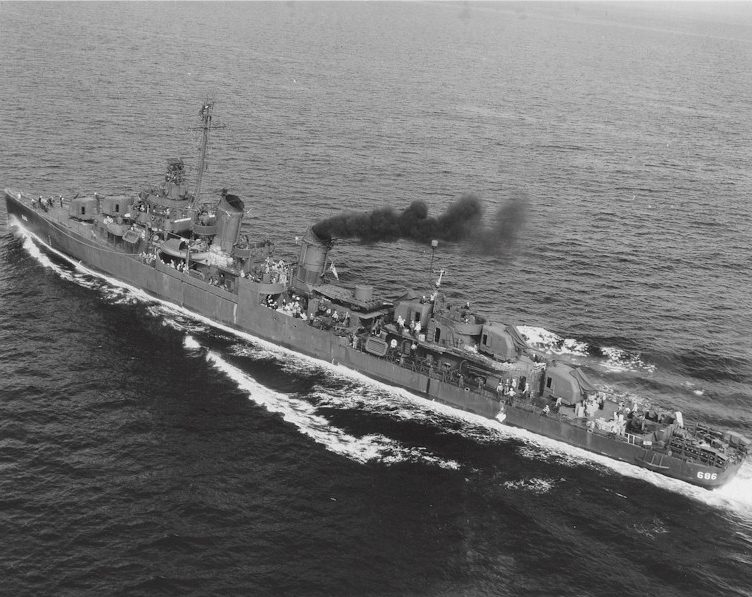
USS Halsey Powell was a Fletcher-class destroyer of the United States Navy. She was launched on 30 June 1943 and commissioned on 25 October 1943, with William Thomas McGarry as commanding officer (DD-686).
Shakedown was carried out off the East Coast. On 20 January 1944 she left Norfolk for the Pacific Fleet and reached Pearl Harbor on 12 February. She then ran to Majuro, brought oilers back toward Hawaii, and in March was again in the Marshall Islands on patrol and escort duty. While American landing troops took the atolls, she and the ships with her guarded the force against planes and submarines. On 23 March she made repeated attacks on the submarine I-32. Her depth charges were used up before the boat was finished, and Manlove and Canastota completed the sinking.
After the Marshalls she cleared Pearl Harbor on 30 May for rehearsals ahead of the Marianas landings. The assault ships left Eniwetok on 11 June. Four days later, as troops went ashore on Saipan, she lay off the beaches and put gunfire into the defense. Screening, radar-picket watches, and support for soldiers inland filled her days, and in the lagoon her guns destroyed a net tender, a freighter, and many small craft. On 21 June she came into the harbor at Saipan, the carrier fight in the Philippine Sea already over and Japanese naval aviation badly beaten. She moved on to Tinian, shelled positions ashore, cleared a path for the troops, and screened the landing of 24 July. For about two weeks she screened and kept radar watch off Guam, then on 22 August was back at Eniwetok to join the fast carriers.
On 29 August she sailed with Vice Admiral Marc Mitscher in TF 38. Fueling and resupply at sea let that carrier force stay out for long stretches and move its strikes over a wide area. Through September the carriers, Halsey Powell among the screen, hit the Palaus and the Philippines, and the formation arrived at Ulithi on 1 October. Sidney Douglas Buxton Merrill relieved McGarry on 6 October, and the ships soon left on a major operation of the Pacific war. Air strikes fell first on Okinawa. The real objective was the airfields on Formosa, where the air battle ran from 12 through 15 October and Halsey Powell helped bring down many Japanese aircraft. Three ships of the force were damaged. Nearly a thousand enemy planes were driven off, and more than five hundred were shot down.
The Leyte landings drew the remainder of the Japanese fleet into the Philippines in a three-part advance that had almost no air cover, and that effort became the Battle for Leyte Gulf. On 24 October Halsey Powell screened Admiral Gerald F. Bogan’s carriers in the Sibuyan Sea phase. Musashi was sunk, and Vice Admiral Takeo Kurita’s ships were delayed and thrown into disorder. That night most of TF 38 turned north to meet another Japanese fleet, and on the following day the Battle off Cape Engaño brought a further large American victory. The destroyer picked up downed pilots on 29 and 30 October and came into Ulithi with the force on 9 November 1944. Through the rest of 1944, TF 38 kept striking the Philippines and Formosa.
Between 9 and 15 January 1945 the fleet entered the South China Sea in support of the Lingayen Gulf invasion. The escorts fought off air attacks while the carriers struck bases in China and Indochina. A kamikaze damaged Ticonderoga on 21 January, and Halsey Powell was ordered to escort the carrier, reaching Ulithi with her on 24 January. In February the carrier force went against Japan itself. She screened the raids, covered the Iwo Jima landing on 19 February, and remained for later strikes on Japan. On 16 February she shot down one attacking aircraft and helped with many others.
The carrier groups returned to Ulithi on 1 March and got underway on 14 March to soften Okinawa for the coming assault and to hit Japan again. On 20 March Halsey Powell was alongside Hancock when Japanese planes attacked. As the destroyer worked clear, one aircraft overshot the carrier and crashed into her. Her steering jammed, and quick handling of the engines kept the ships from colliding. Fires were put out. Twelve men were killed and more than thirty wounded, but she reached Ulithi on 25 March. Battle repairs brought her to San Pedro on 8 May. On 19 July 1945, with the Pacific war nearing its peak, she sailed for Pearl Harbor. She arrived at Eniwetok on 17 August, two days after Japan surrendered, and was in Tokyo Bay for the formal surrender ceremonies on 2 September. Merrill’s command ended on 30 September. She supported the occupation forces until 31 October, then left for Puget Sound.
She was decommissioned at San Diego on 10 December 1946 and placed in the Pacific Reserve Fleet. The demands of the Korean War returned her to service on 27 April 1951. After shakedown and training she left Long Beach on 23 July, reached Japan on 16 August, and joined Task Force 77. There she served as plane guard and screening ship while carrier aircraft kept pressure on Communist lines and shore targets. That duty off Korea’s east coast lasted until October, when she shifted to training off Okinawa. Late in the month she came back to bombard Suwon Dam, the areas around Wonsan and Hungnam, and other targets. Patrol and screening continued until she sailed for the United States on 20 February 1952. A second Korean tour began on 4 October 1952. Over the next seven months she again took up shore bombardment and screening while United Nations naval forces kept North Korea sealed off from the sea, and she then returned home. Halsey Powell had survived the war. On 27 April 1968 she was transferred to the Republic of Korea.