Ships
- IJN Kumano Flag, June 1942
- IJN Yamato Flag, 25 October 1944
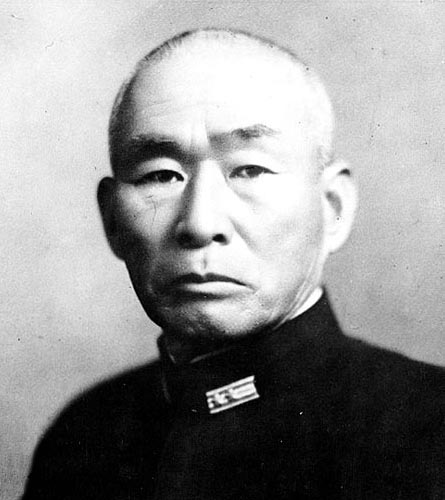
Takeo Kurita was born in Mito, in Ibaraki Prefecture, on 28 April 1889. He entered the Imperial Japanese Naval Academy at Etajima with the 38th class and graduated in 1910, twenty-eighth of 149 cadets. Torpedo work became his trade. Through the 1920s and 1930s he stayed mostly at sea in destroyers, commanding Hagi, Hamakaze, and Urakaze, and later the 25th, 10th, and 12th Destroyer Divisions. He also captained the light cruiser Abukuma and, from December 1937, the battleship Kongo.
He was promoted to rear admiral in November 1938 and led destroyer squadrons before taking the 7th Cruiser Division in November 1940, the four heavy cruisers of the Mogami class. At the opening of the Pacific War he took that division through the Malaya and Dutch East Indies campaigns. On 1 May 1942 he was promoted to vice admiral.
In June 1942 his flag flew in the heavy cruiser Kumano. The division was the support force for the Midway landing operation, under the Combined Fleet commanded by Isoroku Yamamoto. That support force came through the battle still afloat. On 5 June the American submarine Tambor sighted the cruisers. In the turn that followed, Mogami collided with Mikuma. Kurita continued with the undamaged ships. Aircraft sank Mikuma the next day.
In July 1942 he took command of the 3rd Battleship Division. On the night of 13–14 October 1942, during the struggle for Guadalcanal, he brought Kongo and Haruna inshore and poured a long bombardment into Henderson Field. In August 1943 he was appointed commander of the Second Fleet, a seagoing command that usually went to a graduate of the Naval Staff College course he had not passed. In June 1944 the Second Fleet formed the van of the Mobile Fleet at the Philippine Sea, where the Japanese carrier air groups were largely destroyed.
For the Leyte operation in October 1944 he led the Center Force, built on the Second Fleet, from Brunei toward San Bernardino Strait. On 23 October an American submarine sank his flagship, the heavy cruiser Atago, and he went into the water before a boat picked him up. He shifted his flag to the battleship Yamato. On 24 October, in the Sibuyan Sea, carrier aircraft sank the battleship Musashi and damaged other ships in the column. He reversed course for a time, then turned back after dark and passed the strait.
On the morning of 25 October 1944 his flag was in Yamato, off Samar. Nobuei Morishita was the battleship’s captain, and Matome Ugaki was aboard as commander of the 1st Battleship Division. Kurita had four battleships, six heavy cruisers, the light cruisers Noshiro and Yahagi, and eleven destroyers. He ran into American escort carriers with their destroyers and destroyer escorts and ordered an immediate attack. Yamato was still afloat when the day ended. Japanese guns sank the escort carrier Gambier Bay and the escorts Hoel, Johnston, and Samuel B. Roberts. The Japanese ships that delivered the decisive hits on those four have not been sorted out one by one. Yamato’s long turn away from American torpedoes carried Kurita out of close reach of a fight that had already broken into separate actions. After about two hours he gathered the force and turned north, short of the transports in Leyte Gulf. Officers at home blamed him for stopping there.
In January 1945 he left the Second Fleet and became superintendent of the Naval Academy. The fleet and Yamato sailed later under Seiichi Ito, with Kosaku Aruga as the battleship’s captain, and Yamato was sunk on 7 April 1945 on the way toward Okinawa. Kurita went onto the reserve list in October 1945. He lived quietly after the war, earning a living as a scribe and a masseur, and he rarely spoke of the battle until late in life. He then said he had turned away off Samar because he would not spend more of his men on a fight he believed could no longer change the war. He died in Nishinomiya on 19 December 1977, at the age of eighty-eight.