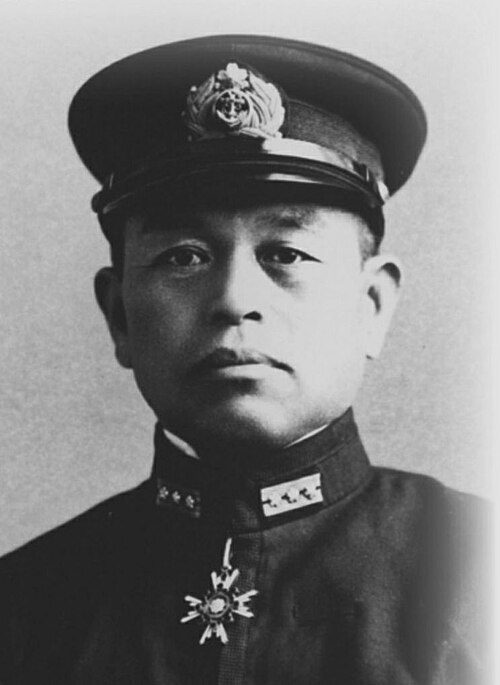
Ships
- IJN Inazuma Captain from 1 November 1934 · Relieved on 15 October 1935
- IJN Arashi Division flag, not her captain, from 18 June 1941 · Relieved on 20 February 1943
- IJN Chokai Captain from 1 March 1943 · Relieved on 6 June 1944
- IJN Yamato Captain from 25 November 1944 · In command when she was lost, 7 April 1945
He was an officer of the Imperial Japanese Navy. The rank he held when he took the ship, and the rank he still held on the morning he died, was captain. The vice admiral's rank that is sometimes printed under his name was given after he was dead. The day of the command, 25 November 1944, is the day in the compiled career table and in the battleship's compiled movements. It is not the only day in the story of how he got the ship, and one biography says he did not actually come aboard until 10 December. The loss of the ship on 7 April 1945, with him still in command, is not in dispute in any source that was opened. What is in dispute is the posture of his body in the last minutes, and almost everything about the life before the last command that is not a posting or a signature.
Nothing here is about John Malet Armstrong of the Royal Australian Navy, and nothing here is about Henry Jacques Armstrong, Jr., of the United States Navy. He is not Asakura, Bunji. The characters confirmed for this man are 有賀幸作.
The name, and which reading he used
The characters are printed by the National Diet Library's authority file, by the Library of Congress authority, by the Japanese article, and by the catalog text of several Navy documents that will be quoted below. The Diet Library heads the record 有賀, 幸作, 1897–1945, gives the katakana as アルガ, コウサク, and the romanization as Aruga, Kosaku. The Library of Congress uses Aruga, Kōsaku, and records Ariga as a variant. Both authorities name, as their source, Hisashi Oide's 1993 biography, 戦艦「大和」艦長有賀幸作.
The reading is not settled by those headings. The Japanese article's first sentence ruby is ありが こうさく. The infobox on the same page is あるが こうさく. The article says that in the southern part of Nagano the surname 有賀 is often read あるが, not ありが, and that this man disliked being asked to repeat himself, so he made people use ありが. It says the name embroidered inside his cap was アリガ. The citation is page 114 of Oide. The book was not opened. The cap was not seen. The Combined Fleet note on the heavy cruiser Chōkai says only that older English sources misspell him Ariga. That is a remark about English spelling, not about what he called himself.
So Aruga matches the library romanization and the あるが reading. The biography, as the article reports it, says he answered to Ariga. Both can be true of one man. Nothing that was opened shows a second officer of this career under either spelling. Hiroshi Nishida's class roll enters him once, as Aruga, Kosaku, of Nagano, Naval Academy 45th.
Where he came from
The birth date is the one the class table, the Japanese article, the Library of Congress (from page 7 of the biography), and a local page at Tatsuno all print: 21 August 1897. The place is Asahi village, Kamiina county, Nagano, the village that is now part of Tatsuno town. The local page, which cites the same biography, narrows it to Ōaza Hiraide, and says he was the eldest son of Aruga Sakutarō. The Japanese article says the father was a hardware merchant and the village mayor, that he had fought at 203 Meter Hill in the siege of Port Arthur, that he received the Order of the Golden Kite, sixth class, and a pension, and that he opposed his son's wish to become an officer. Those sentences are footnoted to Oide, page 17. No family register was opened. The father's decorations were not checked against a medal roll.
The same article, still from the biography, says the shop was called Hiranoya. After this son gave up the succession, a brother, Jirō, was to have it. Then the father, Jirō, a third son, 正次, and a sister, Fusae, died one after another of illness. The naval officer was left as head of the house on paper. The mother, who is not named in anything read here, ran the shop alone. By the time the battleship went down, the article says, the shop had already closed. A local page written much later says the family moved to Tokyo after the war and that the birth house is gone. The grave it names is at 見宗寺 in Tatsuno. That is a local account of what remained. It is not a probate file.
The wife, in the article's chronology, was Miyasaka Yoshiko. The marriage is given as 27 January 1924. A son, Masayuki, is given as born in October 1924. A daughter, Yoshie, on 7 June 1928. A second daughter, Kimiko, on 17 September 1936. Each of those lines is a page citation to Oide, not a line from a register that was seen. They are used here as that book's account. If the book is wrong about a date or a name, this essay is wrong with it.
What the book is said to contain, and what no one else who was opened confirms, is that on 15 November 1941, with the war days away, he wrote a will, and that Yoshiko did not read it until 20 September 1945, when the notice of his death arrived. The text of the will was not printed in the article. What he left her in writing, beyond the fact of a paper she opened five months after the ship sank, is a blank.
The school the article and the local page agree on is Nagano prefectural Suwa Middle School, the school later called Suwa Seiryō. The local page says he entered in March 1910 from the Asahi village elementary school. The Academy entrance itself is in the class table, not in a school ledger that was opened.
The long ladder of a torpedo officer
He graduated from the Naval Academy on 24 November 1917 and was appointed midshipman. Nishida's roll says 58th of 89. The Japanese article says 57th of 89, in a sentence that is not separately footnoted. The English article repeats 58th of 89 and points at Nishida. One place in a class of eighty-nine was not settled against the Academy's own register. He was in the lower half. He was not at the bottom. On the same roll, later, are men who cross his life: Morishita Nobuei, who had the battleship before him and was chief of staff of the Second Fleet on the day it sailed for Okinawa, and Komura Keizō, who commanded the destroyer squadron on that same sailing and lived. Their lives are not this one. They are named because the last week cannot be told without them.
The first sea duty in the table is the cruiser Iwate, from the day of graduation, then the battleship Hyūga from 11 July 1918. Ensign on 1 August 1918. The basic torpedo course from 1 December, the basic gunnery course from 23 May 1919. Then destroyers: Minazuki from 1 December 1919, Nenohi from 1 April 1920. Lieutenant junior grade on 1 December 1920, to Akebono, and on 25 December to the destroyer Aoi. One page of Aoi's log for March to May 1921 is catalogued with a transcription of the watch bill. On Tuesday 1 March 1921 the names of the men on duty include 西尾秀彦 and 有賀幸作. The course that day was southeast. The rank is not in the lines that were transcribed. The table says he was already a lieutenant junior grade and borne in that ship. The log shows he stood a watch in her. What he thought of the work is not in the page.
The table then sends him through Hatsuharu in May 1922 and, from 20 November 1922, as acting division officer in the battleship Nagato. The biography, through the article, says the fourth turret, and says the fussiness of battleship routine bewildered a man who had come up in destroyers. That is the book's coloring. The appointment, acting division officer, is the table. Lieutenant on 1 December 1923, and the advanced torpedo course the same day. From 1 October 1924 he was torpedo officer and division officer of the destroyer Akikaze. The article puts the marriage in January of that year and the son in October, the month the Akikaze job begins. The two facts sit side by side in the compilations. No letter from the ship to the new household was read.
On 25 September 1926 the table moves him to torpedo officer and division officer of a destroyer it only codes as DD-31. The Japanese article does not mention that ship. It puts him, in the same years, as torpedo officer of the light cruiser Jintsū, and says that while he was in her he was present for the Mihonoseki disaster and for the suicide of her captain, 水城圭次. The disaster is a known accident. His presence at it is the biography's sentence, cited to Oide, and it is not in the career table that was opened. DD-31 and Jintsū were not reconciled. From 1 December 1927 the table and the article meet again: torpedo officer of the light cruiser Naka. From 10 December 1928, torpedo officer of Kiso. The article dates a daughter, Yoshie, to 7 June 1928, while he was still in Naka if the table is right.
A fleet notice fixes him in Kiso in his own characters. On 4 September 1929, at Qingdao, with Kiso the flagship of the Second Expeditionary Fleet, a lieutenant was ordered to act as torpedo officer and division officer while 海軍大尉有賀幸作 was away. The notice is dated the 5th and says the order was given the day before. In September 1929 he was still a lieutenant, and the job was still Kiso's. The table promotes him lieutenant commander on 30 November and gives him his first command, the destroyer Yūgao, on 1 November, a month before the promotion. The September document and the November promotion do not clash. The first command, if the table's day is right, began while he was still a lieutenant.
Destroyers, a signature, and a collision before dawn
The commands that follow are the ordinary ladder, and they are ordinary only because the table is full. Fuyō from 1 December 1930. Attached to the Yokosuka Naval District on 28 January 1932, then, from 12 February, captain of Tachikaze and of Akikaze together, and of Tachikaze alone from 1 December. A file on the detention of a Soviet trawler preserves his signature from that command. On 2 August 1933 he signed, as captain of Tachikaze, a certificate with the trawler's master that the cargo of Aleksei Peshkov had been inspected, found in good condition, and sealed, and that the keys had been taken. The forwarding letter from the Ominato Defense Unit is dated 8 June 1934. The bay name in the catalog transcription is garbled and is not guessed here. The signature is not garbled. 有賀幸作, captain of Tachikaze, put his name on a paper that closed another man's ship.
On 1 November 1933 the table attaches him to Destroyer Division 5, and on 15 November makes him captain of Matsukaze. Two log covers from that ship name the captain as 海軍少佐有賀幸作, with the navigator, Lieutenant 妹尾俊生, for 1 December 1933 and for 11 March to 31 May 1934. The covers were read as catalog text. The logs themselves were not. Inazuma from 1 November 1934. She was a new first-line destroyer, and the article says so with some satisfaction, citing the biography. The satisfaction is the book's. The appointment is the table.
Then the table's first accident that is also a document. At 3:00 in the morning of 28 February 1935, the Second Torpedo Squadron was leaving Ariake Bay to take up its station for the Second Fleet's first applied exercise. The squadron commander reported to the Navy Minister on 8 March, from the flagship Jintsū. In the report, as the catalog transcribes it, Sagiri of Destroyer Division 10 collided with Shinonome of Destroyer Division 19, and Inazuma of Destroyer Division 6, whose captain was 海軍少佐有賀幸作, collided with Hayate of Destroyer Division 5. The transcription breaks off before the damage, the blame, or the sea state. He is in the report as the captain of one of the two ships that touched. He is not, in the lines that were read, condemned or cleared. A night departure, a formation, a collision: that is as much as the catalog gives. The rest of the page was not opened.
On 15 October 1935 he went ashore as a staff officer of the Chinkai Guard District in Korea. Commander on 15 November. The article dates the second daughter, Kimiko, to 17 September 1936, while he was at Chinkai if the table is right. Executive officer of the light cruiser Sendai from 1 December 1937. Commander of the 1st Minesweeping Division from 15 December 1938, six small ships, in the China war. The article says the work was not only sweeping, that the division covered landings and sweeps against Chinese troops, and that a price was put on him and raised. The price is a story in the biography, page 85, and it was not checked against a Chinese notice or a Japanese report. What was opened, later, are the covers of his own merit summaries, and they name the rank he held after the next promotion, not the price.
Four destroyers, and the war he actually fought
On 15 November 1939 he was given Destroyer Division 11, in the Second Torpedo Squadron of the Second Fleet. The local page says the division was Hatsuyuki and Shirayuki when he joined, two of the special-type destroyers. Captain on 15 November 1940. Two China Incident merit summaries, the eighth and the ninth, are catalogued with him as their author: 第十一駆逐隊司令海軍大佐有賀幸作. The bodies of those reports were not read. They fix the characters, the rank of captain, and the command, in the period after November 1940 and before he left the division. On 18 June 1941 the table makes him commander of Destroyer Division 4. The ships, in the Arashi movement record, were Arashi, Hagikaze, Nowaki, and Maikaze. Arashi was his flagship. Her own captain was Commander Watanabe Yasumasa. A tenth-period merit summary dated 20 to 26 January 1942 names him again, now as 第四駆逐隊司令海軍大佐有賀幸作. That file's operational text was not read either.
The article says that on 15 November 1941 he wrote the will Yoshiko opened in September 1945. The movement record of the flagship, a compilation by Allyn Nevitt and not a log, puts the division at sea from the end of that month. From 29 November to 2 December 1941 the four ships steamed from the Terashima Strait to Mako in the Pescadores. From 4 December to 11 January they escorted Admiral Kondō's Southern Force main body out of Mako, distant cover for the landings in Malaya and the Philippines, and for a time they were on the troop convoys themselves. A man who joined Chōkai under him two years later remembered him as a veteran of the battle off Hawaii. The flagship's movements do not put the division at Hawaii. They put it on the southern operation. The memory is wrong, or it is using the name of one battle for the start of the war. It is not used here as a posting.
Through January and February 1942 the division covered the Dutch East Indies landings from Palau and then from Staring Bay. The same movement record gives the first week of March as a string of sinkings and captures in which Arashi took part, usually with Nowaki: the Dutch motorship Toradja and the British minesweeper Scott Harley on 1 March, and the capture of the Dutch steamer Bintochan; HMS Stronghold on 2 March, with Maya as well; USS Asheville on 3 March; the British tanker Francol on 4 March, with Atago, and the capture of the Dutch freighter Tjisaroa. The Japanese article, citing the biography, tells the Stronghold chase as a scene: at ten kilometers the gunnery officer and the torpedo officer begged to open fire, and the commodore, on the command platform, had a pharmacist's mate treat his athlete's foot and would not allow a shot until the range was six thousand meters. The book was not opened. The scene is not in the movement record. The sinking is. Whether he waited, and why, is the biography's story. It is not repeated here as a fact from a deck log. The article also says that on 4 March, after a tanker was sunk, eighteen British and twelve Chinese were taken out of the water. That, too, is the biography. The movement record says the tanker was sunk and a freighter captured. It does not count the men in the boats.
At Midway, 4 and 5 June 1942, Destroyer Division 4 escorted Nagumo's striking force. The movement record says that at 6:10 a.m. Arashi was attacked by a submarine's torpedo and counterattacked at once with depth charges, and that in the afternoon she helped Nowaki take survivors off Akagi and then helped scuttle the carrier with torpedoes. The article says he grieved, afterward, that the first torpedo he had fired in the war was fired at his own carrier. The sentence is Oide, page 165. It is the kind of sentence a biography wants, and it may be true, and it was not read in anything he wrote. The English article adds that Arashi picked up an American pilot, Ensign Wesley Osmus, who was killed on her bow, and it places the blame on Watanabe, her captain. The movement record that was opened does not mention Osmus. The killing is not repeated here. It is not this essay's incident until a source that was actually read contains it.
The rest of 1942, in that same record of the flagship, is the Solomons as a destroyer commodore lived them. Troop runs to Guadalcanal and Milne Bay. On 6 September, with Tatsuta, a bombardment of the Gili Gili wharves and the sinking of the freighter Anshun. Escort of Nagumo at Santa Cruz on 26 October. The movement record says Arashi transferred Nagumo from the damaged Shōkaku to Zuikaku. The Japanese article says Aruga received Nagumo and flew the vice admiral's flag for a time. The two sentences are not the same. The log that would decide between them was not opened. Through November and December the flagship escorted a damaged carrier home, ran supplies to Guadalcanal, helped sink the burning Teruzuki and took off 140 men, and towed or escorted other cripples. In January 1943 a near miss jammed her rudder. In the first days of February she was with the covering force north of the Solomons while Guadalcanal was evacuated. On 20 February 1943 the movement record says Captain Aruga was relieved as commander of Destroyer Division 4 by Captain Sugiura Kaju and went to Chōkai.
A gazette confirms the relief and does not, in the lines that were transcribed, name the cruiser. In the confidential Navy appointments for February 1943, the catalog text reads 第四駆逐隊司令海軍大佐有賀幸作, and the order that follows is attachment to the Yokosuka Naval District. The transcription prints 19 February as the date of the block of orders before his. It does not print a separate day on his own line, and it breaks off before the next date. Nishida dates the Yokosuka attachment 20 February, which is the day the flagship's record gives for the relief. The image of the gazette was not opened. The catalog text is the first time the characters were read here as an appointment, rather than as a signature on a log or a collision report.
The local page says that around the Guadalcanal runs, Yamamoto Isoroku told someone not to get Aruga killed, because he and another destroyer captain kept saying yes when other commanders looked for reasons to stay in port. The citation chain runs through the biography. Yamamoto's words were not found in an order or a diary that was opened. They are a story told about him. The movement record shows a commodore whose flagship was at sea, on the Tokyo Express and on the covering sweeps, from August 1942 into February 1943. It does not show what he said when the signal came.
The cruiser, and the fever that took him off her
On 1 March 1943, while Chōkai was in drydock at Yokosuka, the cruiser's compiled movements appoint Captain Aruga, former commander of Destroyer Division 4, as her captain, in place of Captain Hayakawa. Nishida has the same day. The February gazette had only put him on the Yokosuka books. The table and the flagship's record date that relief to the 20th. The cruiser order, if these compilations are right, came nine days later, while she was in the dock he had just been sent to.
A junior officer who was there left a short memoir, not of the battleship but of this ship. Asamura Kōji wrote it after watching a film in which Aruga is a character, and it was printed in the Naniwa-kai news in March 2007. He had reported aboard Chōkai at Palau on 15 November 1943 as a midshipman. He remembered the captain as a bold man, and he remembered, wrongly, Hawaii. What he remembered from his own duty is more useful, because he was in the ship. There were early-morning drills against air attack. Every morning the captain was on the bridge first, setting problems, shouting helm orders, practicing the turns that dodge bombs and torpedoes. Asamura, who served in an antiaircraft division, wrote that the shouting of the oldest captain in the force pulled the crew along. On 1 March 1944 Asamura was ordered to the guard unit at Truk, which had been hit hard on 17 February. Before he left he was called to the captain's cabin, given a send-off, and a farewell cup. He wrote, years later, that he understood afterward it had been the last time.
The cruiser's movements put Aruga in command through the year after Palau: to Lingga, south of Singapore, by 9 April 1944, for battle training, then at Seletar for minor upkeep from 21 April to 3 May. During that upkeep, the same chronology says, he contracted dengue and kept the command anyway. On 11 May the ship sailed with Cruiser Division 4 for Tawi Tawi. On 6 June, at Tawi Tawi, the chronology says his condition had become critical. Captain Tanaka Jō was appointed in his place. There were no proper shore facilities, so Aruga was treated aboard the cruiser he no longer commanded. Nishida's table has him attached to the Yokosuka Naval District on that same 6 June, and chief instructor of the Torpedo School, and chief of its research section, from 10 July. The Japanese article says he fell ill with dengue on 21 April and returned to Japan. The cruiser's movements do not say that. They say he fell ill at Seletar, stayed in command, and was relieved six weeks later at Tawi Tawi, still in the ship. The English article says malaria, and a recall in June. Dengue is the word in the Japanese article and in the cruiser chronology. Malaria is not, except in the English summary. The day he physically reached a hospital in Japan was not in any page that was opened. The school appointment in July is the table.
The article says the school was not what he wanted. A man who had spent the war in destroyers and then in a cruiser was set to teach from a desk, and the biography takes that as a disappointment. The book was not opened. The appointment is real in the table. The feeling is the book's.
Chōkai was sunk on 25 October 1944 in the battle off Leyte, under another captain. Asamura, by then elsewhere, noted the loss in the same memoir. It is not an event in Aruga's command. The cruiser's later life is not his.
The battleship
On 6 November 1944 the table attaches him to the staff of the Second Fleet. The local page, citing the biography, says the order was attachment to Second Fleet headquarters and that he was told, unofficially, that he would have the flagship. It computes his age that day as forty-seven years and three months. From 21 August 1897 to 6 November 1944 is forty-seven years and a little over two months. The page's phrase is close, not exact. On 25 November Nishida makes him commanding officer of Yamato. The ship's compiled movements say the same thing in a sentence: at Kure, in drydock for battle-damage repair, Captain Aruga Kosaku, former captain of Chōkai, assumed command from Rear Admiral Morishita. Morishita's own line in the class table is the other half of that exchange. He had been captain of Yamato since 25 January 1944, he was promoted rear admiral on 15 October, and on 25 November he became chief of staff of the Second Fleet. He did not leave the ship for good. He sailed in her in April, in the other job, and he survived.
The Japanese article says he was ordered, on 6 November, to be the battleship's fifth captain, and that he actually took up the post on 10 December. The citation is the biography. The class table and the ship's movements all say 25 November, and they say it as the assumption of command, not as a private warning. The 10 December date may be the day he walked aboard, if the order and the arrival were not the same day. It may be a slip in the book. No gazette for either day was found in the catalog search that was run, and no image of a November 1944 appointments volume was read. Until that page is opened, the command rests on the class table and the ship's movements, which agree with each other, against one biography that separates the order from the arrival.
The article says the appointment pleased him, and it quotes a letter to the son, Masayuki, who was then in a naval barracks. A battleship's name was not supposed to be written in a letter. The code, the article says, would have been ウ五五六. He wrote the name anyway: 大和艦長 有賀幸作. The article gives the sentence that followed. 大和艦長拝命す。死に場所を得て男子の本懐これに勝るものなし. He had been appointed captain of Yamato. To have found the place where he would die was the greatest wish of a man. The son, the article says, understood that his father had decided he would not come back. The letter is pages 270 and 271 of the biography. It was not seen. It is the nearest thing to his own voice that any source opened for this essay even claims to quote, and the claim runs through a book that was not opened and an article that does not reproduce the letter itself, only those lines. They are printed here as that claim. They are not printed as a letter that was read.
The same article says the crew took to him, that he stood on the bridge in drills without a cold-weather coat and without gloves, and that Komura, his Academy classmate, now commanding the Second Torpedo Squadron, was startled to hear him say that there was not even enough fuel to train the main battery. The coat, the gloves, and the remark are the biography. The fuel shortage is the condition the later operation was built on, and it does not depend on one conversation.
On 19 March 1945, American carrier aircraft hit the ships at Kure. Samuel Cox, writing as Director of Naval History in 2020, says Yamato took minor damage in the bridge area from a bomb and was fit for battle afterward. The ship's movements describe the raid. Neither source puts a decision of his at the center of that day. The ship was repaired. He was still the captain.
The week he knew what the order was
Cox's account of Operation Ten-Ichi-Go, "Heaven Number One," is a historian's reconstruction from American intelligence, from Morison, from Hara Tameichi's memoir, from Prados, and from the same compiled ship movements. It is not a Japanese action report, and it was read as Cox's essay. He writes that the execute order was intercepted and decrypted on 26 March, before most of the men in the ship knew, and that by 5 April the decrypted traffic named Yamato. He writes that the emperor, on 29 March, asked what the Navy was doing about Okinawa, and that the question was taken as a rebuke. Admiral Toyoda Soemu then sent what was left of the Combined Fleet. Vice Admiral Itō Seiichi, who had the Second Fleet and was embarked in Yamato, is said by Cox to have objected to the mission as futile. The plan Cox describes is the one the Japanese accounts also describe in outline: Yamato, the light cruiser Yahagi, and eight destroyers, a surface special-attack unit, to sail on 6 April, to arrive off the transports at Okinawa in daylight on 8 April with almost no air cover, to sink what they could, to beach the ships, and to die ashore with the army. Cox says the words "special attack" were understood to mean that the unit was not expected to come back.
On 5 April, Cox writes, the captains were assembled in Yahagi and briefed, and they objected, almost to the point of refusing. He is following Hara, who had Yahagi. Hara's book was not opened for this essay. Cox does not say that Aruga was the one who spoke, or what Aruga said. He says the captains as a group called the daylight attack without air cover a folly, that they would have preferred to raid the supply line on their own, and that they complied when they were told the emperor wanted it, that the sailing would support the air attacks, and that it was an order. They were offered the chance to stay behind. None took it. That is Cox, through Hara. It is the closest the records come to a choice that cost something, and it is a choice told at second hand, about a room, not about one man's sentence in that room.
The ship's movements give the same afternoon from inside Yamato. At 3:00 p.m. on 5 April, they say, Captain Aruga told the crew. At 5:30 p.m. sixty-seven midshipmen of Etajima class 74, who had come aboard three days earlier, were sent ashore, and then there was a farewell party. Cox has the same sixty-seven, and says many of them asked to stay, and that the sick and the oldest sailors were also put ashore. The Japanese article collects three versions of who argued. One, from a book by Tominaga, has a turret officer named Okuda refusing to leave and being talked down by the captain with the Imperial Rescript to Soldiers and Sailors, both of them in tears. Another, from Oide, has the senior midshipman, 阿部一孝, arguing, and a gunnery officer, 清水芳人, persuading the class. A third, from the executive officer Nomura Jirō's own book, puts the midshipmen outside the captain's cabin and says Nomura, not the captain, persuaded them after the captain had given the order. The three books were not opened. They do not agree on who stood in front of him. They agree that the new officers were ordered off and that someone on board did not want to go. The compiled movements record the outcome. The cadets went ashore.
Cox and the movements agree on the sailing. On 6 April the ship left the Mitajiri anchorage, fueled at Tokuyama — the movements say 3,400 tons — and at 3:20 p.m. stood out with Yahagi and the eight destroyers. Itō had the force. Komura had the destroyer squadron, embarked in Yahagi, and lived through the next day. Morishita was in Yamato as chief of staff. American submarines saw the force in the Bungo Channel that night and got the report off. The ship was still more than three hundred nautical miles from Okinawa when the aircraft arrived on the afternoon of the 7th.
The article says that the night before the sailing, by Nomura's memory the night of the 5th, the captain allowed a party with the ordinary rules of rank suspended, and that a drunk young officer slapped his bald head and called him a wooden fish, and that he laughed and let it happen. The story is Nomura's book, pages 29 to 32, as the article cites it. The book was not opened. It is the last scene anyone claims of him among his own officers before the channel. It is a recollection, not a log.
7 April 1945
He was killed that afternoon, in the ship, in command. That sentence is as far as the sources agree about the manner.
Cox gives a timed narrative of the air attacks and, near the end, two statements about the captain. He says the executive officer reported that the damage-control officers were dead and that counter-flooding could no longer correct the list, and recommended that the ship be abandoned. He says that at 2:02 p.m. Aruga gave the order to abandon ship. He says that by 2:08 the ship was beginning to capsize, that Itō went to his cabin to die there, and that Aruga lashed himself to the binnacle. At 2:23 the main deck was vertical. At 2:30 the ship had rolled under when the forward magazine exploded. Cox's sources for this narrative are the ones named above. He does not name a man who was standing next to the binnacle. The lashing is the famous version. It is the version in Yoshida Mitsuru's Requiem for Battleship Yamato, which Cox does not list, and it is the version cut into the stone at Hiraide.
The Japanese article says Yoshida was a survivor and was not in a position to see the captain at the end, and that his book mixed what he saw with what he was told, including things other survivors disputed and that he did not revise. The article then gives the men who said they were there. 塚本高夫, a petty officer who was the captain's messenger, and Lieutenant 江本義男, in the antiaircraft command post, are quoted through Oide, page 339, as saying that Aruga, still in his steel helmet, gripped the compass with the white gloves he used for command, and went down holding it. They are not quoted as saying he was tied to it. Lieutenant 中尾大三, also of that command post, is quoted through Oide, page 340, as saying the captain went down to the first bridge and disappeared. The article's conclusion from those three is only the negative one: he was not lashed to the compass with a rope. Asamura, who was not in the ship, wrote that after the ship could no longer steam, the captain ordered abandon ship and tied himself to the helm. He wrote 舵, the helm, not the compass. He wrote it after a film. The monument at the Hōshō shrine in Hiraide, dedicated on 6 May 1967, and printed by the local page from the stone's text, says he ordered all hands off and bound himself to the compass on the bridge. The stone follows Yoshida. The men the article cites as having been in the command post do not.
A further story, in a book by Henmi Jun, has him alive in the water after the ship had gone, answering a hail and then sinking. The article says the man in the water was probably Morishita, the former captain, now chief of staff, who was the senior officer to survive Yamato. Cox also says Morishita survived, and that Itō and Aruga did not. Morishita lived until 1960. That much makes the misidentification possible. It does not identify the body.
He died a captain. The Japanese article says so. Nishida marks 7 April 1945 as a double promotion to vice admiral and as killed in action at the age of forty-seven. A double promotion is two steps. The step between captain and vice admiral is rear admiral. The double step is evidence, inside the table, that he had not been given the rear admiral's rank while he was alive. Cox notes that some accounts call him a rear admiral, offers the guess that he may have been selected and not yet promoted, and then says the posthumous vice admiral's rank is the part that is fact. The World War II Database makes him a rear admiral on the day he took the battleship. That date and that rank are not in the class table, and they are rejected here. The gazette that would show the posthumous promotion was not opened. The table and Cox and the Japanese article agree on the result. They do not replace the page.
The age is forty-seven by the Western count, from 21 August 1897 to 7 April 1945. The Japanese article also says 享年 49. That is the old inclusive count, the year of birth and the year of death both reckoned in, not a second date of birth. Nishida's "(47)" and the article's 享年 49 are the same death.
How many of his crew died with him is reported in more than one figure, and the figures were not reconciled against a muster. Cox says the most definite count he found is 3,055 lost out of 3,332 aboard, and that Morison's count of survivors, 23 officers and 246 enlisted, is close but not the same. The local page, citing the ship's detailed action report and the Second Torpedo Squadron's report and war diary, says 4,037 dead in the force, of whom 3,056 were Yamato's. The action report was not opened. The difference of one man, or of a different way of counting who was on the books, is the size of the conflict. It is not a different battle. The ship was more than three hundred miles short of Okinawa. Ten American aircraft were lost, Cox says, and twelve aircrew. The force he had been given did not reach the beach it had been told to die on.
The English article prints a position, 30°43′ N, 128°04′ E, as if it were a grave. It reads as a claim about where the ship went down. It was not checked against a chart or an action report for this essay. The grave the Japanese article and the town page name is on land, at 見宗寺 in Tatsuno.
What was left
Yoshiko, if the biography is right about the date, read the will on 20 September 1945. The son was alive to receive the letter about the battleship, and alive, in the biography's telling, to understand it. The two daughters are names and birth dates in that book and nowhere else that was opened. The mother who had kept the hardware shop is unnamed. The shop was already shut. The birth house, the town page says, is gone. The family went to Tokyo. The grave stayed in Tatsuno, and for a time survivors came to it. The page says that in the seventieth year after the war someone left the cigarettes he had liked. That is a visitor's observation, not a record of his habit, though the article, again from the biography, says he was bald and smoked enough to be called エントツ男, the chimney man, and that he wore sandals in the ship because of athlete's foot. The nickname is in the English article as "Chimney Man." It is the book's, and the crew's, if the book heard it right.
The stone at the Hōshō shrine was put up on 6 May 1967 by a committee of the Asahi elementary school, the Suwa middle school, and his Academy classmates, with Komura among those who pushed it. A painter, Nakagawa Kigen, drew the picture. A sculptor, 瀬戸団治, cut it. The local page thinks the picture follows what Komura saw from the water. The inscription on the face asks that the lives given to the country become, forever, a foundation of peace. The text on the back says the committee built the stone so that the tragedy of the Pacific War would not be repeated. It names him as the man from Hiraide who was captain of Yamato when ten ships, all that were left, were sent as a special-attack force and were destroyed west of Tanegashima. It says he ordered the crew off and bound himself to the compass. The stone is more certain about his last minute than the men who said they were beside him.
No decoration of his own was confirmed from a citation that was opened. The father's Golden Kite is the biography's. The son's, if he had one, is not in the table, which for other officers sometimes notes a medal and for him notes only the double promotion on the day he was killed.