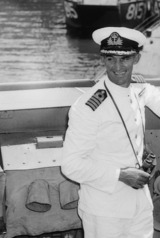
Ships
- HMAS Australia (D84) Captain from 29 October 1944 · Relieved on 6 August 1945
The day is right. The Australian Dictionary of Biography, which used his service file, gives it: he assumed command of the heavy cruiser HMAS Australia on 29 October 1944. He was already a substantive captain, promoted on 31 December 1942. This was his second Australia. He had been her executive officer from the outbreak of the war until March 1942. He had already commanded two armed merchant cruisers. The captain he replaced had been killed eight days earlier. In January 1945, while he commanded her, she took five suicide-aircraft hits in five days at Lingayen Gulf. The Dictionary says he left her on 6 August 1945. A Victorian naval website and a warship-command compilation say 5 August. One day, and it was not settled here against the log.
He is not Henry Jacques Armstrong, Jr., United States Navy. Nothing in the records opened here puts John Malet Armstrong in the United States Navy, at the Naval Academy, in Spence, or in Adams. He is not John H. Armstrong, Jr. He is not Aruga, Kosaku.
The navy is the Royal Australian Navy. The London Gazette says Royal Australian Navy every time it prints him. The ship is His Majesty's Australian Ship.
Where he came from
He was born on 5 January 1900 at Elizabeth Bay, Sydney, the younger child and only son of William George Armstrong, a medical practitioner, and Elizabeth Jane, née Garnsey. The Dictionary of Biography names his grandfathers as Richard Armstrong and Charles Garnsey. His father's own entry is more precise about the naval grandfather: William George was the eldest son of Lieutenant Richard Ramsay Armstrong, Royal Navy, and Eliza Susannah, née Malet, of Jersey. The middle name John carried was his grandmother's. A letter the premier of New South Wales wrote in 1945, as later printed by the Naval Historical Society, calls that grandfather a naval commander. The father's biography calls him a lieutenant. The biography is the better of the two on the rank. The Jersey blood is not in dispute.
William George Armstrong had been born at Leigh, in Essex, on 29 May 1859, had come to Sydney by way of New Zealand, and had married Elizabeth Jane Garnsey on 9 February 1888 at Christ Church St Laurence. He made his name in public health. After acting for a year, he was director-general of public health for New South Wales, and president of the Board of Health, from 1 July 1922 until he retired on 28 May 1924. He stayed on the board until 1941. He died at Vaucluse on 27 December 1941, cremated with Anglican rites, survived by his wife, a daughter, and the son John Malet. The daughter's name is not in that sentence. John was then still the commander, executive officer, of HMAS Australia, a few months short of leaving her. Whether the news reached him at sea, and what he did with it, is not in anything opened here.
The son's own biography says he was educated at Sydney Grammar School and at All Saints' College, Bathurst, and that in 1914 he entered the Royal Australian Naval College at Osborne House, Geelong. The college moved to Jervis Bay the next year. A funeral address read at St Brelade's, Jersey, on 6 January 1989 says he sat the college examinations at the end of 1913, that 189 boys applied and 31 were accepted, and that his was the second class through the college. Those numbers are the address. They were not checked against the college register. The two accounts can both be true — an examination in 1913, entry in 1914, at Geelong rather than at Jervis Bay — but only the Dictionary's version was tied by its author to the college history and the service file. He became a chief cadet captain, had colours for Rugby and swimming, and graduated in 1917.
The long making of a gunnery officer
He was appointed midshipman on 1 January 1918 and joined the battlecruiser HMAS Australia in April, at Scapa Flow. The officers were British. The funeral address, which calls him Jamie, says he remembered the sub-lieutenant in charge of the midshipmen telling a friend that the snotties were not a bad bunch of chaps, but that not one of them could speak like a gentleman. That is a story told at his funeral, not a line from a journal that was opened here. A Victorian naval website prints three commanding officers' words from 1918 and 1919 — Oliver Backhouse on 31 August 1918, "Intelligent, keen and hardworking... a zealous, intelligent and promising officer"; Thomas James on 31 December 1918, "Very conscientious in all his duties"; Claude Cumberlege on 19 November 1919, "A very keen and promising officer" — and presents them as extracts from reports. The service file, National Archives of Australia series A6769, item Armstrong J M, was not opened for this essay. The sentences stay second-hand.
Back in Australia he went to the light cruiser HMAS Brisbane in September 1919 and was promoted sub-lieutenant in October. Lieutenant in March 1921, and then Britain, for the courses that made him a gunnery officer. On 7 July 1924 he married Philippa Suzanne Marett at the parish church of St Brelade, on Jersey. The funeral address says she was one of the daughters of La Haule Manor, and that he promised her then that they would come back. The Dictionary records the marriage and the church. It does not record the promise. It does say that in the years after the wedding the long absences from a growing family were hard on him, that a junior officer's pay was not high, and that he relied on money from his father and from an uncle the article does not name.
The appointments that followed are given as a variety of sea and staff jobs in Britain and Australia, not as a day-by-day list. In 1927 he was the navy's guard commander for the opening of Parliament House in Canberra. In March 1929 he was promoted lieutenant commander while serving in HMS Castor on the China Station. Commander in June 1935. In 1937, as executive officer of HMS Shropshire, he was in the evacuation of refugees from the Spanish Civil War. The Dictionary says he briefly commanded the destroyer HMS Broke and her flotilla, and that the ship-handling stayed with him. A later website dates that command from July 1937 to January 1938 and does not mention Shropshire. How the two appointments sat inside the same year was not settled against the file. He came home in 1938 as executive officer of the naval college, by then at Flinders Naval Depot, Westernport.
The Dictionary's portrait, drawn from the Bulletin of 29 September 1954 and from people who knew him, is specific enough to use and not specific enough to treat as a diary. Known as Jock from childhood, and as Jamie by his wife and his fellow officers. "Inevitably 'Black Jack' to all hands, from hair, cliffy eyebrows and a dark general weathering burned-in over 40 years of naval service." Six feet, a nose broken playing Rugby. Many friends, able to move in all circles, dedicated to the profession, fearless under fire, and, by the same account, a man who preferred activity and practicality to staff work, "which was his distinct weakness." He thought young officers poorly educated, too isolated, over-supervised. Modest, the biographer says, humane, and a devoted family man. The funeral address, read by Michael Marett-Crosby, says there was extraordinarily little in his life for him to be ashamed of. That is an eulogy. It is not a finding.
The war, as he lived it
At the outbreak he was executive officer of the second HMAS Australia, the heavy cruiser, under Captain Robert Stewart, Royal Navy. The Dictionary's summary of 1939 and 1940 is escort of Australian Imperial Force convoys, patrols in Australian waters, and the Dakar operations against the Vichy French in July and September 1940. He did not command her there. The official history is about the ship. It is worth the length of what he was standing inside.
G. Hermon Gill records that on 23 September 1940 Australia, with the destroyers Fury and Greyhound, was sent after a Vichy destroyer off Gorée, at the entrance to Dakar. She opened fire at 4.27 p.m. The third salvo dismasted L'Audacieux. The fourth set her on fire forward. Stewart checked fire after the eighth salvo because he wished to avoid causing casualties. Two torpedoes were seen fired about the time of the fifth salvo. On 25 September, engaging cruisers inside the boom, Australia was hit twice aft by 6-inch shells while reversing course. Gill says no casualties and slight damage, an officers' galley and an engine-room store. During the withdrawal her Walrus was shot down. Gill names three of the crew lost: Flight Lieutenant G. J. I. Clarke, RAAF, Lieutenant-Commander F. K. Fogarty, RAN, and Petty Officer Telegraphist C. K. Bunnett, RAN. A 1989 article in the Naval Historical Review says the Walrus was lost with a crew of four. Gill's footnote names three. The ship's report, as Gill uses it, is the firmer count of the names. None of this was Armstrong's decision. It was the cruise he was second-in-command of, and the first time the official history puts that ship under fire with him aboard.
After Dakar she was with the Home Fleet, based on Greenock, mostly patrol and escort. On 29 October 1940, Gill writes, she rescued, in a gale and a high sea, nine of the crew of thirteen of a Sunderland which had force-landed west of the Hebrides. The Dictionary says Armstrong led a dozen sailors with bowlines over the side into the freezing water, and that the flying boat capsized as the ship came up. It calls the aircraft a Sutherland. That is a slip. Gill says Sunderland, and so does every other account that names the type. Gill does not name Armstrong. The personal role is the Dictionary's, written from the service file and from private information, not from a page of Gill.
The long retelling published in 1989 by Alan Zammit, who served in Australia under Armstrong in 1945 and so was not there in 1940, adds times, a position, and names, and quotes a midshipman. Zammit has the ship ordered to search at 8 a.m. on 29 October, a Force 8 gale, no radar, visibility of two or three miles, a signal at 2.20 p.m. of "Hurry up, cracking up," the flying boat sighted at 2.35 two miles on the port bow, and then the capsize. He names the nine: Flight Lieutenant Giddy, Pilot Officers Evans and Neugebauer, Sergeants Gough, Taylor and Cusworth, Leading Aircraftman Gay, and Mechanics Hicks and Bond. He has four men swept out of reach. A Victorian naval page, using the same narrative, gives the grave of those four as 60°50' North, 11°35' West. None of that detail is in Gill's two sentences. It is used here as Zammit's account, not as the ship's report read at first hand. What is secure is the date, the gale, nine of thirteen, a Sunderland west of the Hebrides, and, from the Dictionary, that the executive officer went over the side with a dozen men.
Australia spent much of 1941 escorting convoys and searching for raiders in the Indian Ocean. That year Armstrong was mentioned in despatches. The London Gazette of 1 July 1941, a Birthday Honours list, places Commander John Malet Armstrong, Royal Australian Navy, under a single heading that covers the whole list: outstanding zeal, patience and cheerfulness, and for never failing to set an example of wholehearted devotion to duty, without which the high tradition of the Royal Navy could not have been upheld. The Gazette does not, on the page, add "while serving in HMAS Australia." Later articles put those words in quotation marks as if they were his citation. They are a shortening of the general formula. The mention itself is real. The ship is known from the Dictionary, not from that page of the Gazette.
Recalled in December 1941, the cruiser operated from Nouméa with American forces. He left her in March 1942. The Dictionary says he then commanded, as an acting captain, the armed merchant cruisers Manoora from April to October and Westralia from October to December. A 1989 article calls Westralia a landing ship infantry at the moment he became her captain. The Dictionary calls her an armed merchant cruiser. Her later conversion is a different story from his command, and the landing-ship label is not followed here. Day-by-day limits for those two commands — 30 April to 26 October, and 30 October to 17 December — appear on a warship-command compilation and, for the acting rank, on a naval website. They were not read from a Navy List or from the file. What he did with either ship, and what the commands cost, is not in the sources that were opened. They are not given a battle they have not earned in the record.
On 31 December 1942 he was promoted substantive captain, while chief of staff to the flag officer-in-charge, Sydney. In November 1943 he was appointed naval officer-in-charge, New Guinea. A year of that shore command is almost a blank in print. The premier of New South Wales, William McKell, later wrote that in the early Pacific war Armstrong had come to weekly conferences as chief of staff, and that he had spoken for war loans, including at a rally in Rockefeller Center in New York. That is McKell's letter of 2 October 1945, as printed in 1989. The speeches were not found in a newspaper for this essay. The appointment was.
On 21 October 1944 a Japanese aircraft struck Australia at Leyte Gulf, wounded Commodore John Collins, and killed her commanding officer, Captain Emile Dechaineux, with others of her company. Armstrong was not in the ship that day. He assumed command on 29 October, eight days later. The funeral address says he was flown up as the replacement. The Dictionary does not say how he travelled. He took over a ship that had already buried her captain.
Lingayen
In January 1945 Australia supported the landings at Lingayen Gulf, on Luzon. Gill's chapter is built on the action reports. Armstrong's own report is quoted in it at length. This is the closest thing to his voice that was read.
On 5 January, about ninety miles west of Subic Bay, between fifty and sixty aircraft made runs on the bombardment group over two and a half hours. At 5.35 p.m. one of them, weaving in low with others, turned into a vertical dive and hit Australia on the port side of the upper deck amidships. It carried a bomb. The fire was quickly put out. Material damage was slight. The loss, the report says, was the men: some twenty-five killed and thirty wounded, the whole of one 4-inch gun's crew, eight of another, men from the Bofors and the multiple pompoms, most of the upper-deck ammunition parties, three officers killed and one wounded. Gill adds that the surgeon's journal and the other sources he could see did not establish which of the fatal casualties of this attack and of the next day's fell on which day. He therefore prints one list for both.
The ship bombarded on the 6th, with Shropshire, under Rear-Admiral Weyler, against Poro Point and San Fernando. At 5.34 p.m. a Val dived from the starboard quarter, flattened, and hit the upper deck between the two starboard 4-inch mountings. This aircraft also carried a bomb, which fragments suggested had been converted from a large-calibre shell. "A" boiler room was shut down for a time. The mounting that was hit lost both guns and all form of control. Fourteen killed and twenty-six wounded, the whole of one gun's crew and most of the other. After that, except for a special bombardment firing, there were crews enough for only one 4-inch mounting each side.
The 7th was quiet. She fired at railway sheds and at places where pillboxes might have been. On the 8th, last in the line going into the gulf, she took two more aircraft within a few minutes. At 7.20 a.m. a twin-engined plane was shot into the sea twenty yards off and skidded into the side. Little damage. At 7.39 a second was put down just short but hit on the waterline below the bridge. A hole fourteen feet by eight feet opened a provision room and an oil tank to the sea. She took a five-degree list. Flooding was brought under control. Casualties in these two attacks were minor, "mostly shock." The report says that was remarkable, because a lot of shrapnel, one engine, and a propeller came inboard. Blast from the forward 8-inch guns on the port side was straining the inner bulkheads, so those guns were not to be fired on that side except in emergency. She still met the scheduled bombardments.
On the 9th she finished her firings by 10.30 a.m. At 1.11 p.m. two aircraft came in from the east. One hit USS Mississippi. The other tried for Australia's bridge, missed, caught a wingtip on a mast strut, swung into the foremost funnel and went over the side. No casualties. The top third of the funnel was cut off. Two boilers were closed down and were back next day after a hole was cut in the damaged funnel. Gill, quoting the report: "So ended Australia's last operation in the war."
The arithmetic of the dead does not close neatly, and it should not be forced. The report as Gill quotes it gives some twenty-five killed on the 5th and fourteen on the 6th. Gill's footnote names forty-four men for the two days together, three of them officers: Sub-Lieutenant K. Levy, RANR, Lieutenant M. H. Marsh, RAN, and Lieutenant C. N. Russell, RAN, and then forty-one ratings, among them Able Seaman A. W. Lade. The 8th and the 9th, on the report, killed nobody. The Dictionary's figure for the operation is forty-four killed and sixty-nine wounded. A website that follows it says three officers and forty-one ratings killed, and one officer and sixty-eight ratings wounded. The report's wounded, thirty and then twenty-six, add to fifty-six before the "mostly shock" cases of the 8th. Forty-four dead is the number the named list and the Dictionary share. Sixty-nine wounded is the Dictionary's, not a sum that can be read straight off the two paragraphs Gill quotes. Gill himself could not make the surgeon's journal say which day each of the dead had died.
Armstrong's report, still as Gill prints it, does not describe his own nerve. It says they were lucky in casualties compared with other ships that had taken only one or two hits. Two of the attackers were put down before they hit. Two did not seem affected by the anti-aircraft fire. One missed his aim, which might have been the fire. The same number of hits from bombs or torpedoes would probably have done more damage. Then: "The behaviour of the ship's company which I have the honour to command was in accordance with the traditions of the service. They were steady under attack, and action to repair and make good damage was taken promptly and efficiently."
Other men's signals, which Gill also prints, were less spare. Vice-Admiral Oldendorf, of the bombardment group: "Your gallant conduct and that of your ship has been an inspiration to all of us. Sorry to lose you at this time." Later retellings cut that to the first sentence and date it 9 January. Rear-Admiral Berkey: "Sorry the Hell Birds concentrated on you. My deep regrets for losses in the stout ship's company." Weyler, forwarding the bombardment report: heavily hit three times, most of her dual-purpose battery out of commission, she nevertheless executed scheduled fires in her usual effective manner. Kinkaid, to the Commander-in-Chief of the United States Fleet: two minor and three major hits from suicide planes, damage and casualties notwithstanding, the fire schedule carried out satisfactorily, performance excellent. Zammit prints a sentence he attributes to the navigator, Commander Jack Mesley: as Armstrong stood on the forward end of the exposed open bridge, he didn't turn a hair. That is a recollection in a 1989 article, not the action report.
She was sent south, patched at Leyte, then to Manus and on for repairs. The Dictionary says she sailed for Plymouth in May, and that in New York in June she embarked McKell for the passage across. A naval website gives 24 May from Sydney and 1 July at Plymouth, and a story of Sunderlands of No. 10 Squadron dipping their wings as she came in, a salute to the 1940 rescue. Those dates and that salute were not in Gill's Lingayen chapter, which ends with the ship sent south, and they were not checked against a report of proceedings. The embarkation of McKell is in the Dictionary.
Zammit, who was in the ship, prints a letter Armstrong wrote on 28 January 1945 to the mother of Able Seaman Alan Lade, and says a letter of the same kind went to the next of kin of each of the men killed. In one place Zammit says forty-five men. The named list in Gill is forty-four. The letter, which Zammit says came from Lade's cousins Jean and David Hopkins, reads:
HMAS Australia, C/o G.P.O. January 28th, 1945. Dear Mrs Lade: I wish to convey to you my sincerest sympathy on the loss of your son who is missing and must be presumed killed in action in Lingayen Gulf in the Philippines. Your son was at his action station (a four inch gun) about 6 p.m. on January 6th and we were under air attack at the time. The gun was in action and firing at the enemy when it received almost direct hit. He must have been killed instantly and can have known nothing about it. A memorial service with full naval honours was held on our return to non operational waters on Sunday, January 14th. I realise what a great loss it must be to you and how young he must seem to have taken on man's responsibilities. He gave his life for his country and the freedom of the world and no man can do more. Knowing how much the men miss their shipmates I do extend to you their deepest sympathy and mine. Yours sincerely, J. Armstrong (Captain).
The original was not seen. Gill's account of the 6 January hit, at 5.34 p.m., on a 4-inch mounting, with that gun's crew wiped out, is the same hour and the same kind of gun the letter names, and Gill's list includes A. W. Lade. Zammit calls him twenty. The letter says "missing and must be presumed killed," which is the language of a man whose body had not been found, written three weeks later. The sentences about country and the freedom of the world are the sentences he chose to send a mother. They are not a speech. There is no record here of what he thought of them afterwards.
The London Gazette of 1 May 1945 made him a Companion of the Distinguished Service Order, for gallantry, skill and devotion to duty while serving in HM Australian Ships Australia, Shropshire, Arunta and Warramunga in the assault on Lingayen Gulf. The citation is the group's, not a paragraph about him alone. The United States awarded a Navy Cross. The Dictionary dates it 1946 and quotes only "gallantry and intrepidity." A compilation of foreign awards prints a fuller text and says it was published in the Commonwealth of Australia Gazette of 15 May 1947, page 1325. That gazette page was not opened. The text, as the compilation gives it, calls him Commodore 2nd Class and then, in the next sentence, Captain. In January 1945 he was a captain. By 1947, as the London Gazette of 1951 still styles him, he was Captain (Commodore Second Class). The rank in the American citation is the later style, or a confusion of styles. The action it describes is Lingayen: the ship heavily hit, heavy casualties, a large part of the anti-aircraft guns and the radar out, and the captain keeping her on her station and carrying out the bombardments. The dates in that printed citation run from 6 January to 9 January, which leaves out the hit of the 5th. Gill does not.
He gave up the cruiser, the Dictionary says, on 6 August 1945, "with the jocular 'Goodbye you pack of bastards.'" A website adds that there were tears in his eyes. The Dictionary does not. Neither is a deck-log entry that was read. He had been selected to command the aircraft carrier the Australian navy expected after the war, and he was sent to command the escort carriers HMS Ruler and HMS Vindex to learn the trade. McKell's letter of 2 October 1945 says he was then "presently in the service of the Royal Navy," which fits those ships. How long he had either of them is not stated in the Dictionary. The funeral address says "briefly."
What it cost, and what was refused
The cost that can be counted is the ship's company's, not his. Forty-four dead in the two heavy days, on the named list. His letters. A ship he had known as a young commander, given back to him with her captain already dead, and then hit five times while he was the man on the bridge. His report spends its adjectives on the sailors.
There was also a prize he did not get. McKell had taken passage in Australia to England. He was impressed. On 2 October 1945 he wrote to the lieutenant-governor, Sir Frederick Jordan, a reply meant for Lord Addison, Secretary of State for Dominion Affairs. Zammit prints it. McKell recommended Captain John Malet Armstrong for governor of New South Wales when Lord Wakehurst's term ended. Zammit's introduction says that term expired in 1936. That date is wrong on its face. Wakehurst was the man McKell was trying to replace in 1945, and the letter itself is about an appointment "in the near future." The letter praises Armstrong's address, his war-loan speeches, a speech at the Guildhall when the lord mayor received the officers and company, and the family's service to the state. It asks that the appointment be taken as recognition of the Australian armed forces.
The Dictionary says the Dominion Office rejected the nomination. Zammit prints what he presents as Addison's cable: of the names offered, including Armstrong's, Lieutenant-General Northcott was the only one Addison felt confident putting to the King; Northcott was not free; the King's brother-in-law, Michael Bowes-Lyon, was then proposed. Zammit says the Dominion Office wanted a man born in the United Kingdom and ruled Armstrong out for lack of seniority, and that Northcott's appointment as governor was announced on 1 April 1946. The cable, as printed, is not a document that was seen in a file. The outcome is corroborated by the Dictionary: the nomination failed. The funeral address says the Australian navy was not enthusiastic either, and that the matter lapsed. The Dictionary does not say that the navy opposed him. Two refusals are claimed. One is secure.
On 3 April 1946 he was appointed second naval member of the Naval Board, with the rank of commodore, second class. The Dictionary says a medical examination that year found him unfit for sea service, and that deteriorating eyesight and weak bones ended his prospects of further promotion. Zammit, in the June 1989 article, says naval medical officers classified him unfit for sea in 1946 and that this ended his chance of becoming an admiral. A website adds a broken arm, slow to heal because the same place had been broken before, selection as captain of the navy's first carrier HMAS Sydney, and a declaration of unfitness in July 1951 that kept him from that command. The arm, Sydney, and July 1951 are not in the Dictionary or in Zammit's article. They are not used here as fact. What those two sources agree on is enough: in 1946 the sea career stopped, by a doctor's finding, while he was still a man the navy had been schooling for a carrier.
The London Gazette of 7 June 1951, a Birthday honours list issued on the advice of Australian ministers, appointed Captain (Commodore Second Class) John Malet Armstrong, D.S.O., Royal Australian Navy, an Ordinary Commander of the Military Division of the Order of the British Empire. The Gazette gives no sentence of citation beyond the appointment. A website's date of 24 July 1950 for a "confirmed" promotion to commodore was not found in a gazette that was opened. In June 1951 the style was still captain, with the rank of commodore second class.
After
From 1948 he held staff appointments at Navy Office, Melbourne, and in London. In 1955 he became the Department of Supply's liaison officer in Washington. The funeral address calls the 1955 post Australian naval liaison officer. A website calls him Australia's first defence research and development representative. The Dictionary's title is the one cited to the service file. He retired on 14 August 1958.
The children, as the Dictionary gives them, were two sons and a daughter, all of whom survived him, as did Philippa. The related entries name one son, David Malet Armstrong. The funeral address names three: David, Philip, and Suzanne. The address is a family document, read by his wife's kinsman. It is the only place those two other names were read. No birth dates were opened.
From 1962 he and Philippa lived on Jersey. The funeral address says this kept the promise made at the wedding, in the house at La Haule she had inherited from her father, and that he was a little homesick for Australia. The Dictionary says he trained the Jersey Sea Scouts, fished, tended his gardens, and joined the Imperial Service Club and the Naval and Military Club in London. It does not mention the inheritance or the homesickness. A serious illness in 1980, the address says, greatly restricted him. Zammit, writing in March 1989, says he had been in failing health for eight years, which is the same span.
He died at home at La Haule. The Dictionary says 30 December 1988, aged 88, and that he was cremated, his ashes buried in the Marett family grave in the cemetery of the parish church at St Brelade. Zammit's article of March 1989 gives the same day. The funeral address, as printed by the Naval Historical Society and described as read on 6 January 1989, says he died on 20 December 1988. Both texts cannot be right. The later article and the Dictionary agree on the 30th. The address is the outlier, and it is the text that claims to have been read at the funeral. The ashes and the grave are in both the Dictionary and the address. Philippa survived him. The address's last judgement is that he had many friends and remarkably few enemies, and that he was a loving husband and father. Zammit, who had served under him, wrote that he was the most popular captain Zammit ever served with, and that in harbour he would walk the upper deck and talk to the sailors. Vice-Admiral M. W. Hudson, then Chief of Naval Staff, wrote to the effect that only a very professional officer could have taken a battered cruiser, still mourning Dechaineux, and kept her a front-line ship. Those are later voices. The sentence from 1945 that still sounds like the man is the one in the action report, about the people he commanded.