Ships
- HMAS Vendetta (D69) Captain from 9 December 1943
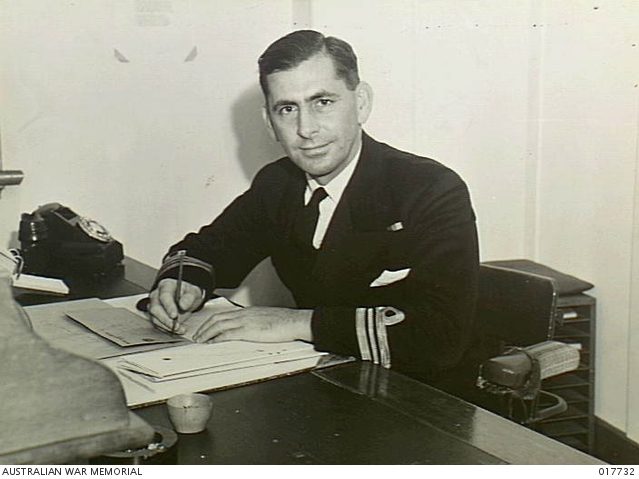
Jack Statton Mesley was born at Brunswick, Victoria, on 11 December 1910, a son of the schoolteacher Arthur Mesley and Annie Jeanette Catherine Mesley. Early in 1912 the family moved to Leongatha, where his father became the first headmaster of the new agricultural high school, and Jack attended the local primary school. On 1 January 1924 he entered the Royal Australian Naval College at Jervis Bay as a cadet midshipman. He finished at the top of his class, played in the college cricket, rugby, and hockey teams, and received colours for rugby and hockey. On passing out in 1927 he won the prize for the highest aggregate and stood first in navigation, mathematics, English, history, physics, and chemistry.
Rated midshipman in May 1928, he went to Britain for further training at the Royal Naval College, Greenwich, and in the ships Tiger, Marlborough, and Renown. He was promoted lieutenant on 1 February 1932 and specialised in navigation. In November 1939 he joined the cruiser Hawkins as navigating officer for service in the South Atlantic, and on 1 February 1940 he was promoted lieutenant commander. Hawkins afterwards worked off East Africa. She took part in the bombardment of Mogadishu and, in April 1941, in the capture of several Italian merchant ships off Kismayu.
In July 1941 Mesley travelled to Egypt and joined the light cruiser HMAS Hobart. In the eastern Mediterranean that year Hobart bombarded Bardia and Tobruk and carried troops to Cyprus and Beirut. He returned to Australia in November 1941 and joined the heavy cruiser HMAS Canberra in February 1942. Canberra was sunk off Savo Island on the night of 8–9 August 1942, at the start of the fighting in the Solomon Islands. The United States Navy rescued the survivors, and Mesley came home in the transport President Grant. He was appointed to the staff of the flag officer commanding in Sydney. In July 1943 he became staff officer (operations) at Port Moresby and, for a short period, naval officer in charge of the port.
On 9 December 1943, still a lieutenant commander, he took command of the destroyer HMAS Vendetta, an Admiralty V and W class ship with the pennant number D69, in succession to John Plunkett-Cole. The old destroyer had already seen hard service, and her wartime captains before him included Glen Loftus Cant, C. J. Stephenson, W. G. Whitting, and David Logan. Under Mesley she escorted convoys in Australian and New Guinea waters. On 10 December she left Brisbane with the American transport Cape Mendocino, took that ship out to a position well offshore, met HMAS Manoora near Lady Elliot Island, and reached Sydney on 13 December. He remained in command until late September 1944, when William Cook relieved him. Gilbert Gordon and William Tapp commanded Vendetta in the final year of the war.
From Vendetta he went briefly to Navy Office in Melbourne, then joined the heavy cruiser HMAS Australia in late November 1944 as squadron navigating officer. He was made acting commander on 23 November 1944. At Lingayen Gulf in January 1945 Australia was struck several times by Japanese kamikaze aircraft and continued in action. In March 1945 he joined HMAS Shropshire and took part in operations through the last months of the Pacific war. For that service he received the Distinguished Service Cross, announced in November 1945. He was confirmed as commander on 31 December 1945.
He remained in the Royal Australian Navy after the war. From 19 February 1947 he commanded the Sydney shore establishment HMAS Rushcutter, with duties that covered the reserves and recruiting. Promotion to captain came on 30 June 1953. He later commanded the naval air station HMAS Albatross for three years, and during that appointment he served as a naval aide-de-camp to the Queen. On 1 January 1965 he was appointed a Commander of the Order of the British Empire. In July 1965 he was promoted rear admiral and took up his last post, at Navy Office in Canberra, as Second Naval Member of the Naval Board and Chief of Naval Personnel. He retired on 7 December 1967.
Throughout the service he was known simply as Mes, and he left a reputation as an experienced officer at sea with a brisk and cheerful manner. He died at Darlinghurst, Sydney, on 24 February 1987. A service was held at HMAS Watson, and he was cremated. His wife and three sons survived him.