Ships
- HMAS Vendetta (D69) Captain from 29 September 1938
Origins
The name on the Navy's cards is Glen, not Glenn. Glen Loftus Cant was born on 7 June 1902 at Glenelg, Victoria, and the service record gives Sydney as his home port. On the last day of 1915, still short of fourteen, he joined the Royal Australian Naval College as a cadet midshipman. Later college rolls count him in the 1916 entry. The engagement written against his name was the ordinary long one: twelve years from the age of eighteen, and then such further service as the regulations required. Nothing on the cards says who his parents were, or what Glenelg meant to the family. The place is written as Victoria. That is the record, and it is also the first oddity in it.
He was a permanent officer of the Royal Australian Navy, not of the Royal Navy, though the Navy lent him to the Royal Navy twice before he was thirty. He is not the later officer Richard Glen Loftus Cant, born in Sydney on 12 March 1937, whose own card names "Cant Glen" as next of kin and who appears on the college roll as a 1951 entry. The American Navy lists of the 1930s and 1940s contain no Glen Loftus Cant.
Formation
The college kept him until 31 December 1919. The next day he was a midshipman, seniority 1 January 1920. The first fortnight was at Cerberus. From 15 January to 18 June 1920 he was in the cruiser Brisbane, then in Sydney from 19 June to 23 August, a short spell in the old cruiser Encounter from 24 August to 19 September, and back to Sydney from 20 September 1920 until 14 January 1921. A few days at Cerberus followed, then the London Depot from 29 January to 4 March 1921. The loan to the Royal Navy for service and training is entered as beginning on 15 January 1921.
What came next was the ordinary education of an Australian midshipman in British ships, written ship by ship. Conqueror, 5 March to 16 April 1921. The destroyer Walpole, 27 April 1921 to 3 January 1922. The next day, 4 January 1922, he joined the battlecruiser Hood, and he left her on 9 August 1922. He had been made acting sub-lieutenant on 1 May 1922. Hood was not a decoration on a biography. It was seven months of a midshipman's time, and it ended.
From 10 August 1922 to 3 January 1923 he was in the sloop Snapdragon. The miscellaneous side of his record says a watchkeeping certificate was granted on 30 January 1923, in Snapdragon. Sub-lieutenant, substantive, came on 15 December 1922. The card then puts him in President from 4 January to 5 July 1923, with the remark that this was the Royal Naval College at Greenwich; in Excellent, the gunnery school, from 6 July to 10 November 1923; and in Dryad, the navigation school, from 11 November 1923 to 26 March 1924. A sub-lieutenant's examination in ship, gunnery, navigation and torpedo is entered against a May date. The loan to the Royal Navy was terminated on 26 January 1924. He was a lieutenant from 15 December 1924.
Home, the work was small ships and depots. Additional to the depot ship Platypus for the destroyer Stalwart from May 1924, he was reappointed on promotion that December and stayed with Stalwart into the winter of 1925. Through the second half of 1925 and 1926 the cards carry him additional to Cerberus for a run of the old Australian destroyers, the remarks naming Yarra, Huon, Swan, Torrens and Tattoo, often for only weeks at a time. Platypus itself had him from 17 December 1926 to 26 February 1929. It was a long apprenticeship in ships that spent much of their lives in reserve, and it was how a lieutenant learned the Australian flotilla from the inside.
In 1929 the Navy sent him to England again, the remark on the card saying the passage was in the liner Otranto. Victory took him from 12 April. Vivid bore him additional for Iron Duke, and for her commissioning, at the end of April and the first days of May. He was in Iron Duke, on exchange service, from 11 May 1929 until early October 1930, the card marking much of it "time only." Victory again, briefly, and then the passage home, again annotated to Otranto, in November and December 1930. The second loan is entered as terminated on a minute dated 5 November 1930.
On 15 April 1931, in Sydney, he married Alice Jean Robertson. The next-of-kin line names his wife Alice Jean, at a Double Bay address. From 9 March to 31 December 1931 he was in the seaplane carrier Albatross. Through 1932 and 1933 Penguin had him, additional for the destroyers in reserve, in the groups the card numbers as the reserve flotilla. Lieutenant-commander came on 15 December 1932, and the same day the card notes that he was reappointed on promotion, still among those reserve destroyers.
The first command was short, and the card is unambiguous about it. From 5 to 26 October 1933 he was in Tattoo, "in command (on commissioning)." On 27 October he was back at Penguin, the remark reading that this was on paying off Tattoo, and he stayed there until 8 July 1934. Three weeks in command of a destroyer being brought out of reserve and then put away again: that was the whole of it.
Canberra had him from 9 July 1934 to 5 July 1936. Penguin and Cerberus filled the next year. On 28 June 1937 he joined Vendetta, and a note on the record calls him her intelligence officer. The destroyer command examination is written up on the same card, with the marks as entered: gunnery 352 out of 450, torpedo 83 per cent, navigation 81 per cent, signals 90.8 per cent, and a separate 79 per cent for custody of victualling stores. Vendetta paid off on 1 June 1938. Cant's attachment runs to that day. Another line carries him from 2 June to 28 September 1938; the ship on that line is not clearly written. On 29 September 1938 Vendetta recommissioned, and the Sea Power Centre's history of the ship says she did so under Lieutenant Commander Glen Loftus Cant.
War years as lived
The months before the war, in that same history, were mostly harbour, with exercises off New South Wales, and one cruise that was not an exercise. Vendetta carried the body of the former prime minister Joseph Lyons from Sydney to Devonport, Tasmania, where he was buried on 13 April 1939. The ship's history places that passage in the commission Cant had just begun. A photograph in the same history shows the flower-covered coffin on her quarterdeck on 11 April.
War with Germany was declared on 3 September 1939. On 14 October Stuart, Vendetta and Waterhen left Sydney for Singapore by Darwin and the Lombok Strait. Vampire and Voyager sailed from Fremantle to meet them. The flotilla was under Commander H. M. L. Waller, in Stuart. The intention had been training at Singapore. While the ships were still at sea the destination became the Mediterranean. Vendetta reached Malta on 14 December 1939. From 2 January 1940 the Australian destroyers formed the 19th Destroyer Division. The Sea Power Centre describes the work of that winter as routine escort and patrol, singly and in pairs, from one end of the Mediterranean to the other, in a sea the British and French fleets still controlled. Vendetta entered Alexandria for the first time on 12 January 1940. Until March her escort and patrol took her to Marseilles, Malta, Gibraltar and Haifa.
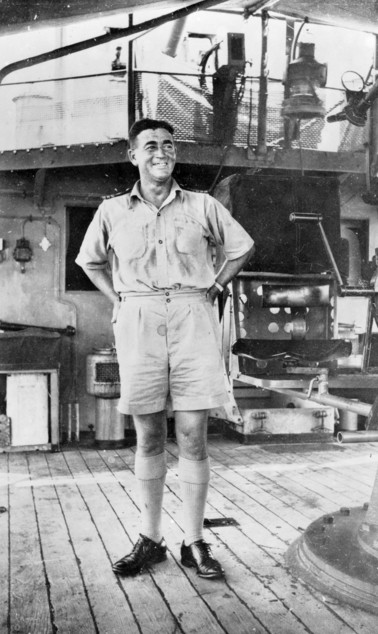
That is as far as the ship's narrative can be treated as his. The same history goes on, through the bombardment of Bardia, the Greece convoys, Matapan, the evacuation of the army, Crete and the Tobruk ferry, and it includes a photograph of Cant with his bridge team and a sentence that he and his ship's company were held in high esteem by Waller. It does not say on what day he ceased to be captain. His own card keeps him borne in Vendetta until 6 May 1940. Rodney Rhoades's biography in the Australian Dictionary of Biography says Rhoades was given command of Vendetta on 30 March 1940, and calls him Australia's youngest destroyer captain of his day. Secondary lists put a Lieutenant John Smallwood in the ship from 24 February to 29 March and end Cant on 23 February. Those lists are not the Navy's card.
What the card does say, in the margin beside the May entries, is that he was admitted to hospital with appendicitis, that he was progressing satisfactorily, that he was resurveyed and recommended to return to Australia for a period of light duty, and that he was to be granted a month's sick leave and resurveyed on arrival. From 7 May to 6 June 1940 he was at Cerberus, and from 7 June to 16 October at Penguin. Italy entered the war on 10 June. The fighting that made the Scrap Iron Flotilla famous was fought by Vendetta after the date on which his card takes him off her, and after the date on which Rhoades is said to have taken her.
Kybra appears next, as Penguin (tender) Kybra, from 16 October 1940 to 12 January 1941. The auxiliary had commissioned on 30 September 1940 under Lieutenant Commander Basil T. Brewster, as a tender to the anti-submarine school. The card does not say Cant commanded her. Penguin again, 13 January to 5 February 1941, then Brisbane until 11 June.
On 12 June 1941, at Maryborough, Queensland, the new Australian minesweeper Maryborough commissioned under Lieutenant Commander Glen L. Cant. The ship history is plain about that. She had been laid down at Walkers' yard on 16 April 1940 and launched on 17 October 1940. Cant's card shows him borne at Penguin, additional to Maryborough, from the commissioning day until 30 October 1941, and then in Maryborough herself from 31 October 1941 to 19 February 1942. On 10 November 1941 he was to be paid the rates of a commander, on promotion, while acting in that rank.
The ship's history says that after a short time on the east coast she went in November 1941 to Singapore, and that on 28 November she joined the 21st Minesweeping Flotilla. With six of her sisters she was in the Malayan, Javan and Sumatran operations that the same history carries through to 2 March 1942, when Maryborough left Tjilatjap for Fremantle. Cant's card does not carry him that far. It moves him to Leeuwin, the Fremantle depot, from 20 February to 29 October 1942, and the Maryborough bracket that marks his other periods in the ship is not on that line. A 2024 Naval Historical Review account, drawing on later histories of the ship, still calls him the flotilla commander who took Maryborough out of Tjilatjap with the Dutch ship General Verspyck. The service card and that story cannot both be right about the last days of February and the first days of March. What can be said is that he commissioned her, took her to the war that opened in December 1941, was an acting commander in her, and was still borne in her on 19 February 1942, four days after the fall of Singapore and thirteen days before the history has her sailing from Tjilatjap.
He was back in her books on 30 October 1942, additional, under the parent establishment Lanka, until 23 April 1943, and then under Nile, at Alexandria, from 24 April to 23 May 1943. The ship history has Maryborough leaving Fremantle on 3 November 1942 for Diego Garcia and the Eastern Fleet, and the next four months escorting between Colombo, Bombay and the Persian Gulf. In May 1943 she entered the Mediterranean. A photograph in the official history shows Lieutenant Commander G. L. Cant with his ship's company at Alexandria in 1943. On 24 May 1943 the card reverts him to lieutenant-commander. The Sicily landings, which the ship history includes in her five months in that sea, came after he had left her.
Platypus had him from 24 July 1943 until 12 August 1944. From 30 July 1943 he was again to be paid as an acting commander. Bungaree, the auxiliary minelayer by then employed on survey and transport, had him from 13 August to 3 December 1944. The card does not call that a command. Adelaide had him from 4 December 1944 to 25 February 1945, Penguin for a few days, and Melville, the Darwin depot, from 9 March 1945 to 9 March 1946. Katoomba overlaps that last attachment: 10 February to 25 November 1946. In the post-war months the ship history places Katoomba in the 20th Minesweeping Flotilla, working in New Guinea, New Britain and the Solomons, and in October 1946 at Sydney preparing to pay off. It does not name her captain. A compiled biography later calls Cant the flotilla commander. The card says where he was borne.
Cost
The record is a pattern of being given the ship at the beginning and being taken off her before the worst of it. He recommissioned Vendetta and took her out to the Mediterranean in the first months of the war. Appendicitis, hospital, and a recommendation for light duty in Australia sit on the card at the moment the Mediterranean ceased to be a quiet escort station. He commissioned Maryborough and was in her when the Pacific war began and Singapore fell. The card then puts him at Leeuwin for eight months, ashore at Fremantle, while the corvette he had brought into service spent 1942 on the Western Australian escort and, from November, with the Eastern Fleet. He rejoined her for the Indian Ocean winter and for a few weeks at Alexandria, and left again in May 1943, days before the reversion to his substantive rank and weeks before the ship's Sicilian work.
No decoration is entered on the cards read for this essay. The college roll's column for honours is blank beside his name. The Sea Power Centre's judgment, that Waller held him and his company in high esteem, is the one contemporary-flavoured assessment the official ship history offers, and it is not quoted from a letter or a report that could be checked here. On 19 December 1952 he applied to retire. The application was withdrawn. A marginal note records a war pension at 30 per cent from 9 July 1955, and names Parkinson's disease and lateral epicondylitis of the right elbow. The card does not say when either condition began, or what the war had to do with them beyond the fact of the pension.
After
The fighting appointments end in 1946, but the service does not. From 26 November 1946 to 29 May 1947 he was borne in the cruiser Australia. A remark on that line is about being paid as borne additional; the card, as read, does not say "in command," though a later biography says he commanded her and then paid off her sister Shropshire. The card does attach him to Shropshire from 30 May 1947. Later lines, less clearly dated, put him at Platypus, at Tarangau, and at Penguin, and a shore entry is dated 31 May 1955.
On 7 June 1947, his forty-fifth birthday, he was transferred to the Emergency List and reappointed for temporary service. That temporary service was terminated on 31 May 1955. On 1 June 1955 he was promoted commander on the Emergency List, with seniority of the same day. On 7 June 1962, his sixtieth birthday, he was transferred to the Retired List. The cards do not record his death, or where he lived after Double Bay, or whether Alice Jean Robertson survived him. They do record that a younger officer, Richard Glen Loftus Cant, carried the same two given names into the Navy a generation later, with Glen Cant named as next of kin. The wartime captain and that officer are not the same man.
What he left, on the paper the Navy kept, is a college boy of 1915 who learned his trade in Hood, in the reserve destroyers, and in a three-week command of Tattoo; who recommissioned Vendetta and commissioned Maryborough; who was acting commander while the second of those ships was in the war that began at Singapore; and who was a commander, at last and only on the Emergency List, in the decade after he had stopped going to sea.