Ships
- HMAS Quickmatch (G92) Captain from 14 September 1942
Rodney Rhoades (8 April 1909 – 22 November 1991) was an Australian naval officer, known to his shipmates as "Dusty," who at thirty became the youngest destroyer captain in the Royal Australian Navy of his day when he was given the Vendetta in March 1940, and who commissioned and commanded the Q-class destroyer Quickmatch from September 1942 to March 1944. In the Vendetta he escorted Mediterranean convoys, bombarded the Libyan coast, helped to evacuate Greece and Crete, and ran stores into besieged Tobruk, work for which he received the Distinguished Service Cross. In the Quickmatch he escorted convoys in British waters, the South Atlantic and the Indian Ocean. He retired from the Navy as a commodore, managed a charitable fund in Melbourne, and died at Hornsby, New South Wales, at eighty-two.
He was born on 8 April 1909 at Woollahra, Sydney, the youngest of four children of Walter James Rhoades, an English-born timber company manager, and Edith Laidley Rhoades, née Doddemeade, who was born in New South Wales. His father served in the British Army in the First World War, and his brother John, who joined the Australian Imperial Force, was killed in action. He attended Edgecliff Preparatory School and Mowbray House School in Sydney.
He entered the Royal Australian Naval College at Jervis Bay as a cadet midshipman in January 1923, at thirteen. He won the English prize on graduating in May 1927, according to the Australian Dictionary of Biography, and went to Britain as a midshipman, completing courses and serving in Royal Navy ships. He was promoted to sub-lieutenant in May 1930. In 1931 he came home and was posted to the heavy cruiser HMAS Australia.
On 5 December 1932 he married Valerie Myra Florence Williams, known as Val, at St Mark's Church, Darling Point, Sydney. From May 1935 to July 1936 he was seconded to the Royal Navy. In 1938 he served as aide-de-camp to the governor-general. A month after war broke out, in October 1939, he sailed for the Mediterranean in the destroyer HMAS Vampire.
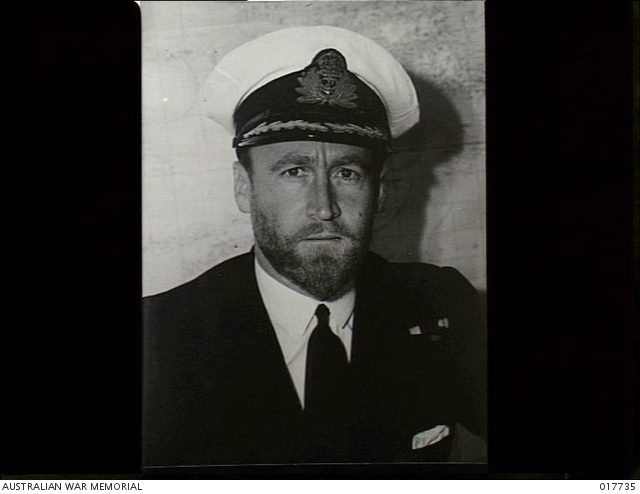
On 30 March 1940 he was given command of HMAS Vendetta, one of the old destroyers of the flotilla known as the "Scrap Iron Flotilla," a name given in mockery by German propagandists. He was thirty, nine days short of his thirty-first birthday, and a lieutenant; he was promoted lieutenant commander in July. In the eighteen months that followed, the Australian Dictionary of Biography says, the Vendetta escorted convoys, bombarded shore positions, evacuated troops from Greece and Crete, and ferried reinforcements into Tobruk, "regularly under fire." Operating from Alexandria and Mersa Matruh in the Tobruk run that sailors called the "spud run," an obituary in the Naval Historical Society's journal says, she delivered four thousand men and hundreds of tonnes of ammunition and supplies to the garrison in seven weeks. Damien Parer photographed Rhoades in 1940; the portrait is in the Australian War Memorial. He was awarded the Distinguished Service Cross, announced in December 1941, and mentioned in despatches, for what the biographer calls devotion to duty, courage and skill. The citation text was not examined here.
After a spell at home he sailed for Britain in April 1942 for the commissioning of the Quickmatch, which he was to command.
The Quickmatch was built at Cowes, on the Isle of Wight, and commissioned for the Royal Australian Navy on 14 September 1942, with Lieutenant Commander Rhoades in command. He was thirty-three. From October 1942 she worked as a convoy escort, first in British waters, then in the South Atlantic, and then in the Indian Ocean. In July 1943 she rescued survivors of a ship sunk by the German submarine U-177. In the Indian Ocean she was assigned to a force covering convoys between the Gulf of Aden and India. In May 1944 she joined the British Eastern Fleet and, shortly after, screened the carriers during the air raid on Japanese-held Surabaya.
In March 1944, aged thirty-four, Rhoades returned to shore duties in Australia, and in June he was promoted commander. His successors took the ship through the rest of the war: refit in Australia in the autumn of 1944, reassignment to the British Pacific Fleet in March 1945, and operations off Okinawa and the Japanese home islands. She earned six battle honours.
His later career is set out in the biographical dictionary. He commanded the frigate HMAS Shoalhaven in 1946 and 1947, then the shore establishment HMAS Moreton at Brisbane, and served as executive officer of the naval air station HMAS Albatross at Nowra. Seconded to the Royal Navy from 1950 to 1952, he commanded the destroyer HMS Opportune and, escorting the flotilla of King Frederick IX of Denmark during a royal visit to Britain, was appointed to the Danish Order of the Dannebrog. He was promoted captain on 30 June 1951. In December 1952 he took command of Albatross, and in 1955 and 1956 he commanded the 10th Destroyer Squadron in HMAS Tobruk, which for much of that time served with the British Commonwealth Far East Strategic Reserve. He then took command of the shore establishment HMAS Watson in Sydney.
His superiors were divided on him. According to the biographical dictionary, "some admirals, reporting on his performance as a captain, emphasised his excellent professional and personal qualities. Others, however, found him wanting in keenness and ambition in comparison with the most outstanding among his peers." By 1958 he had given up hope of becoming a flag officer. That year he was made Australia's defence representative to New Zealand, and he and his wife became popular in Wellington's diplomatic circle. New Zealand's minister for defence, Philip Connolly, commended his "sound advice, his frank and forceful approach to problems, and his willingness to help." Back in Australia in 1960 he was naval officer-in-charge for Western Australia, as a commodore, and then commodore superintendent of training at HMAS Cerberus.
He was transferred to the Emergency List of the Navy on 4 July 1963 and became director-secretary of the Melbourne Lord Mayor's Fund for Metropolitan Hospitals and Charities. From 1964 to 1967 he was a director of David Syme and Company, the owner of the Melbourne Age. A Melbourne newspaper described him walking along Collins Street to the Melbourne Club, "steering a straight course." Fishing and gardening were his recreations. He retired in 1975 and settled at Wahroonga, Sydney. He lost his eyesight but kept, the biographer says, "his renowned sense of humour." He was survived by his wife and one of their two daughters. He died at Hornsby on 22 November 1991, aged eighty-two; the Dictionary gives the cause of death as accident. He was cremated, and a funeral service was held at the chapel of HMAS Watson.
The Sydney Morning Herald of 27 November 1991 headed its obituary "The Man Who Fed Tobruk." It was the Vendetta, not the Quickmatch, that gave him that name.