Ships
- HMAS Vendetta (D69) Captain from 26 September 1944
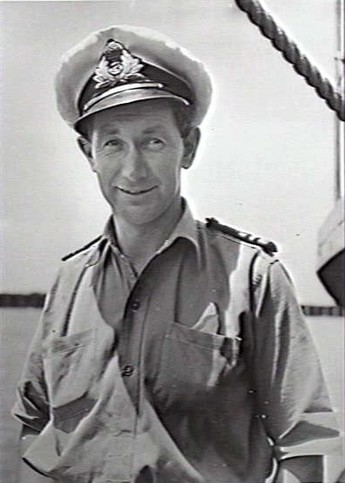
The initials expand. He is William Frank Cook, Royal Australian Navy, called Bill, later a Member of the Fourth Class of the Royal Victorian Order (the class later styled Lieutenant of that Order), Mentioned in Despatches, and, on retirement, honorary captain. He was born at Numurkah in northern Victoria in 1916 and died in November 2003, aged 87. No service number was found. Officers of his generation in that navy often had none.
Line 117, Cook, William, is not another man. The card is RAN and empty of ships. The Sea Power Centre history of HMAS Vendetta (I) drops the initials and says that on 26 September 1944 Lieutenant William Cook, RAN, assumed command. The officer who held that appointment wrote it himself, and signed the account William F. Cook. The college roll of entrants, 1913 to 1985, has one Cook of the wartime generation with the initials W. F.: male, entry 1930, graduated, final rank captain, Mentioned in Despatches. The London Gazette of 11 November 1941 and of 27 April 1954 prints the names in full, Lieutenant and then Commander William Frank Cook, Royal Australian Navy. The February 1945 report of proceedings of HMAS Nizam is signed W. F. Cook, lieutenant commander, commanding officer. Those are one career.
He is not line 114. That is his elder brother, Frederick Norton Cook, the 1919 college entry, Distinguished Service Cross and a mention in despatches, captain, who survived the sinking of HMS Royal Oak and died on 1 August 1985. Bill followed Fred into the college. They wrote to each other. They are not interchangeable. He is not line 115, Cook, L. B., whom the card file marks as United States Navy. The 1931 Lucky Bag gives that man as Lawrence Blanchard Cook of Nashua, New Hampshire, Naval Academy class of 1931. He is not Lieutenant (E) William Arthur Cook, Royal Australian Navy, appointed MBE in the birthday honours of 8 June 1950. That officer is engineer branch. No ship command of his was opened here. He is not William Frank Cooke of the Royal Marines, a different spelling and a different service, killed in 1944. A commander index on uboat.net lists temporary commands of Voyager in the winter of 1941–42 and of Nizam in the early summer of 1943. His own account says his first command was Vendetta in September 1944. Those temporary commands are not used below.
Origins
Scott Milson's obituary, taken from the Sydney Morning Herald of the Christmas weekend 26–28 December 2003 and reprinted in the Naval Historical Review of March 2004, says he was born at Numurkah in 1916. He does not give the day or the parents. In Vendetta, in the second half of October 1944, Cook noted a birthday party on board for his twenty-eighth birthday, given while the ship was at Madang and before she sailed on 31 October for the landing at Jacquinot Bay. A man who turned twenty-eight then was born in 1916, and the party sits in the last ten days of October. Compilations that print 20 October 1916 were not checked against a birth register. The day is left open. Parents are not named in anything opened here.
The family that is documented is the brother's. Frederick Norton Cook wrote to him from the Manor House at Buriton, in Hampshire, on 10 November 1939, "My Dear Old Bill," while Bill was in HMAS Perth. The letter says Bill was an uncle again. A niece, Venetia Bonham Norton, had been born at 3 p.m. on Saturday 4 November, eight pounds, fair, the hair a little gingery, blue eyes. Fred's wife is Bettie in that letter. The child is the Venetia Jones who, with Rhod Cook, later let an association article use the letter. Geoffrey Cole's article of 31 March 2016 thanks "Rhod Cook (son of Bill Cook)." That is the only child of William Frank Cook named in a source opened here. No wife is named. No marriage, and no other children, were found.
What the brother wrote him in November 1939 is also a picture of how the two of them stood. Fred had been sunk in Royal Oak at Scapa Flow on 14 October, had ordered Bill a Gieves waistcoat on Bill's own account because his own had not arrived in time, and spent the letter on how to get out of a ship that goes in minutes: a hammer under the bunk for scuttle clips, valuables ashore, Carley floats on slips rather than lanyards, because men at one in the morning do not carry knives. Bill, in Perth, was the younger one still to be told. The obituary says he followed Fred into the college in the face of fierce competition.
Formation
The college roll records the entry as 1930 and the exit as graduated, final rank captain. Milson says he was one of twelve boys in that intake, a class that later produced fighting commanders, a state governor and two admirals, and that he passed out as a midshipman in 1934 and joined the heavy cruiser HMAS Australia. The Australian National Maritime Museum's description of his midshipman's journal places him in Australia (II), lent with the ship into the Royal Navy's world, from January 1934 to July 1936, and says the journal carries his own maps and sketches of the voyage to England and the Mediterranean. The journal itself was not read.
In March 1996 he published, from the diary and the journal, the visit Australia and Sydney (II) paid to Gallipoli on 29 and 30 April 1936. The Turks were marking their own anniversary on the 25th, so the ships were allowed in afterwards. Australia sailed from Malta on 27 April and met Sydney in the Doro Channel, east of Athens, at 8 p.m. on the 28th. He had the morning watch on the 29th as they passed Imbros and Lemnos, entered the Dardanelles at 7 a.m., Cape Helles to port with the remains of the River Clyde, and anchored off Maidos. An official of the War Graves Commission and senior members of the Turkish People's Party came aboard. Half of each ship's company landed. His party, delayed until the chaplain could come, held a short service at Beach Cemetery. The captains laid wreaths. Then he ate what he called a pusser's cut lunch of salmon sandwiches above Anzac Cove, walked the beach and the lighters, and climbed Walker's Ridge, the Nek, Chunuk Bair, Quinn's Post, Lone Pine, Shrapnel Gully and Hell Spit. They were back at 7.30 p.m. He was born during the first war. The debris was still on the ground. He wrote that sixty years later the mixture of excitement and awe was still vivid, and that he could not see how the Anzacs had got off the beach. That is the earliest of his own voices, and it is a midshipman's, not a captain's.
Milson says two years in the Mediterranean followed the first English posting, then a year at the Royal Naval College, Greenwich, with meals in Wren's Painted Hall under the portraits of Drake and Nelson. No Navy List page was opened for the terms or the courses. By the time he sailed for England to commission Perth he was a lieutenant. His own account of that passage, given to the Naval Historical Society shortly before he died and printed in March 2004, names the six RAN officers who lived in the passenger accommodation of the Blue Funnel ship Autolycus: Commander D. H. Harries, Lieutenant Commander H. C. Wright, Lieutenant A. S. Storey, Lieutenant W. F. Cook, Lieutenant (E) L. N. Dine, and Surgeon Commander C. Downward. He joined her in Melbourne on 18 May 1939. He had already been in a small ship. When Captain H. B. Farncomb left HMAS Yarra for the United Kingdom and Perth, he asked Cook, then his sub-lieutenant, what he wanted next. Cook said he wanted to go to Perth with him. The dates of the Yarra time were not read from a list.
Autolycus sailed from Melbourne on 20 May, after the beer was embarked, with no absentees and one stowaway, landed at Albany. She called at Albany on 24 May and Durban on 8 June, coaled, crossed the line on 19 June, took water at Funchal on 25 June without leave, and arrived at Portsmouth on 29 June. The sailors' messes had been built into forward holds half full of cargo, wool as he remembered it. He admired the way they took it. On the last Saturday night at sea the RAN officers dined the ship's officers. Captain Hetherington of Autolycus conducted the band in the Maori Farewell. They went alongside HMS Amphion at North Wall and turned her into HMAS Perth. On 10 July the Duchess of Kent came aboard at 1.40 p.m., lunched with Farncomb, and renamed the ship on the quarterdeck. Stanley Bruce, the High Commissioner, and Admiral Sir William James, Commander-in-Chief at Portsmouth, were there. Perth sailed next day for trials at Spithead and left Portsmouth for New York on 26 July. He remembered a raw ship's company, because there had been no work-up in home waters, a small refusal to clear lower deck in the New York heat when white uniforms were insisted on, and Farncomb not being a man one took liberties with. He remembered a police escort to a march at the World's Fair, lunch at the Brooklyn Navy Yard, and a dessert glass so cold that it came apart when he touched it. They sailed on 16 August, leaving a painter, Chief Petty Officer Kinsella, in the naval hospital. In Kingston, in the last days of peace, he wrote later that they had been naive. The Czech crisis of 1938 had dulled them. If Chamberlain had bought peace once, why not again.
War years as lived
Lower deck was cleared during the forenoon of 3 September 1939. Farncomb, who did not make long speeches, read the Admiralty signal TOTAL GERMANY TOTAL, told them they were at war with Germany, and called for three cheers for the King. Cook wrote that the officers did not throw the wooden wardroom furniture overboard, and did not sharpen their swords. Perth stayed on the West Indies station. His second instalment, printed in June 2004, remembers ten days at sea and three or four in Kingston, banana loaders, rum in Coca-Cola bottles, a hurricane with him in the 6-inch control tower in the middle watch, Halifax and a rugger match, the Panama Canal, and a fuelling at sea that moved 242 tons in three and a half hours, a rate later sailors would smile at. Christmas at sea was happy, he wrote, despite the disappointment of men who had expected Australia. Tahiti was still unspoiled. In Sydney they were treated as returned men for a pleasant patrol. He was embarrassed by it. He stayed only a day or so after Captain Bowyer-Smyth relieved Farncomb. Farncomb asked him again what he wanted. The only war worth being in, Cook answered, was in the Mediterranean, and he asked for the 10th Destroyer Flotilla. He got it, in his recollection, in June or July 1940, in HMAS Voyager.
He joined Voyager at Alexandria on 25 August 1940 and relieved Lieutenant Commander A. G. Lewis as first lieutenant. It was his first destroyer. The armament, as he remembered it, was two twin Lewis guns, two 2-pounder pom-poms and four 4-inch low-angle guns, no match for high Italian aircraft, and in the days before radar the first news of a raid was often the splash. In Malta, during a refit, they took out the after triple torpedo tubes, put in a 3-inch high-angle gun, and the chief made an illegal bath out of steel sheet in the wardroom store. He respected the Maltese dockyard men who worked under the bombing.
Then the desert. Commando landings behind the Italian lines, supply, bombardments in which Voyager mostly escorted the monitor Terror and the gunboats Aphis, Cricket and Gnat, submarine alerts, a schooner taken at night trying to run the blockade. They were bombed on Christmas Day at Sollum while No. 3 Squadron RAAF, in Gladiators, went for Savoia 79s. He went ashore at Bardia and Derna soon after the army took them. There were runs on the screen of the battle fleet, and convoys to Athens with all-night leave. Then the evacuation of Greece. On the night of 24/25 April 1941, Anzac Day, Voyager took out 106 nurses of the 5th and 6th Australian General Hospitals from Nauplia. The officer commanding them was Lieutenant Colonel McDonald, later Sir Charles McDonald, Chancellor of the University of Sydney. They were bombed all the way to Crete, and the nurses were landed there. His letter of record is that sentence. He does not decorate it.
After Crete the ship went back to the desert and found Tobruk besieged. Voyager and Vendetta did the first "Spud Run" of the Tobruk ferry. They nearly ended the ferry for themselves that night: they could not find the way out through the boom and had to wait for daylight. A German aircraft sighted them soon after. They got back to Alexandria under a khamsin. After that the run was routine. Load at Alexandria, unload at Tobruk, take wounded to Mersa Matruh, load again, and so back. Two days in port, then the same again. The flotilla lost HMAS Waterhen and HMS Defender. On the last trip Voyager limped home on one engine at 17 knots. He wrote that the ship had had it.
The London Gazette of 11 November 1941, a third supplement, is the King's approval of rewards for gallantry and distinguished services in operations in Greek waters. The list runs through the Distinguished Service Order, the Distinguished Service Cross and the medal, and on the following pages through Mention in Despatches. In that mention is Lieutenant William Frank Cook, Royal Australian Navy, H.M.A.S. Voyager. The gazette does not say what he did. It puts him with the ships of that campaign, among them Stuart, Perth, Ajax and Orion. Milson ties the mention to the Greek campaign. The gazette itself is the award. The college roll records the mention and not the theatre.
They steamed home by Aden, Bombay, Colombo, Singapore, Surabaya, Darwin, Cairns, Townsville and Brisbane, and refitted in Sydney. In January 1942 he left on what he called a pierhead jump, took the Cunard liner Aquitania to Singapore, and arrived on 29 January. He stayed forty-eight hours, thankfully as he wrote it, and went on to find Nizam. Singapore fell about a fortnight later. The editor added that sentence. Cook does not describe the forty-eight hours.
Milson says that in 1942 he was posted as first lieutenant of the new fleet destroyer HMAS Nizam, and that a busy eighteen months followed in the Mediterranean and the Indian Ocean. That is the obituary's summary, not a cruise reconstructed from the ship's history. Nizam's battle honours and her operations under other commanding officers are not narrated here as his. He was the first lieutenant. What he himself chose to write down, in the memoir he left, jumps from the pierhead in Sydney to the day he joined Vendetta.
He joined Vendetta at Cockatoo Dock on 26 September 1944 and took over as commanding officer from Lieutenant Commander J. S. Mesley on 27 September. The Sea Power Centre's ship history says Lieutenant William Cook assumed command on 26 September, and that the ship had been in dockyard hands at Brisbane through September. His own account puts the handover at Cockatoo, a day after he joined. The two are the same appointment. They do not agree on the day, or on the yard. Neither is a deck log. His is a diary turned into a memoir and printed in September 2004. The Sea Power Centre page is a compiled history.
On 3 October they moved to Kurraba to oil, ammunitioned, and went out for trials on 5 October. They left Sydney on 9 October, fuelled at Brisbane on the 10th, and sailed on the 11th, long enough for him to see the Borovansky Ballet. They came through the China Strait on 14 October and into Milne Bay at 11 a.m., sailed for Langemak next day, and he noted the Ham and Veal Passage, where they used the asdic to range off the reefs. Later he found the dockyard had connected the training gear to the wrong leads. When they thought the oscillator was trained to starboard it was facing to port. He wrote down what that would have been worth if they had run aground.
They reached Madang on 17 October. He was proud, he wrote, to bring the old V and W alongside under the eye of Commander J. C. Morrow, his captain from Voyager, now Commander (D) of the escort forces working from Madang. They went on to Manus, exercised with a submarine on the 19th, and found the oscillator fault. Lieutenant Hinchliffe was the flotilla anti-submarine officer. Back at Madang they secured with an anchor down and a line to the coconut trees. There was bombardment practice. He went up in a Beaufort spotting for Swan. The pilot tried, and did not quite succeed, to make him ill. The birthday party fell in these days. Then, on 31 October, Operation Battleaxe: Morrow embarked in Vendetta, with Swan (Peter Hodges) and Barcoo (Colin Hill). They fuelled at Dredger Harbour, went into Langemak, slipped at 5.30 a.m. on 2 November for Lae, and left there at 7 p.m. with the two ships and a Liberty. They were off Jacquinot Bay, New Britain, before dawn on 4 November. There was no resistance. They anchored close in and landed the army. He went ashore with Morrow and Group Captain Lachell, stayed until midnight on 5/6 November, and at 6 a.m. on the 6th took up bombarding positions off Wide Bay. After twenty Beauforts had struck, they closed to 4,000 yards and fired. One target they took at 800 yards, for thirty minutes. The jungle hid the result. His diary remark, which he printed, was "What a war!"
They fuelled at Langemak and were back at Madang on 9 November. That day he got a signal confirming a buzz that he had been appointed commanding officer of Nizam, refitting in Melbourne. Lieutenant Commander Gilbert S. Gordon arrived later on the 9th and took over Vendetta officially on 11 November. The Sea Power Centre dates Gordon's assumption as 9 November. At 4 a.m. on the 12th the officers rowed Cook ashore in the whaler. He wrote that he was terribly proud the ship's company turned out at that hour to see him go. He had had the old destroyer for six weeks.
The Naval Historical Society's daybook says that on 5 December 1944 Lieutenant W. F. Cook was appointed to command Nizam, and that at 28 he was the youngest officer appointed to command an Australian fleet destroyer. His own diary puts the confirming signal at Madang on 9 November. The Sea Power Centre says the ship was under refit in Melbourne from 3 November 1944 to 31 January 1945, and that on 1 February 1945 Lieutenant Commander W. F. Cook assumed command. The February report of proceedings, which he signed, begins on 1 February with the ship already his: at 9 a.m. she slipped, carried out full-calibre firings at a pattern VI target in Port Phillip Bay, and secured alongside Nelson Pier at noon. It does not contain a sentence that says "I assumed command today." The appointment and the assumption are three dates in three kinds of record: his signal of 9 November, the daybook's 5 December, and the ship's history's 1 February, with the report of proceedings showing him in command from the first day of that month. Milson says he had barely unpacked in Vendetta before he was given his old ship, and that at 28 he was the youngest destroyer captain in the navy. "Captain" there is the appointment, not the rank. The rank he signed in February was lieutenant commander.
The February report is the cost of the appointment. Dockyard work on both main feed pumps went on from 2 to 6 February. On the 7th she slipped at 6 a.m. for trials, swung ship at 9.20, and secured again at Nelson Pier. On the 8th the dockyard men were put ashore at 11.50 p.m. after bedding down the port main feed pump, and the ship's staff finished the installation. At 0001 on the 9th she slipped for Fremantle. At 10.11 p.m. on the 11th the course was altered from 306 degrees to 000. At 10.15 p.m., in a position 090 degrees, 12 miles from Cape Leeuwin light, she rolled very heavily to port, 75 to 80 degrees. The wind was east, force 7. Sea and swell were 64. Weather and visibility were b/7. He thought the roll was a freak wave, from an excessive piling up of the seas. His signal 120526Z February, his letter 08/5 of 13 February, and the Naval Officer-in-Charge at Fremantle's 120947Z refer. The letter was not separately transcribed here. The report is in his words as commanding officer, filed as a duplicate in Australian War Memorial series AWM78, class 277, item 3.
She reached Fremantle on the 12th and secured to the tanker British Rose at 3.14 p.m., then moved to G and H ramp at 7.35. The damage list is long because the port side had been in the water. The low-power switchboard was renovated. Ventilation fans to the engine room, from the engine room, to the radar cabinet, to the petty officers' mess, to the torpedomen's messdeck and to the seamen's heads had been immersed and needed new field coils and rewound armatures. The torpedo hoisting winch, the cordite hoist and the 20-inch signal projector had been under. Spare bearings went into the starboard high-pressure turbine. Both boilers were opened and washed through. The sheer strake at the break of the forecastle was cracked and a butt strap fitted. Port Oerlikon shields and a twin Oerlikon platform were straightened or rebuilt. On 18 February a memorial service was held on the wharf alongside the ship. The Reverend N. Paynter, chaplain, RAN, conducted it. On 19 February a board of enquiry sat in the ship. Commander C. H. Brooks, RAN, was president. Brooks is the officer the Sea Power Centre names as having relieved Nizam's commanding officer in January 1943, while Cook, on the obituary's dating, was still her first lieutenant. The report says the conduct and health of the ship's company that month were very satisfactory. She had steamed 1,916 miles in 101 hours. Western Australian natives were given seven days' leave.
The signal to the Australian Commonwealth Naval Board, from Nizam, timed 120826Z February 1945, says he regretted to inform them that the following ratings had been lost overboard in bad weather off Cape Leeuwin on the night of 11 February, and that a full report would follow by air. The typescript in the file is faint. A compiled casualty list of Royal and Dominion Navy dead for 11 February 1945, the naval-history.net transcription, names the ten as missing, presumed killed, lost overboard from Nizam, and gives service numbers that match the shape of the signal. They were Acting Leading Seaman Colin S. Ryder, W 1225; Ordinary Seaman Garnet J. Hill, H 2725; Ordinary Seaman John S. Wallace-Barnett, B 5081; Able Seaman Victor C. Keys, S 7606; Able Seaman Alfred G. Kerr, S 8275; Able Seaman Allen W. Milich, PA 2184; Ordinary Seaman Keith J. Mills, PA 4702; Ordinary Seaman Leslie A. Holloway, PA 4696; Able Seaman Vincent G. Richardson, PM 4069; and Stoker John Poulton, PA 4871. All are marked RANR. The signal, as read from the scan, gives next of kin: a wife at Altona in Victoria for the leading seaman; fathers at Evandale in Tasmania and in Brisbane; mothers at Tamworth, Dawes Point, Loxton or a name read as Lorton in South Australia, Albert Park, Eudunda, North Carlton, and Semaphore Park. Where the scan and the compilation disagree on a surname or a digit, the compilation is the one used for the names above, and the disagreement is left in the last section. Ten men. He had been in command of a fleet destroyer for eleven days.
She lay at Fremantle making good the damage until 7 March, slipped from G shed at 8.25 a.m., and entered Sydney on 14 March, Kurraba and then No. 1 berth, Farm Cove. The rest of March was defects and a short, bad escort of HMS Formidable. On 22 March a Corsair crashed. The seaboat searched until Formidable recalled it. No trace of the pilot was seen. Speed had to be cut to 22 knots. A full-power trial on 26 March reached 315 revolutions, which he logged as 30 knots. She secured alongside HMAS Shropshire for evaporator and condenser repairs. On 1 April she followed Nepal out of Sydney, fired full calibre, and went north with Napier and Norman. On 9 April an explosion and petrol fire in Glenearn, in company, caused about forty casualties, and the force altered for Hollandia to land the serious ones. Nizam entered San Pedro Bay, Leyte, on 13 April.
On 26 April a rating went to the hospital ship Maunganui. His complaint was diagnosed as acute anterior poliomyelitis. Another case was admitted on 1 May, and two more on 4 May. Nizam was placed in quarantine and pronounced unfit for operational service. Between 4 and 9 May ten ratings were discharged to the hospital ship. All of those proved negative, and the diagnosis was changed to pharyngitis. On 9 May she exercised in the gulf anyway. Full-calibre high-angle and short-range firings were carried out. The new Bofors accounted for one target. She streamed and recovered TSDS, eighty-five minutes each way, and exercised anti-submarine with Burnie towing an Oropesa target. Temperature gradients in the gulf were marked. The target, he wrote, was useful for want of something better. Because the hospital ship Tjitjalengka would be nearby, the Rear Admiral (Destroyers), British Pacific Fleet, let her operate with the Logistic Support Group for Task Force 57. She went with Task Unit 112.2.5, Striker, Parrett, and the oilers Wave King and Wave Monarch. Off Leyte they sank a prefabricated pontoon section that was a menace to navigation. On 15 May an injured rating was transferred to Striker in a cot on a flying fox. Both main feed pumps were again out of action. Speed was restricted to 25 knots. The refits at Melbourne and Fremantle had not cured them. On 23 May she sailed with HMS Tyne for Manus and then Sydney, and entered on 4 June for the fleet's replenishment. The May report says that in spite of quarantine and a large amount of harbour time, conduct was very good and morale stayed high, and that the mail service had been of great value. June was stores, four days' leave to each watch, boiler cleaning, docking at Mort's Dock at Balmain from 18 to 22 June, a Bofors fitted on the searchlight platform, and trials of the port main feed pump. She sailed with the 7th Destroyer Flotilla for Manus via Milne Bay on 28 June.
Through July she was with the logistic groups and the fleet train, escorting escort carriers that ferried aircraft to the strikes. The Sea Power Centre narrative of those weeks was not copied into this essay beyond what his later writing and the reports confirm about August and September. On 15 August 1945 he was in Nizam as anti-kamikaze destroyer, covering a carrier of the British Pacific Fleet, itself a task group inside Halsey's Third Fleet. In the Naval Historical Review of September 1995 he printed the signals of those days and described the morning. Strikes had gone on after the first news, early on 12 August, that agreement on surrender terms had been reached. They stopped on the 15th, when the flag hoist was "Cease Hostilities with Japan — Splice the mainbrace." As the flags went up there was a Flash Red. A kamikaze, intercepted by the fighter cover, was shot down and fell close to the carrier they were covering. Milson's obituary adds a signal he says Nizam and others received: any enemy aircraft approaching the fleet was to be shot down in a very friendly manner. That sentence is the obituary's. It is not in the selection of signals Cook printed.
John Pacini, a war correspondent in Napier, writing at the time and reprinted by the Naval Historical Society in 1974, names Lieutenant Commander W. F. Cook, of Victoria, as captain of Nizam in a photograph with Stephenson of Nepal and Plunkett-Cole of Norman, and describes the boarding, just before the peace, of a ship challenged at night and found at first light to be flying a Japanese ensign and painted with red crosses. Pacini calls her the hospital ship Kiku Maru, bound for the Marcus Islands. The Sea Power Centre spells the name Kiru Maru and dates the investigation 2 August, before the surrender. A boarding party went by whaler. Nobody in it spoke Japanese. The Japanese captain had a dictionary and could explain the destination. The log could not be translated. Pacini reports matting mattresses two inches thick on the deck, no operating theatre, one small operating table, one refrigerator, no blood serum or plasma seen, a clean ship, and a bottle of sake offered to the boarding officer and refused. An American destroyer, he adds, later boarded another hospital ship and found arms. The two spellings and the date are left in conflict. The boarding itself is contemporary.
The September report of proceedings, signed in the same file, opens with Nizam at anchor in Tokyo Bay in company with the British Pacific Fleet, the Royal Australian Navy squadron and the United States Third Fleet. On 2 September, in USS Missouri, the Japanese delegates signed the instrument of surrender. Nizam was duty destroyer. She made three trips between the fleet anchorage and ships anchored off Tokyo, and carried recovered Allied military personnel. The ship's company listened to them. At 2.45 p.m. on 3 September HMS Speaker took the first of them to sea, and the ships manned and cheered her. The officers and ratings who had been in the British landing force at Yokosuka returned on 5 September. On the 6th, still duty destroyer, she made three trips into Yokohama and landed a Royal Marine guard for the British Consulate. The Naval Historical Society's daybook for 30 August says Nizam, with Cook in command, led Napier in behind HMS King George V, and that they were the first RAN ships into the port after hostilities ceased. The Sea Power Centre says Task Force 37 moved into the bay on 27 August, and that Nizam there met Shropshire, Hobart, Warramunga and Bataan. Cook's own 1994 account says she had been in Tokyo Bay since 30 August when she sailed on 12 September. The September report supports his presence for the signing. It does not say she was the first RAN ship in, and it does not date the entry. The "first in" claim is the daybook's, not the report's.
On 12 September, at 11 a.m., she sailed with HMNZS Gambia for detached duty with the United States Fifth Fleet at Wakayama, to meet prisoners coming down by rail. It was, he wrote in 1994, their first night at sea in peacetime since 2 September 1939, and the pipe to place oil and steaming lights puzzled everyone but the oldest hands. An American destroyer escort led them in through a channel only lately swept. They anchored in Wakanoura Wan at 3.30 p.m. on the 13th. Rear Admiral Biggs, USN, in USS Montpelier, was the senior officer present afloat. On the 14th a reception party went ashore. There were more Australians than expected, so the party was increased. The report says the organisation bathed them, examined them, clothed them, fed them, took particulars and let them send messages. Men were glad to see HMAS on the cap tallies. Among the Australians were four ratings, survivors of HMAS Perth, with whom he had been shipmates at the start of the war. Next day, in his later account, they came aboard for Sunday divisions and prayers, the first shipboard service of that kind for them in more than three and a half years. Embarkation into the hospital ships Consolation and Sanctuary was finished by the afternoon of the 15th.
Warnings of a typhoon came on Sunday the 16th. In the 1994 account the captain of Gambia and his meteorological officer came across and briefed him. They thought the storm might recurve over Wakayama. The anchorage was reasonably safe, and the way out to sea was restricted, so Gambia advised him to stay. The report says that during the afternoon of the 17th the wind came up from the south-west, that she was lying to six shackles in eleven fathoms with steam at immediate notice, and that by 10 p.m. the wind was above gale force. USS Floyds Bay recorded, between 9 and 10 p.m., an average of fifty knots with gusts to sixty-five, and in the hour from 11 p.m. to midnight an average of sixty-five with gusts to eighty-five. Rain cut visibility at times to about 200 yards. The wind raised a short steep sea that swept the forecastle while the ship was almost stopped. The largest roll recorded in the engine room, during later steaming at slow speed in the harbour, was thirty degrees.
At about 10.30 p.m. she began to drag. He had not dropped the second anchor. He thought it would be more of a liability than an asset, and he later thought that judgment had been right. Thirty or forty small American vessels had weighed after dragging and were steaming slowly round Consolation, whose lights made her a beacon and, he wrote, lived up to her name. Even her outline disappeared at times at three cables. She yawed sixty degrees on her cable. With what the Americans later called some hundred fathoms of chain out, she dragged a couple of cables in the night. He weighed, tried twice for an anchorage under the southern shore, and dragged each time before the cable could hold. At the last attempt the capstan showed fatigue. He left Wakanoura Wan for the more open water of the Kii Suido. To turn into the wind, wheel hard over, he ordered slow ahead on the weather engine and half ahead, 180 revolutions, on the lee. The rest of the night was spent at slow speed off the bay, avoiding small craft. Gambia, in a deeper berth with more room, had also dragged, as he thought most of the American ships had. The report estimates that the centre passed forty to fifty miles to the westward of Wakayama. The 1994 reprint says 405 miles. That figure does not match the report he signed in 1945, and it is treated here as a printer's error unless a later correction turns up. The wind eased on the 18th. In the afternoon she anchored in her original berth. Three light craft were left high and dry, seven American officers and men were lost, and a PBM flying boat was destroyed. His later account adds the explanation of the capstan: while weighing, the anchor had twisted and both flukes had caught under the forefoot, so the capstan was trying to haul the ship up through the hawsepipe. He had been on the bridge all night. He wrote that he was more worried about grounding than about the small vessels, because he was bigger than they were, and that no dawn had ever looked so beautiful.
On the 19th Gambia and Nizam went back to Tokyo and Task Force 37. She lay alongside Nepal at No. 9 buoy in Yokohama on the 22nd and 23rd, and landed parties so that all hands could see what was left of the port. At 1 p.m. on the 24th she sailed for Guam with mails and despatches, fuelled at Port Apra, went on to Manus, and left Manus at 5 p.m. on the 29th by the Jomard route for Sydney. The conduct of the ship's company that month was very satisfactory. A mild influenza went through the messdecks. Distance steamed in September was 3,601.4 miles. The Sea Power Centre says that on 17 October 1945 her commission in the Royal Australian Navy ended, that she paid off and recommissioned the same day as HMS Nizam, and that her complement transferred to HMAS Quadrant. The reports in the file opened here run through September. They do not include an October report, so the last month is the ship history's, not a report signed under his hand in the bundle that was read.
After
The Sea Power Centre history of HMAS Quadrant says she commissioned at Sydney on 18 October 1945 under the command of Acting Lieutenant Commander William F. Cook, RAN. That is the day after Nizam went back to the Royal Navy, and it matches the transfer of the complement. The page does not say how long he kept her. She paid off into reserve at Sydney on 20 June 1947, having steamed 39,093.2 miles in that first RAN commission. Other commanding officers are not named until the ship recommissioned as a frigate in 1953. His command is the commissioning. The rest of her career, the tow to Melbourne, the conversion, the royal yacht escort in 1954, is not his unless a later list puts him there, and none opened here does. The rank on the Quadrant page is acting lieutenant commander. In February 1945 he had signed himself lieutenant commander, without "acting." The difference is noted and not resolved. No Navy List was opened.
In June 1947 he joined HMAS Wyatt Earp as first lieutenant, while she was still a gutted hulk on the slipway at Adelaide. His account was printed in the Naval Historical Review in December 1978. The ship had been the Norwegian herring boat Fanefjord, bought and renamed by Lincoln Ellsworth, bought by the Commonwealth in 1939, and used in the war as HMAS Wongala. She was recommissioned Wyatt Earp for the first postwar Australian expedition to the Antarctic. The nickname on board was the Twerp. The captain was Commander K. E. Oom, who joined later. The scientific staff was led by P. G. Law. Cook had a notice painted for the wardroom, Drake's line that the gentlemen must haul and draw with the mariners and the mariners with the gentlemen. After storing at Hobart he wrote home that the hauling ruined one's hands. They sailed from Adelaide on 13 December 1947 after one day's trials, weeks late, took water through the side in Bass Strait, put the gyro out by flooding, broke the steering, and were ordered back from the Southern Ocean on New Year's Day 1948 after their wireless reports worried the Naval Board. A second sailing, on 8 February, got them to the pack ice, the Balleny Islands, and a running survey, and not to the continent. The pack off Adélie Land and King George V Land did not open. The Kingfisher seaplane flew twice, on 13 March, and confirmed unbroken ice to the south. He thought the two hours spent crossing the shelf off Macquarie Island in a westerly gale, on 24 March, the most dangerous of the voyage. They anchored off Portarlington on 31 March and reached Port Melbourne at 9 a.m. on 1 April. Nobody was seriously hurt. She paid off in June 1948. He was the first lieutenant, not the captain. The decisions to turn back, to stay out of the pack at night, and to fly or not fly were Oom's. Cook's writing is the wet cabins, the sail that slowed the roll by two seconds, and the pride he took in piping hands to sailing stations.
Milson says that later his qualities helped his selection as RAN escort officer for the Queen's 1954 tour, and that for it he was appointed a Lieutenant of the Royal Victorian Order. The London Gazette of 27 April 1954, in the list of appointments to the Royal Victorian Order made for that Australian visit, places Commander William Frank Cook, Royal Australian Navy, among the Members of the Fourth Class, to be dated 1 April 1954. The Fourth Class was restyled Lieutenant in 1984, which is why later notices, including his own byline and the obituary, say LVO. The gazette does not recite the duties. The obituary does. For the next three years, Milson says, he helped oversee the fitting out of the aircraft carrier HMAS Melbourne and, on her commissioning in the United Kingdom as the RAN's new flagship, became her commander, the executive officer. No ship's book was opened for that appointment. In 1960 he resigned. The Australian National Maritime Museum's catalogue of his appointment papers describes a letter from the Department of the Navy, 18 August 1960, accepting the resignation of Acting Captain W. F. Cook, and says his discharge to shore from HMAS Kuttabul would be 30 October 1960. A further letter of 20 October 1960, in the same catalogue, approves the honorary rank of captain. The letters themselves were not read. The catalogue is a description of them.
Milson says the resignation opened a second career at the heart of the Sydney legal world, and that he finally retired in 1985, the retirement being relative. The Bar Association obituary in the winter 2004 Bar News was not opened, so the admission, the chambers and the years as a registrar, if those are what that page says, are not repeated here. What is in Milson is the Naval Historical Society, of which he was president from 1994 to 1997, the N-class destroyers' association, which he led on Anzac Day as the last surviving skipper of the five Australian N-class ships, and the RAN Ski Club. Milson says there were few parts of Australia he had not travelled or walked, and that family, friends, old shipmates and former colleagues filled the Naval Chapel at Garden Island for the memorial. He had died in November 2003, aged 87.