Ships
- IJN Yamato Aboard, not her captain, 7 April 1945
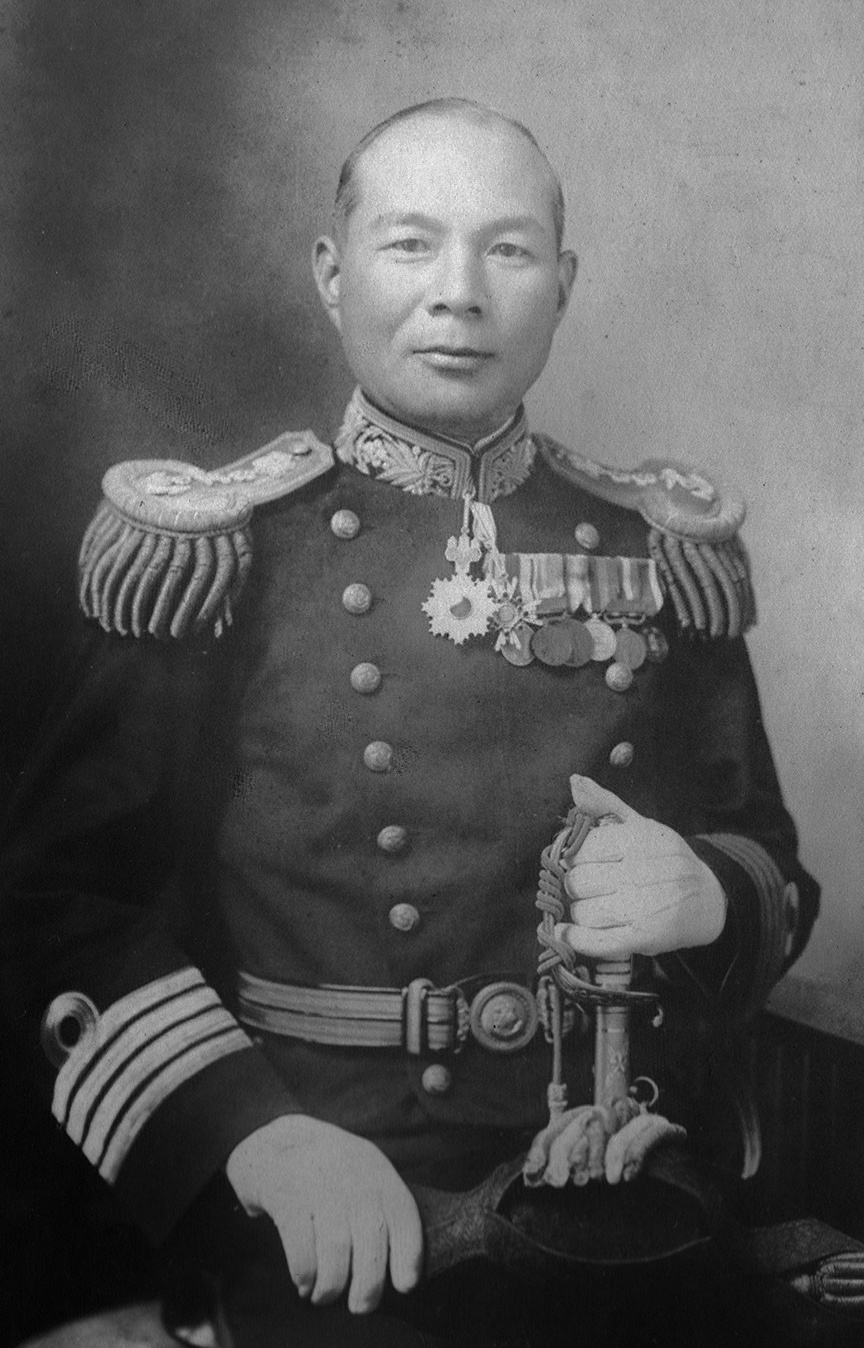
Matome Ugaki was born on 15 February 1890 to a farming family in Akaiwa District, Okayama Prefecture. He entered the Imperial Japanese Naval Academy in 1909 and graduated in July 1912, ninth in a class of 144. As a midshipman he trained in the armored cruiser Azuma and the cruiser Hirado. In the First World War he was aboard the battlecruiser Ibuki for the hunt for the German cruiser Emden and for the long escorts that carried Australian and New Zealand troops across the Indian Ocean. Later tours took him to the battlecruiser Kongo, to a training cruise along the west coast of North America in the armored cruiser Iwate, and to the destroyer Nara at the end of the war.
Gunnery became his trade. After he made lieutenant he went through the naval gunnery school, served as gunnery officer of the destroyer Minekaze, and returned to Kongo in the same line of work. In 1924 he finished the Naval Staff College. Staff duty, a further stretch at the gunnery school, and two years as a resident officer in Germany followed, and he came home to the staff of the Second Fleet and then to a teaching post at the Naval Staff College. He reached captain in 1932. His first command was the training ship Yakumo, which he took on a cadet cruise to Suez and the Mediterranean in 1937. That December he took the battleship Hyuga for a tour spent on the blockade off southern China. Promoted to rear admiral in November 1938, he became director of the operations bureau of the Naval General Staff the next month.
In April 1941 he was given Cruiser Division 8, the heavy cruisers Tone and Chikuma. In August he became chief of staff of the Combined Fleet under Isoroku Yamamoto, and he stayed in that post until Yamamoto was killed. From the flagship he took a large part in planning the Pearl Harbor strike, and he kept the staff plot through the long turn of the war that followed, including Midway, where the Main Body under Yamamoto remained far behind the carriers. He was promoted to vice admiral on 1 November 1942. On 18 April 1943 he and Yamamoto left Rabaul in separate bombers for an inspection of forward bases. American fighters shot both aircraft down over Bougainville. Yamamoto was killed in the jungle. Ugaki's bomber went into the sea at high speed. He lived, badly hurt, one of three men from that aircraft who survived, and in May he was attached to the Naval General Staff while he recovered.
On 25 February 1944 he took command of Battleship Division 1, Nagato, Yamato, and Musashi. The flag opened in Nagato and moved to Yamato early in May. Nobuei Morishita commanded Yamato while Ugaki's flag flew in her. After American troops landed on Biak, Ugaki argued hard for a relief of the island, and in June the navy gave him charge of a force formed for that purpose. The sortie was soon called off so the battleships could join the defense of the Marianas. In the Battle of the Philippine Sea his ships screened the carriers, came under American air attack on 20 June 1944, and came through, with strafing damage to Nagato.
He still had Battleship Division 1 at Leyte Gulf in late October 1944, in the surface force led by Takeo Kurita. On 24 October, in the Sibuyan Sea, American carrier aircraft sank Musashi. The next day, off Samar, Yamato and Nagato engaged a small American escort group and did only modest harm. On 15 November 1944 Ugaki was ordered back to duty with the Naval General Staff in Japan.
On 10 February 1945 he was appointed commander of the Fifth Air Fleet, the naval air strength gathered on Kyushu for the defense of the home islands. In March he sent a long-range special-attack strike against the American anchorage at Ulithi. After the landings on Okinawa he ordered the series of mass raids called Kikusui, mixing suicide aircraft with what conventional planes he still had, and he spread surviving aircraft across the island for use if Allied troops came ashore in Japan. On 7 April 1945 he was aboard Yamato on the sortie toward Okinawa. He was not her captain. Seiichi Ito had the flag, and Kosaku Aruga had the ship. American aircraft sank Yamato that day. Ugaki survived. He was not lost with her. On 10 August he was named commander of the Third Air Fleet and never took up the post.
On 15 August 1945 he heard the Emperor's broadcast announcing that Japan would accept defeat. In the last pages of the diary he had kept since the autumn of 1941, he wrote that no formal order to cease fire had reached him, and that he would fly one more mission himself. Officers under him asked him to remain. He removed his rank insignia, put on a plain dark uniform, and carried a short sword that Yamamoto had given him. At Oita he climbed into the rear seat of a Suisei dive bomber. A warrant officer whose place on the roster he had taken crowded into the same cockpit, so three men rode that one aircraft. The formation departed for Okinawa, and some planes turned back with mechanical trouble. The rest were not seen again. American records of that evening list no ship struck by the flight. Ugaki was lost off Okinawa at the age of fifty-five.