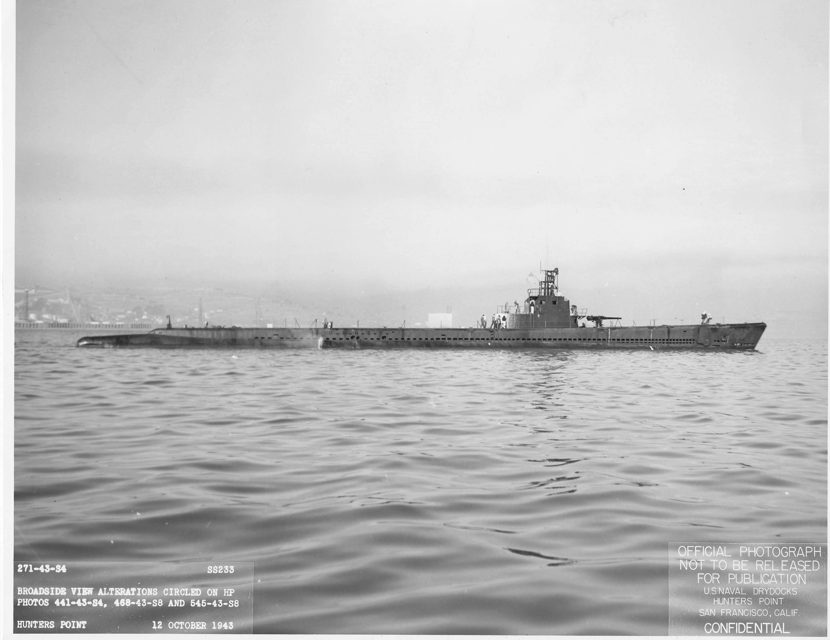
Herring was named for the fish. The Portsmouth Navy Yard at Kittery laid her down on 14 July 1941, launched her on 15 January 1942, and commissioned her on 4 May 1942. She was SS-233, a Gato-class submarine, and the first submarine the yard launched after Pearl Harbor. Mrs. Ray Spear, wife of Rear Admiral Ray Spear, sponsored her. Raymond W. Johnson took her out.
Her first patrol was for the landings in North Africa. She was off Casablanca on 5 November 1942. On 8 November she sank the Vichy cargo ship Ville du Havre, 5,083 gross tons, at 33°34′N, 07°52′W. She was back at Rosneath on 25 November. The second patrol, from 16 December, found little to shoot at. John Corbus had her from 5 March to 13 April 1943. A wartime credit that she had sunk the German submarine U-163 on 21 March was later withdrawn. That boat had already been sunk, on 13 March, by the Canadian corvette Prescott. The fourth patrol, near Iceland, found no targets. The fifth brought her to the United States on 26 July 1943. She left New London on 9 August for the Pacific.
Johnson had her again from 13 April 1943. On 15 November she left Pearl Harbor on her sixth patrol. On 14 December she sank Hakozaki Maru, 3,948 tons, northeast of Shanghai, about 33°01′N, 124°01′E. On 1 January 1944 she sank Nagoya Maru, 6,072 tons, about 220 miles south-southwest of Tokyo Bay, at 32°10′N, 138°37′E. He left her on 6 February.
David Zabriskie, Jr. took her that day. He was a lieutenant commander. On 24 March she closed a large carrier, was detected, and was driven deep before she could attack.
The eighth patrol left Pearl Harbor on 16 May 1944. She topped off at Midway on 21 May and met Barb on 31 May, about 150 miles west of Matsuwa, now Matua, in the Kuriles. Eugene Fluckey had Barb. That night, west of the island, she sank the escort Ishigaki, about 860 tons, with one torpedo, and the army cargo ship Hokuyo Maru, 1,590 gross tons. Ishigaki had sunk S-44 on 7 October 1943. Barb heard the depth charging from a distance, later took a prisoner from the convoy, and sank two other ships of it.
The next morning, 1 June, two ships lay at anchor off Matsuwa. She sank Hiburi Maru, 4,366 gross tons, and the troop transport Iwaki Maru, 3,124 gross tons. Shore batteries then hit the conning tower twice as she backed into the fog, about two kilometers south of Point Tagan. Bubbles covered a patch about five meters across, and oil spread for about fifteen miles. No one came off her. The patrol is credited with four ships and 13,202 tons.
On 3 June she did not answer a call for a receipt. Barb could not raise her after 31 May. Midway was told to watch for her, and she was expected about 3 or 4 July. On 13 July she was reported presumed lost. She was struck from the Navy Register on 13 November 1944. She received five battle stars. On 1 June 2026 the Navy identified the wreck, using a survey by the Russian Geographic Society and the work of two American researchers and one Japanese researcher. She lies upright on her keel, the bow aground and the conning tower damaged. Eighty-three men were lost with her. The wreck is a war grave.