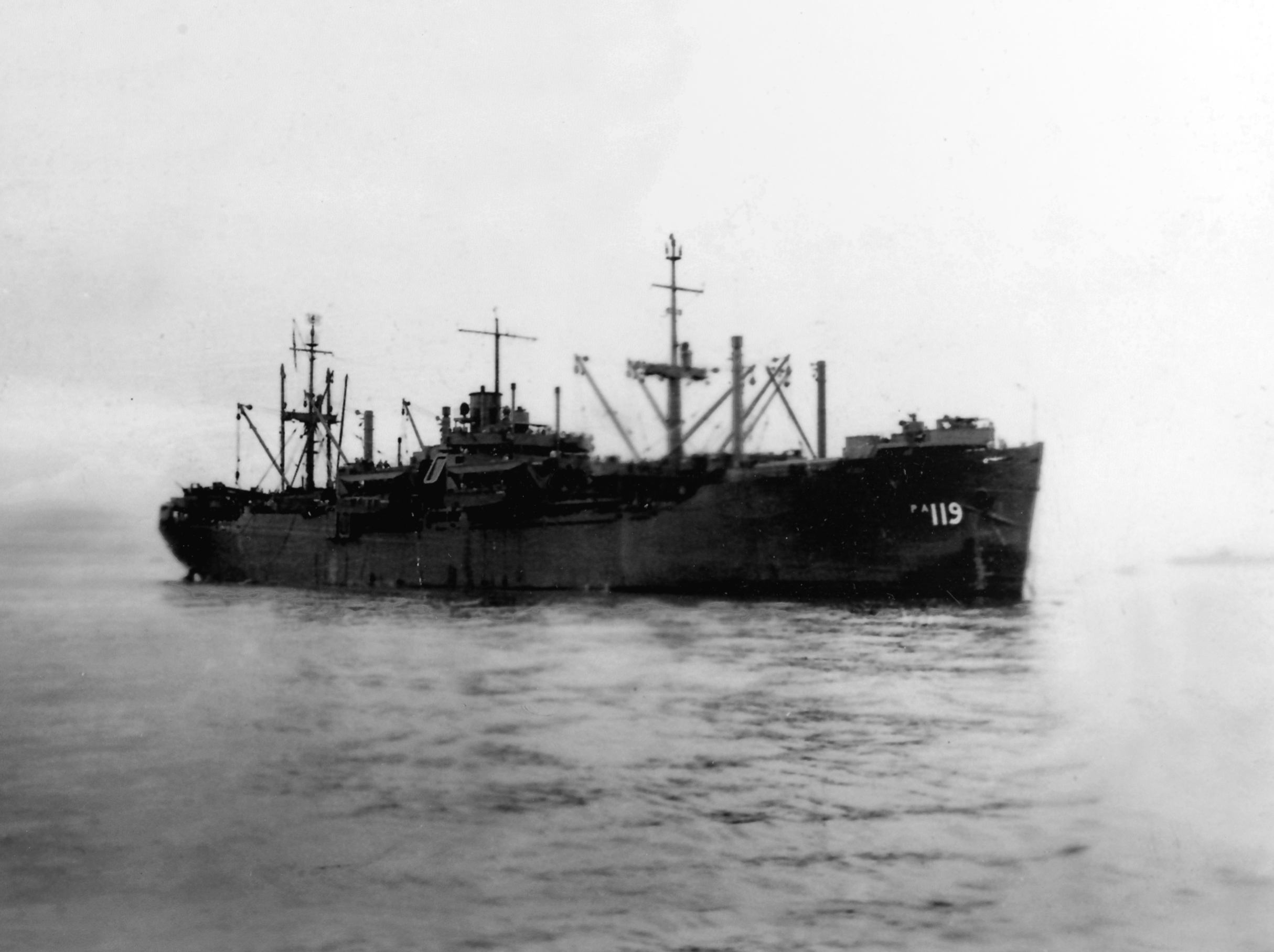
Highlands was named for a county in Florida. California Shipbuilding at Wilmington built her under a Maritime Commission contract and sent her down the ways on 8 July 1944. Mrs. G. W. D. Dashiell sponsored the hull. The Navy took delivery, and the attack transport joined the fleet on 5 October 1944. Her first commanding officer was Captain G. D. Lyon.
San Pedro remained her drill port through 30 October. She then embarked troops at San Francisco and on 23 November headed for Hawaii. From 29 November Pearl Harbor was her base for landing practice pointed at Iwo Jima. The task group sailed on 27 January 1945, called at Eniwetok, and reached Saipan on 11 February. Five days later she was underway again. Beach work at Iwo Jima opened on the morning of 19 February. Six days of unloading followed, done by daylight, and each night she drew off under escort. Enemy aircraft were thick. A kamikaze sank the escort carrier Bismarck Sea on 21 February, and other ships were damaged, Saratoga among them. On 22 February Highlands received more than 150 men from Bismarck Sea, together with wounded Marines brought off the island. She cleared Iwo Jima on 25 February, landed those casualties at Saipan, and went on to Espiritu Santo, arriving 15 March.
A fresh lift of troops was bound for Okinawa, but she missed the opening landings. The Ryukyus came up on 3 April, and she waited at Kerama Retto until 11 April. That morning she went in with the attack on Tsugen Jima. After Marines held the island she took wounded aboard, and on 12 April she shifted to Hagushi to land men who had been kept in reserve. Her antiaircraft guns, and smoke laid around the ship, carried her through three days when air attacks hardly let up. She left for Saipan on 16 April, arrived on the 20th, put the casualties ashore, and sailed the next morning for Ulithi.
On 22 May she departed for Guam and then Leyte, entering Leyte Gulf on 31 May. The weeks that followed were spent getting ready for a landing in the Japanese home islands. Surrender on 15 August ended that plan. She was off Panay when the news arrived. On 21 August she sailed to Luzon to load occupation troops. Her group stood into Tokyo Bay on 2 September, the day of the formal surrender ceremony, and landed the 1st Cavalry Division. September took her back to the Philippines and to Okinawa for more occupation troops. Once mines had been swept from the Inland Sea, she landed men at Kure on 6 October.
Returnees filled her for the passage that began on 11 October, by way of Okinawa toward San Diego, and she was back in the United States on 2 November. A further trip to Japanese ports ran from 17 November to 26 December and ended at San Francisco. On 11 January 1946 she left for the east coast through the Panama Canal, reached Hampton Roads on 26 January, and was decommissioned on 14 February. The Maritime Commission then laid her up in its National Defense Reserve Fleet in the James River. Two battle stars were credited to her war record.