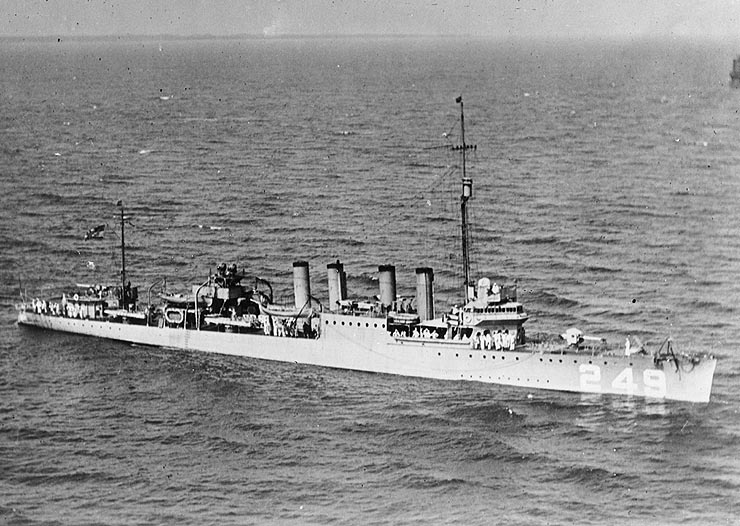
Hopkins, DMS-13, was the third ship of the name. She was named for Esek Hopkins, the Continental Navy's first commander in chief. She was built as the destroyer DD-249, a ship of the Clemson class: 1,190 tons, 314 feet 5 inches long, with a beam of 31 feet 8 inches, a draft of 9 feet 3 inches, a speed of 35 knots, and a complement of 101. As a destroyer she carried four 4-inch guns, one 3-inch gun, and twelve 21-inch torpedo tubes. The New York Shipbuilding Corporation at Camden launched her on 26 June 1920. Miss Sarah Babbitt, a descendant of Esek Hopkins, was her sponsor. She was commissioned at Philadelphia on 21 March 1921. Lieutenant Commander Carlos Augustus Bailey was her first commanding officer and had her until 17 February 1922.
After shakedown she reached Newport on 31 May 1921 for battle practice. In November she joined Destroyer Squadron 15 for tactical training with the Atlantic Fleet. She sailed from Hampton Roads on 2 October 1922 and reached Constantinople on 22 October. She protected American interests and worked with the Relief Mission, ranging to Beirut, Jaffa, and Smyrna, and left Constantinople on 18 May 1923 for New York on 12 June. For seven years she operated from New England in the summer, Charleston in the winter, and the Caribbean in the spring. In the spring of 1930 she took part in force battle practice with aircraft. On 3 February 1932 she was one of two naval ships giving medical aid after the earthquake at Santiago, Cuba, and on 5 February she left to join the Pacific Fleet at San Diego. In July 1936 she escorted President Roosevelt's cruise to Canada, then trained on the West Coast. She returned to Norfolk in April 1939 and did Neutrality Patrol from September 1939 until she sailed for San Diego and on to Pearl Harbor. She was converted to a high-speed minesweeper, DMS-13, in the Pearl Harbor Navy Yard. Lieutenant Commander Robley Westland Clark commanded her from 8 August 1940.
On 7 December 1941 she was at Johnston Island for war maneuvers. Lieutenant H. Still, who had her from 27 November to 10 December, turned her back toward Hawaii. She patrolled the Hawaiian Sea Frontier, with a short overhaul in the States, until late summer 1942, when she joined the invasion fleet for Guadalcanal. Lieutenant Commander Benjamin Coe had her from 10 April 1942 to 12 December 1942.
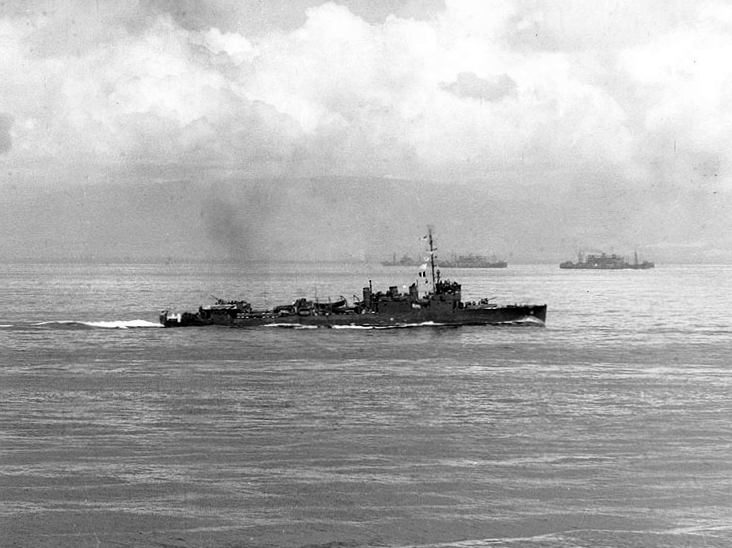
Commander William H. Hartt, Jr., commanded the Minesweeper Group, Task Group 62.5, in Rear Admiral Richmond K. Turner's amphibious force. Hopkins was one of the five ships of that group. Morison's task organization for the landings, and chapter 5 of the combat narrative, name Lieutenant Commander Benjamin Coe as her commanding officer. As the first offensive of the Pacific war began on 7 August, she swept the transport area and covered the landings on Tulagi. On 8 August she was still a four-piper, and she was photographed steaming past the transport area between Guadalcanal and Tulagi. In a heavy air attack on 9 August she shot down two enemy planes. In the months after the landing she escorted transports, swept, and carried supplies to Guadalcanal.
Lieutenant Commander Francis Marion Peters, Jr., relieved Coe on 12 December 1942 and had her until 26 July 1943. She was flagship for Rear Admiral Richmond K. Turner when the Russell Islands were invaded on 21 February 1943. During that action she shot down a third plane. She stayed in the southwest Pacific, joined the landing at Rice Anchorage, New Georgia, on 4 July, and the landing at Bougainville on 1 November. Lieutenant Alton Louis Clifford Waldron, known as Red, had her from 26 July 1943 to 26 May 1944. Escort, antisubmarine patrol, and sweeping kept her in the Solomons until they were secured.
Lieutenant Commander Douglas P. Payne relieved Waldron on 26 May 1944 and had her until 6 September 1945. He was still in command on 2 September. Under him she arrived off Saipan on 13 June 1944, swept the approaches, and screened and supported the landings of 15 June. She picked up 62 prisoners from sunken Japanese ships and rescued a fighter pilot and a seaplane crew. After Eniwetok she reached Guam on 14 July for the sweeping and bombardment before the landings, and gave fire support on 16 July. After an overhaul at Pearl Harbor she reached Leyte Gulf on 27 December 1944. The minesweepers sailed on 2 January 1945 to sweep Lingayen Gulf under dive-bomber and kamikaze attack. When her sister Palmer was hit on the morning of 7 January and went down in thirteen minutes, Hopkins rescued 94 survivors. She left the Philippines on 15 January, rested at Eniwetok, and swept the transport areas and channels off Iwo Jima for the landing of 19 February. She patrolled off Iwo Jima under air and shore fire and came through without a hit. She left on 6 March for Okinawa. While she fought off raids and suicide attacks, the ship her crew called Lucky 13 shot down several Japanese planes. On 4 May 1945 a flaming kamikaze struck her a glancing blow and plunged into the sea. She stayed afloat.
On 7 June she left for overhaul at Leyte and was still there when the fighting stopped. She then met units of the Third Fleet bound for Tokyo Bay, swept the entrances for two days, and anchored in sight of Mount Fuji on 30 August 1945. Payne still had her for that arrival. Lieutenant Robert Louis Jacobs relieved him on 6 September 1945 and had her until she was decommissioned. Japan had given up. The weather had not. She rode out two typhoons, with winds to 125 knots, before leaving Tokyo Bay on 10 October for the east coast. She reached Norfolk on 28 November and was decommissioned there on 21 December 1945. She was sold for scrap on 8 November 1946 to the Heglo Sales Corporation of Hillsdale, New Jersey. She received two Navy Unit Commendations, for Guadalcanal and for Lingayen Gulf, and ten battle stars.
A note on sources. The career is the Dictionary of American Naval Fighting Ships entry for Hopkins III. Commanding officers are NavSource's page for DD-249 and DMS-13. The Minesweeper Group, and Coe's name in it, are Morison, volume IV, pages 270 to 274, and the combat narrative, chapter 5. The 8 August 1942 photograph is the frame whose caption places her, still a four-piper, in the transport area between Guadalcanal and Tulagi. The Dictionary names the commissioning officer as Lieutenant Commander C. A. Bailey. NavSource names Lieutenant Commander Carlos Augustus Bailey. The Dictionary prints the sailing from Neutrality Patrol for San Diego as "37 May," so that day is omitted here. NavSource gives Lieutenant William Tenney Dutton from 10 December 1941 to 10 April 1941, an end before the start, and begins Lieutenant Commander Benjamin Coe on 10 April 1942. Still's given name is only the initial H. Payne's middle name is only the initial P.