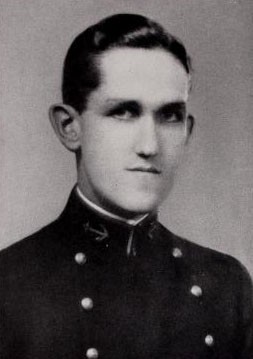
Ships
- USS Ross (DD-563) Captain from 21 February 1944
By 1 July 1945 the Navy Register carried him as a temporary captain, dated 30 March 1945, with two Silver Stars recorded against his name. He left the active list in 1950 as a rear admiral and died in 1989. He is not James W. Coe, Charles F. Coe, Douglas W. Coe, Henry Eugene Coe, Jr., or the other Coes who stand as separate officers in the same registers, and he is not his own son, Benjamin Plaisted Coe.
Origins
The Navy Register of 1 July 1945 gives his date of birth as 19 November 1906 and his date of entry as 17 June 1925, in a block of line officers whose entry dates cluster in the middle of that June, the ordinary way the register records a Naval Academy class. A Navy biographical sketch, preserved in a 2024 genealogy transcription that points to the Naval History and Heritage Command, supplies the place and the household the register does not. It says he was born in Springfield, Illinois, on that November day, the son of Louis Johnson Coe and Lydia Williams Coe, that he finished Springfield High School, and that he was appointed a midshipman from Illinois. Hall of Valor, which prints his citations, gives the same birth date and lists his home as Springfield. No middle name appears in the registers, the citations, or the sketch.
He entered the Naval Academy in June 1925. The sketch says he graduated and was commissioned ensign in 1929. His widow's obituary, published in the Almanac of Menlo Park and Portola Valley on 4 February 2004, calls him a Naval Academy graduate. Hall of Valor says the same, class of 1929. The registers never spell "Naval Academy" on his own line, but the entry date, the classmates around him, and those later notices agree.
Formation
The sketch is the only continuous account of the years between graduation and the war, and the registers catch him at intervals that match it.
On graduation in 1929, the sketch says, he went to the carrier Saratoga and stayed until October 1930. The next year he was at Naval Air Station, Pensacola, for flight training, and was designated a naval aviator. In November 1931 he returned to Saratoga with Torpedo Squadron 2B and served there until December 1933. From December 1933 to July 1936 he was aboard the battleship Maryland, based at San Pedro. The Register of 1 January 1933 already lists him among the lieutenants (junior grade). The station column in that year's OCR is too scrambled to assign him a ship from the register alone.
On 1 July 1936 the register still has him a lieutenant (junior grade), marked on the promotion list, with the numeral the 1936 register uses for a naval aviator designated in heavier-than-air craft, and ordered to the Fleet Air Base at Pearl Harbor. The sketch says that Pearl Harbor duty ran from July 1936 to May 1938. In June 1938, it continues, he went back to sea in Southard, flagship of Destroyer Division 8 in the Battle Force and later flagship of Mine Division 5 at San Diego. The Register of 1 July 1940 has him a lieutenant, still carrying the aviator qualification, and stationed in Southard. He was a lieutenant commander by the Register of 1 July 1942. The Register of 1 July 1945 dates his permanent rank of lieutenant commander from 30 June 1942. When the temporary rank of lieutenant commander began, the registers in hand do not say.
In 1929 he married Mary Ricker Plaisted. Her obituary says she was born in Fresno, moved with her parents to San Diego, attended business school in Los Angeles, and married him that year. Their son, Benjamin Plaisted Coe, was born on 24 August 1930 in Long Beach, California, where, the son's own obituary says, his father was serving. The widow remembered a Navy household that followed Maryland, Saratoga, Southard, and later Ross. The order in that sentence is memory, not a cruise. The son's obituary adds that he was a Navy junior who passed through sixteen schools, that years in Hawaii stayed with him, and that on 7 December 1941 he and his mother were living temporarily in a hotel in Honolulu near Pearl Harbor and were there for the attack. It does not say where the father was that morning. The sketch's next dated move is January 1942, when Coe transferred to Hopkins as commanding officer, so the family story and the duty story meet only at Honolulu, not on a named bridge.
War years as lived
The war that can be documented for him was fought from minesweeper and destroyer bridges, not from the cockpit in which he had qualified.
The sketch says that in January 1942 he became commanding officer of Hopkins. Compiled lists of commanding officers give 10 April 1942 as the day he took her and 12 December 1942 as the day he left. Those lists are not a deck log, and they are not used here as dates. What is secure is the citation. The Silver Star, as printed by Hall of Valor, is to Lieutenant Commander Benjamin Coe, commanding officer of the destroyer Hopkins (DD-249), for 7 August and from 7 to 15 September 1942 in the Solomon Islands. The ship he actually had was already a high-speed minesweeper. The Naval Historical Center's history of Hopkins records that she was converted and given the hull number DMS-13 in 1940, well before this command, and that in mid-1942 she went to the South Pacific for the invasion of Guadalcanal and Tulagi, then stayed on to escort, sweep, and carry during the campaign. The citation still styles her DD-249, and it describes the work: she took part in the initial attack as a screening and minesweeping vessel, and under his direction she repeatedly re-entered the Guadalcanal-Tulagi area, under persistent Japanese air attack, to escort and protect ships bringing reinforcements and supplies to the Marines ashore. The Navy's photograph of her on 8 August 1942, steaming past the transport area between Guadalcanal and Tulagi while George F. Elliott burned in the distance, is the scene the day after the landing. The citation does not name that photograph, and the photograph does not name him. Together they are the same week.
The sketch says that in December 1942 he commanded Craven for one month, and that from January 1943 into 1944 he served in turn with the South Pacific Force and the U.S. Pacific Fleet. No register in hand gives those stations. The Register of 1 July 1944 lists him a commander, still a naval aviator by the old qualification numeral, with one Silver Star already recorded. That star is the Hopkins award. The second had not yet been earned.
He assumed command of a ship that did not yet exist as a commissioned man-of-war. The Dictionary of American Naval Fighting Ships records that Ross (DD-563), a Fletcher-class destroyer built by Seattle-Tacoma Shipbuilding at Seattle, was commissioned on 21 February 1944 with Commander Benjamin Coe in command. The encyclopedia stub had that date and that ship. DANFS confirms both. She finished shakedown off California in early May and sailed for Pearl Harbor on the 5th. On the 29th she sortied with Task Force 52 for Eniwetok, and from there the fleet went on to Saipan.
DANFS puts her, with the carrier support group, on station east of Saipan on 14 June. Through the landings on the 15th and until the 19th she screened and plane-guarded. On the 19th she went east with Kalinin Bay to meet replacement aircraft from Eniwetok, and on the 25th the two ships rejoined the Saipan support force. She stayed off Saipan and Tinian well into July, leaving at the start of the month only to escort another replacement-aircraft run. The Bronze Star citation, covering his command from June 1944 to March 1945, says he provided an effective screen for escort carriers at Saipan. That much the citation and DANFS tell the same way.
On 1 August Ross returned to Eniwetok, then went to the Solomons to rehearse the Palau operation. On 6 September she left Purvis Bay in Task Group 32.5, the Western Fire Support Group. Off Peleliu by dawn on 12 September she screened the heavier ships as they opened on the proposed beaches. On the morning of the 13th she closed White and Orange beaches to cover the underwater demolition teams, and through that day and the next she swapped that fire for screening. On the night of 14–15 September she shelled Ngesebus and patrolled against boat traffic. Before the 0830 landings she fired on observation posts in the assault area. After the troops were ashore she shifted to call fire, and until the 20th she rotated that duty with night patrol and picket. On the 20th, in Kossol Roads, she embarked Major General Julian Smith, Marine Corps, and his staff, and carried them to Peleliu, arriving on the 26th. She fired harassing rounds, call fire, and illumination until the 29th, then sailed for Manus. The Bronze Star citation adds shore bombardment at Palau, which this passage supports, and also names Ulithi and an island it spells, in Hall of Valor's text, "Homonhen." The biographical sketch's quotation of the same citation spells that island Homonhon. DANFS, for this command, describes Peleliu, Ngesebus, and later Dinagat, and does not use either spelling.
Leyte was next, and it was the cruise that broke the ship. Ross left the Admiralties on 12 October. Five days later she was off Dinagat. On the morning of the 18th she covered the landing on Black Beach 2, then joined Task Unit 77.2.6 to cover a minesweeping and hydrographic unit. DANFS says that duty ended less than fifteen hours later.
At 0133 on 19 October she struck a mine to port, under the forward engine room and fire room, and began to list. At 0155 a second mine exploded near the after engine room. The list went to fourteen degrees. Chickasaw (ATF-83) and Preserver (ARS-8) came alongside. Soon after 0210 the ship jettisoned six torpedoes, every port depth charge, and miscellaneous gear, and shifted movable topside weight to starboard. The list began to come off. At 0315 her medical officer, the seriously injured, and the ship's funds went across to Chickasaw. At 0343 the tug took her in tow. Four hours later she anchored off Montoconan Island. DANFS counts the mine explosions as three killed, twenty missing, and nine injured.
The morning was not over. At 1204 the anchorage was attacked by Japanese aircraft, and shrapnel wounded two more of her men. In the afternoon she was towed to an anchorage south of Mariquitdaquit Island. At dawn on the 20th that anchorage was attacked as well. Salvage went on under repeated air attack. On 23 November she was shifted to the Northern Transport Area anchorage. On the 24th she was towed into San Pedro Bay and docked in ARD-19. The raids continued. On the 28th a Japanese fighter crashed into the drydock, passed through the starboard wingwall, and set gasoline-fed flames over the dock basin. While men fought that fire, another fighter started a strafing run and was shot down by the combined gunfire of Ross, the drydock, and LST-556.
The Gold Star in lieu of a second Silver Star, printed by Hall of Valor, is the Navy's reading of that morning and of the hours that followed. It is to Commander Benjamin Coe, commanding officer of Ross, for the naval operations immediately before the Philippine landings, when the ship struck two floating mines in quick succession in the dark of 19 October 1944. During salvage and rescue, alone, unsupported, listing, and in a condition the citation calls alarmingly dangerous, the ship was bombed and strafed. The citation says that by courageous leadership and calm, cool, intelligent direction he made the ship fight the attacks off, stop the leaks, correct the list, and arrest further damage, and that his effort saved the ship and the crew to fight again. The biographical sketch quotes a closely related text and calls him Captain in that passage. The July 1945 register, recording distinctions through 1 May 1945, shows two Silver Stars, (E)(E), where the July 1944 register had shown one. The second star is this one.
Repairs on the dock waited while the dock itself was mended. On 13 December Ross got underway under tow for Humboldt Bay, was patched further there, and on 2 March 1945 reached Mare Island. The Bronze Star, with Combat "V," covers the whole command from June 1944 to March 1945 and adds a claim DANFS does not itemize: that in the narrow waters of Surigao Strait, still in the mine-damaged ship, he fought off attacking aircraft and shot three of them down. Hall of Valor styles him Captain in that citation. His temporary captaincy, in the 1 July 1945 register, dates from 30 March 1945, at the end of the period the citation names, not at its beginning. He was a commander when Ross commissioned and when she hit the mines.
The sketch's summary of the cruise says Ross survived two mine explosions, 286 air raids, an aerial strafing, a typhoon, and a kamikaze crash before she reached Mare Island. DANFS supports the mines, the repeated air attacks during salvage, the strafing, and the 28 November crash into the drydock. It does not, in the text used here, give a raid count or a typhoon.
The sketch says that in April 1945 he was ordered home. Lists of commanding officers end his Ross command on 14 April 1945. That day is not confirmed here by a log or a register. DANFS carries the ship's story on, through San Diego, Pearl Harbor, Ulithi on 14 August, occupation duty, and inactivation, without saying he was still in command. Those later movements are the ship's, not a cruise that can be claimed for him.
Cost
The price of the morning of 19 October is stated once, in DANFS, and it is not a round number softened into "losses." Three men were killed. Twenty were missing. Nine were injured by the mines. Two more were hurt by shrapnel when aircraft hit the anchorage at 1204. The medical officer and the seriously wounded had already been sent to the tug before dawn, with the ship's funds, which is a detail of how close the ship was to being abandoned as a fighting unit. The citation's claim is that she was not. Leaks were stopped, the list was taken off, and the hulk was kept. She spent the next four months and more under tow and in dock, and she did not fight another surface action under the command that can be documented for him.
Nothing in the citations or the sketch records what he said to the crew, or what he thought when the second mine went off, or whether he considered putting them in the water. The Navy's adjectives are the ones it used for many commanding officers in 1944: calm, cool, inspiring. They are evidence of the kind of conduct the Department was willing to decorate, not a diary. The measurable facts are the two explosions, the fourteen-degree list, the jettisoned torpedoes and depth charges, the men dead and missing, and a ship that reached a California yard five months later.
Hopkins had been a different kind of pressure: not one catastrophic minute but a repeated return into an area where Japanese aircraft were already hunting transports. The citation's point is that he took her back in anyway, as screen and sweeper, so that the ships carrying men and food could keep going to the beach. No casualty figures for those August and September weeks are attached to his name in the sources used here. The Naval Historical Center's later account of Hopkins, including the Russell Islands, New Georgia, Bougainville, Saipan, Lingayen, Iwo Jima, and Okinawa, belongs to the ship after other captains had her. It is not his year.
There is a separate cost that fell on the household rather than on the bridge. On the morning the war came to Pearl Harbor, his wife and his eleven-year-old son were in a hotel near the harbor. The son's obituary says they experienced the attack. It does not make the father a witness on the ship or on the beach, and this essay does not put him there.
After
The sketch says that from the time he was ordered home in April 1945 until July 1947 he was Director of Personnel Distribution in the First Naval District, at Boston. His son's obituary places the boy, in the 1947–48 school year, at Winchester High School in Winchester, Massachusetts, which fits a Boston shore tour, and says the son met his future wife there. From July 1947 to February 1948 the sketch has Coe in command of Destroyer Division 82 in the Atlantic Fleet, a return to sea after the yard and the bureau. It then leaves a blank until August 1948, when he went back to the First Naval District as Assistant Chief of Staff for Administration. He was in that billet, the sketch says, when he was relieved of active duty pending retirement. Transfer to the retired list took effect on 1 September 1950, and he was advanced to rear admiral on the basis of combat awards. Hall of Valor says he retired as a rear admiral. His widow's obituary says that after his retirement in 1950 the couple left the Boston area for California, and it calls him Admiral Coe.
The sketch's inventory of decorations, beyond the two Silver Stars and the Bronze Star with Combat "V," is the ribbon for a facsimile of the Navy Unit Commendation awarded to Hopkins, the American Defense Service Medal with Fleet Clasp, the American Campaign Medal, the Asiatic-Pacific Campaign Medal, the World War II Victory Medal, and the Philippine Liberation Ribbon with two bronze stars. Those ribbons are not itemized in the registers used here. The two Silver Stars are.
They lived, his widow's obituary says, in Los Angeles, La Jolla, and Menlo Park, and then at The Sequoias in Portola Valley. They had been married sixty years when he died in 1989. She died on 27 January 2004 in Portola Valley, at ninety-six. The obituary says they were also guardians of Daniel J. Carver of San Jose and Saralynn Carver of Mountain View. It does not say when or why. Their son, Benjamin Plaisted Coe, lived until 21 March 2026, dying at home in Watertown, New York, at ninety-five, survived by his wife, Margaret Butler Coe, four children, and grandchildren. The funeral notice names his parents as Rear Admiral Benjamin Coe, U.S. Navy, and Mary Ricker Plaisted Coe. That is the household the cruise left behind: a widow who had followed four ships and had been in Honolulu on 7 December 1941, a son raised as a Navy junior, and two young people for whom the couple stood as guardians.
Hall of Valor dates his death 30 October 1989. A genealogy compilation places it in Santa Clara County, California. The widow's obituary confirms the year and not the day or the county. No obituary of the admiral himself was found.