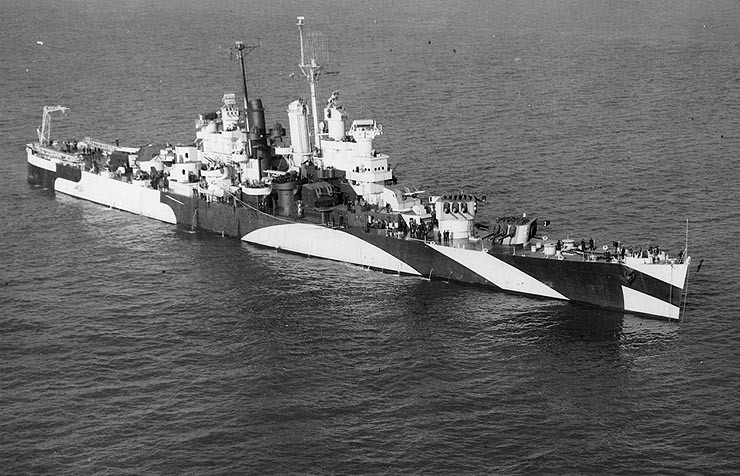
Houston (CL-81) was a Cleveland-class light cruiser, the third Navy ship named for the city in Texas. The heavy cruiser Houston (CA-30) had been lost in 1942. This Houston (CL-81) was launched by Newport News Shipbuilding and Dry Dock Company at Newport News on 19 June 1943, sponsored by Mrs. C. B. Hamill. She had originally been named Vicksburg. The name was changed on 12 October 1942. She commissioned on 20 December 1943 with Captain William Wohlsen Behrens in command. The DANFS line for the hull gives 10,000 tons, a length of 610 feet 1 inch, a beam of 66 feet 4 inches, a draft of 20 feet, 33 knots, a complement of 992, and twelve 6-inch and twelve 5-inch guns.
Houston (CL-81) left Norfolk on 1 February 1944 for a shakedown in the Caribbean. After training out of Boston she sailed for the Pacific on 16 April. She reached Pearl Harbor on 6 May, by way of the Panama Canal and San Diego, trained some more, and arrived at Majuro on 31 May to join Vice Admiral Mitscher's fast carrier task force.
Houston (CL-81) left on 5 June for the Marianas. She screened the carriers while they struck the Marianas on 12 and 13 June and the Bonins on 15 and 16 June. As Admiral Kelly Turner's forces landed on Saipan on 15 June, the Japanese came out for a fleet action. The fleets met on 19 June. Four large air raids hit the American disposition. Fighter cover and antiaircraft fire from Houston (CL-81) and the other screen ships cut the attacks down. It was the Battle of the Philippine Sea, the first phase of it called the Marianas Turkey Shoot. After the offensive raids had sunk the carrier Hiyo, the task force went back to cover the Marianas. The digitized DANFS text prints the carrier's name as Hiji. Houston (CL-81) stayed with the carriers and on 26 June bombarded Guam and Rota, destroying a radar station, an airstrip, and ten aircraft on the ground. She returned to Eniwetok on 12 August.
Assigned to the new Task Group 38.2 under Rear Admiral Bogan, the name the digitized text prints as Bogen, Houston (CL-81) sailed on 30 August. The carriers struck the Palaus on 6 September. She and a group of destroyers then bombarded Peleliu and the other islands ahead of the landings. The group turned to the Philippines for strikes on airfields and shipping, and came back to support the troops on Peleliu from 17 to 19 September. She was at Ulithi on 1 October.
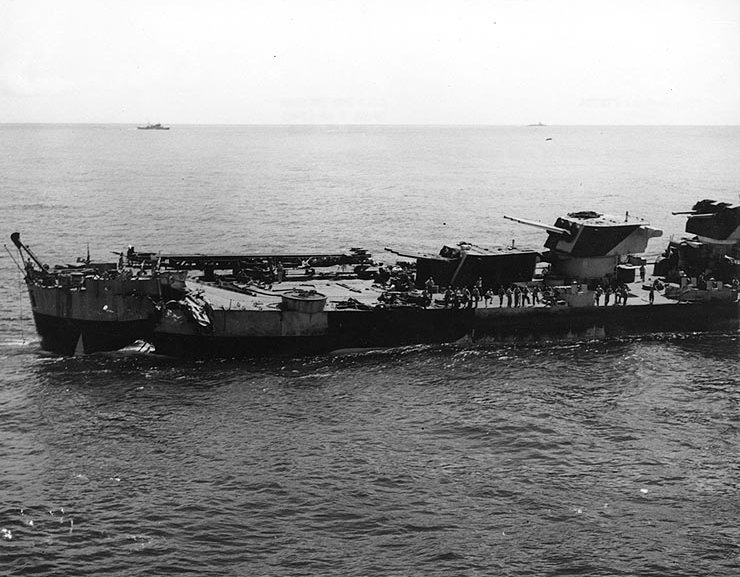
Houston (CL-81) and the task group sailed five days later. Strikes on Okinawa on 10 October warmed the force up for Formosa, the real object, on 12 October. Three days of attacks did a great deal to take Formosa apart as a base for the battles still to come. Japanese land-based aircraft struck back, hard and often. Houston (CL-81) splashed four of them in one attack on 12 October and helped beat off another the next day, in which Canberra was hit. On 14 October she took Canberra's old station. The gunners shot down three of the attackers. A fourth put a torpedo into the engine room and she lost power. Captain Behrens asked for a tow. Boston took her. By midnight both cruisers were under tow for Ulithi. On 16 October the fleet tug Pawnee took the tow. The digitized text prints the tug as Paivnec. Late that afternoon another strike from Formosa put a second torpedo into Houston (CL-81), this one in the stern. Surplus men went to the escorts. The damage-control parties kept her afloat and moving slowly toward Ulithi.
Admiral Halsey, learning that the Japanese thought the group called CripDiv I was the beaten remnant of Task Force 38, set a trap, hoping they would come out after the two crippled cruisers. The Japanese fleet did sortie from the Inland Sea. After an air attack it thought better of the idea and retired. Houston (CL-81) and Canberra were soon beyond the reach of land-based air and reached Ulithi on 27 October 1944. After temporary repairs she went to Manus on 20 December and then to the New York Navy Yard, arriving 24 March 1945. Behrens was relieved on 30 July 1945 by Captain Howard Emery Orem.
Houston (CL-81) came out of New York harbor on 11 October 1945, after a long rebuild. She refreshed in the Caribbean and trained out of Newport. On 16 April 1946 she sailed on a goodwill cruise of European ports, in Scandinavia, Portugal, Italy, and Egypt. Captain Neil Kittrell Dietrich relieved Orem on 21 June 1946, during that cruise. She was back on 14 December 1946 and stayed in training and readiness until 17 May 1947. Captain Kenmore Mathew McManes had relieved Dietrich on 30 January 1947. She sailed that May with Cruiser Division 12 for the Mediterranean and returned to Philadelphia on 16 August 1947. Houston (CL-81) was decommissioned on 15 December 1947, with McManes still in command that day, and placed in reserve. She was stricken on 1 March 1959 and scrapped. She received three battle stars for World War II. She was not sunk.
A note on sources. The narrative follows the Naval History and Heritage Command Dictionary of American Naval Fighting Ships entry for Houston III (CL-81). The HyperWar copy of that entry was not available. The fetch of the usual HyperWar address returned no page. The NHHC text prints Hiji for the carrier sunk in the Philippine Sea, Bogen for the rear admiral who had Task Group 38.2, and Paivnec for the fleet tug. Those are Hiyo, Bogan, and Pawnee. The Navy Cross citation for Behrens, on Hall of Valor, calls Houston (CL-81) a heavy cruiser. She was a light cruiser. The same citation puts the evacuation of excess men on 14 October, the day of the first torpedo, and the second torpedo on 16 October. The DANFS entry puts the request for a tow on the 14th, the second torpedo and the evacuation of surplus hands on the afternoon of the 16th, and does not give a casualty figure. None is invented here. NavSource, not DANFS, gives the keel, laid on 4 August 1941 as Vicksburg, and the sale for scrap on 1 June 1961 to Boston Metals. DANFS gives the renaming on 12 October 1942, the striking on 1 March 1959, and the scrapping, and no sale price. NavSource also gives 32.5 knots and a crew of 1,255 against the DANFS line of 33 knots and 992. The DANFS figures are the ones used above. Commanding officers and dates are NavSource's list. DANFS names only Behrens, at the commissioning. Uboat.net matches his dates, 20 December 1943 to 30 July 1945, and Orem's, 30 July 1945 to 21 June 1946. It does not list Dietrich or McManes on this ship. NavSource prints McManes as Mc Manes. The spelling used here is McManes, which is how uboat.net and Hall of Valor print it, and Mathew, which all three print, not Matthew. Dietrich is the officer who had temporary command of Alabama for three days in March 1943. The older Houston (CA-30) is a different ship and is not this one.