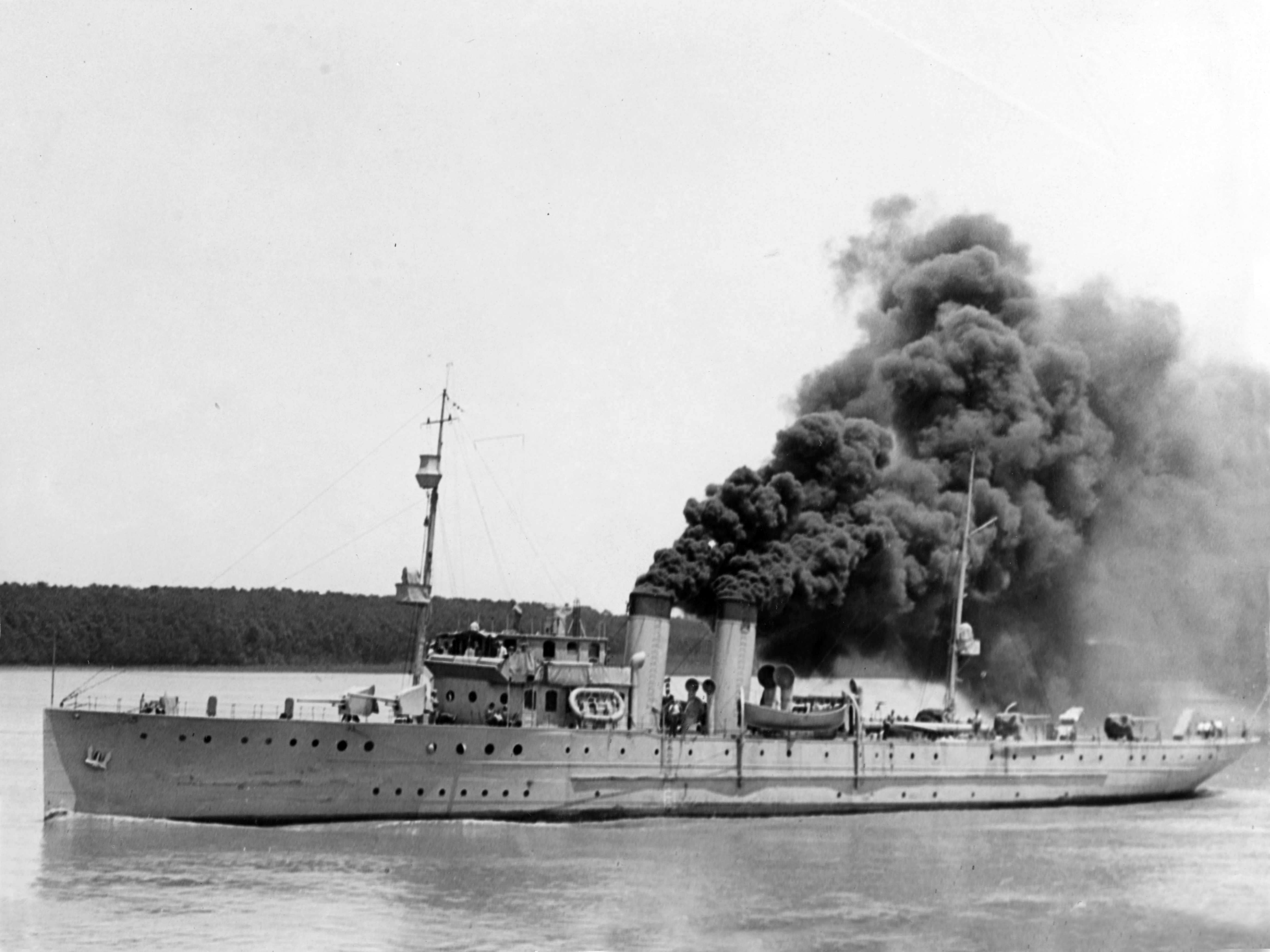
Isabel (PY-10) began as a steam yacht. Bath Iron Works at Bath, Maine, built her in 1917 for John North Willys. She was launched on 7 June 1917. The Navy took her before she was finished, numbered her S.P. 521, purchased her on 3 July 1917, and commissioned her at the Boston Navy Yard on 28 December 1917, with Lieutenant Commander Harry E. Shoemaker in command.
She was 245 feet 3 inches long, with a beam of 27 feet 9 inches and a draft of 8 feet 6 inches. She was given as 710 tons, with a speed of 26 knots and a complement of 103. Her battery was four 3-inch guns, two 18-inch torpedo tubes, one depth-charge projector, and two Lewis guns.
She went out of commission at the Philadelphia Navy Yard on 30 April 1920. On 17 July 1920 she was designated PY-10. On 18 July 1921 she was commissioned again at Philadelphia, Lieutenant Commander Frank Loftin in command. She reached Hong Kong on 7 November 1921 and joined the Yangtze Patrol.
On 3 December 1941 she was ordered stripped and fueled in four hours. She stood out of Cavite under sealed orders to look along the coast of Japanese-occupied French Indochina. Off Cam Ranh Bay she was told a Japanese fleet was fifty miles away and was sent back toward Manila. On 8 December, by the Philippine calendar, she was about seventy miles from Manila when the attack on Pearl Harbor was reported. On 10 December, during the raid on Cavite and Manila, eight bombs that did not explode fell around her fantail. She was credited with bringing down one of the attackers. She left Manila Bay that night with the submarine tender Holland and reached Balikpapan on 14 December.
On 7 February 1942, near Surabaya, she took aboard 187 survivors of the Dutch merchant ship Van Cloon and drove down a surfaced submarine. She reached Fremantle on 7 March 1942 and stayed on escort duty and submarine training there until 27 August 1945. She reached San Francisco on 26 October 1945. She was decommissioned on 11 February 1946, struck on 26 February 1946, and scrapped on 25 March 1946. She earned one battle star.
A note on sources. The career, the 710-ton figures, the two 18-inch tubes, the owner John North Willys, the Indochina trip, the eight bombs, the night sailing with Holland, and the 187 men from Van Cloon are the Navy's ship history. That history does not give a launch day. A second account dates the launch on 7 June 1917, the purchase on 3 July 1917, and delivery on 11 August 1917, spells the owner John Willys North, and gives four 21-inch tubes. The same account gives 930 tons, 245 feet 6 inches, and a complement of 103 in the war. The ship history calls her commanding officer in the summer of 1941 Lieutenant (junior grade) James W. Payne Jr., from 2 August 1941. The second account calls him Lieutenant (junior grade) John Walker Payne, Jr., from 1 December 1941, and keeps Lieutenant Commander Walter Ellsworth Linaweaver until that day. The combat narrative of December 1941 calls him Lieutenant John W. Payne, Jr. The surfaced submarine on 7 February 1942 is named I-55 in the ship history. Both accounts agree she was scrapped on 25 March 1946. This is the yacht S.P. 521, not the Spanish cruiser Isabel II and not the merchant ship Cape Isabel.