Jamestown was named for the English settlement in Virginia. Pusey and Jones of Wilmington built her in 1928 as the yacht Savarona, for Mrs. Thomas S. Cadwallader. The next year Colonel William Boyce Thompson bought her and renamed her Alder. She was 294 feet long, with two diesels, and she made about 15 knots. The Navy took her at New York on 6 December 1940 and sent her to the Bethlehem yard at Hoboken to be fitted as a gunboat. She commissioned at the New York Navy Yard on 26 May 1941 under Andrew Petrie Lawton.
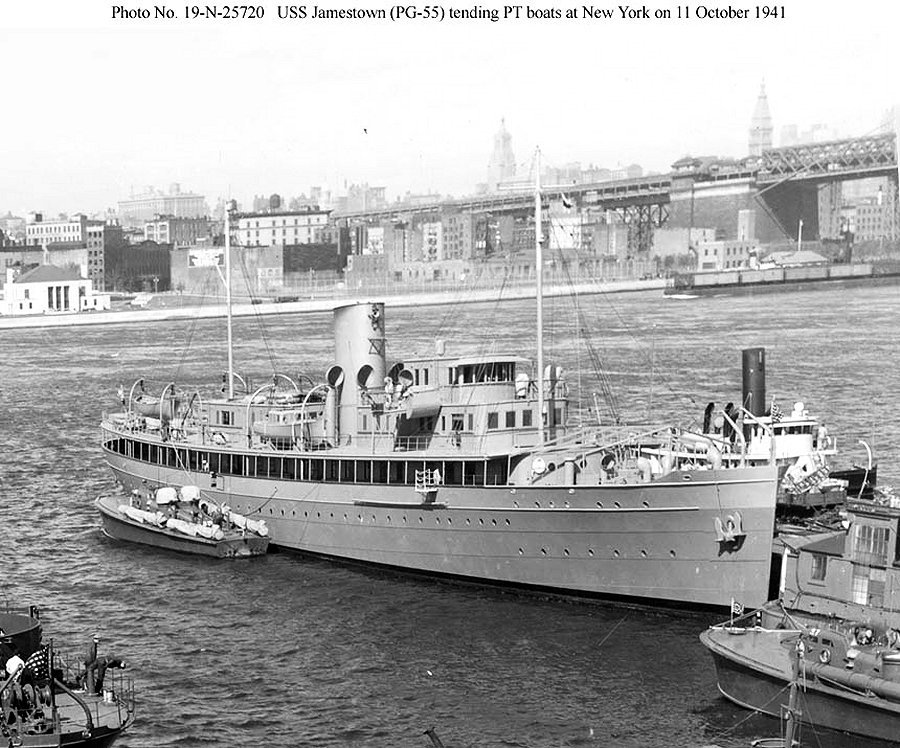
Her first summer was midshipmen. She took Naval Academy classes from Annapolis down to Norfolk and back. When that was done she was fitted as a tender for motor torpedo boats and sent to the new training center at Melville, Rhode Island, to look after Squadron 4. On 11 October 1941 a Navy photographer caught her at the New York Navy Yard with boats alongside. She had no guns mounted yet. The boat in the lower right of that print is PT-37.
She left New York on 1 August 1942, went through the Panama Canal and Pearl Harbor, and reached Espiritu Santo in September. While she waited for the boats she was meant to tend, she escorted supply runs between the New Hebrides and Tulagi and towed a barge of gasoline and quarter-ton bombs. On 19 September she was at Noumea when the first division of Motor Torpedo Boat Squadron 3 came in on the cargo ship Bellatrix. She helped tow those boats on to Espiritu Santo. Two fast minesweepers took them the rest of the way to Tulagi.
Charles Black Beasley relieved Lawton on 15 October. Jamestown reported at Tulagi on 22 October. For about four months she was the tender for the boats based there, PT-37 and PT-40 among them, and the place was under air attack. The repair work was done by day. She also did the first repairs on damaged cruisers, and her people went ashore to lay pipe out to a water hole. She and Squadron 3 were named in the Presidential Unit Citation given to the 1st Marine Division. On the night of 11–12 December she stayed at the anchorage. She was not in the fight off Savo in which Teruzuki sank. Lester H. Gamble in PT-37 and Henry S. Taylor in PT-40 each claimed a torpedo hit. The hit is not pinned to one boat.
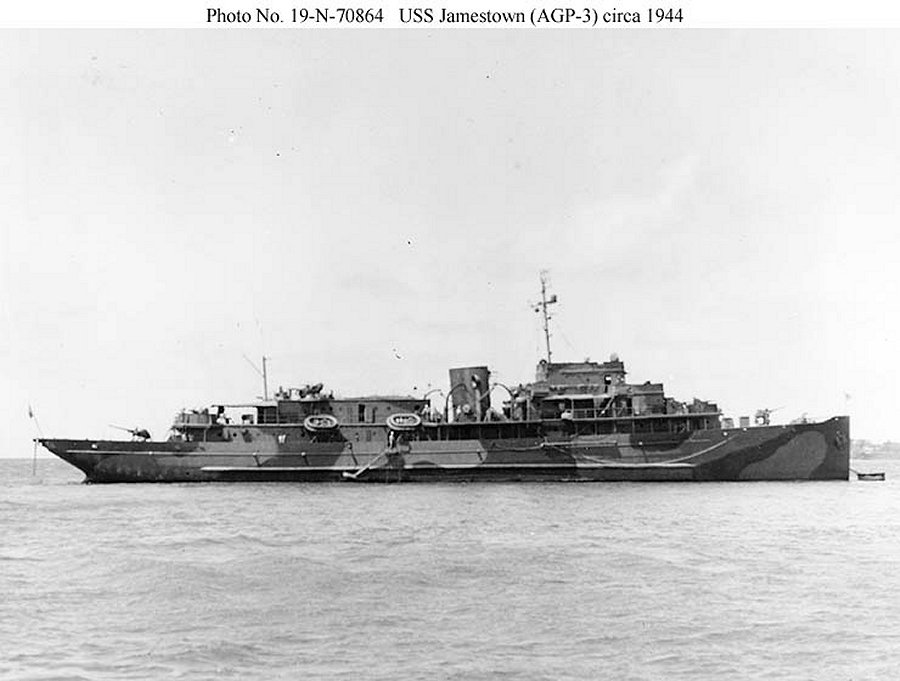
On 13 January 1943 the Navy redesignated her AGP-3, a motor torpedo boat tender. Joseph Allen Edward O'Handley took her on 1 February. That same day PT-37 burned off Cape Esperance after a shell hit her gasoline tanks. One man was picked up. Jamestown left Tulagi on 18 February. For about a year after that she ran to the New Hebrides or to Rendova for supplies, and she escorted ships between the islands.
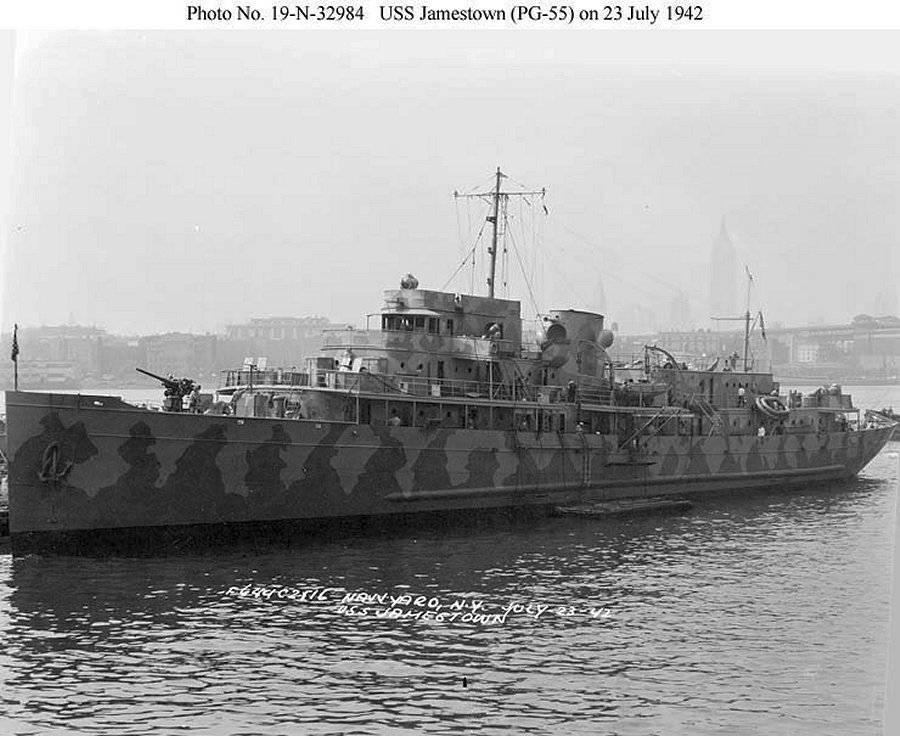
She left Tulagi on 9 February 1944 for an overhaul at San Pedro. The yard added six 20 mm guns to the two 3-inch guns she already carried, and she came out in a camouflage scheme drawn for her that June. She sailed from San Pedro on 17 July and was back at Espiritu Santo on 5 August. Larger tenders, built for the job, had taken the PT boats. Jamestown spent the rest of that year moving supplies and troops between the Solomons and New Guinea and keeping the bases in touch. On 6 September she left Treasury Island, met a troop transport at Bougainville, and took it to Milne Bay.
On 5 February 1945 she was ordered to the Philippines. She reached Leyte on 12 February and berthed and messed Motor Torpedo Boat Squadron 24 until mid-March. After that she ran convoys among Samar, Woendi in the Schouten Islands, Borneo, and ports in the Philippines, and she was still at it after the surrender. John Charles Dean, a Naval Reserve lieutenant commander, relieved O'Handley on 27 March.
She left Samar on 20 October 1945 and reached San Francisco on 24 November. Dean still had her when she was decommissioned there on 6 March 1946. She was struck on 20 March, turned over to the Maritime Commission on 4 September, and sold on 16 December.