Kaskaskia, AO-27, was named for a river in Illinois. She was a Cimarron-class fleet oiler, laid down on 16 January 1939 as the tanker Esso Richmond, a Maritime Commission T3-S2-A1, hull 11, at the Newport News Shipbuilding and Dry Dock Company. She was launched on 29 September 1939. Mrs. Joseph P. Kennedy was her sponsor. The Navy acquired her from the Esso Oil Company on 22 October 1940 and commissioned her on 29 October 1940. She was 553 feet long, with a beam of 75 feet and a draft of 32 feet 4 inches, and she made 18 knots. Commander Joseph Wesley Gregory was her first commanding officer.
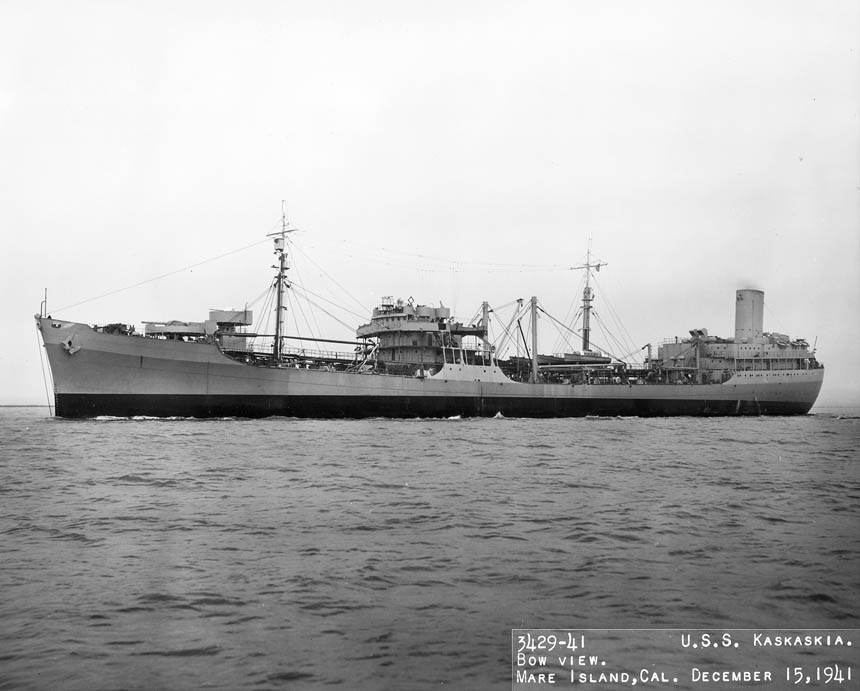
She cleared Boston on 19 November 1940 for Pearl Harbor and arrived on 3 January 1941. She transported oil between West Coast ports and Pearl Harbor, six cruises before 7 August, when she made an oil run to Johnston Island. She returned to Mare Island on 10 September for overhaul. She was at San Francisco when the Japanese attacked Pearl Harbor, and she began preparations to join the Service Force in the Pacific. A Bureau of Ships photograph, 19-N-26317, shows her at Mare Island on 15 December 1941.
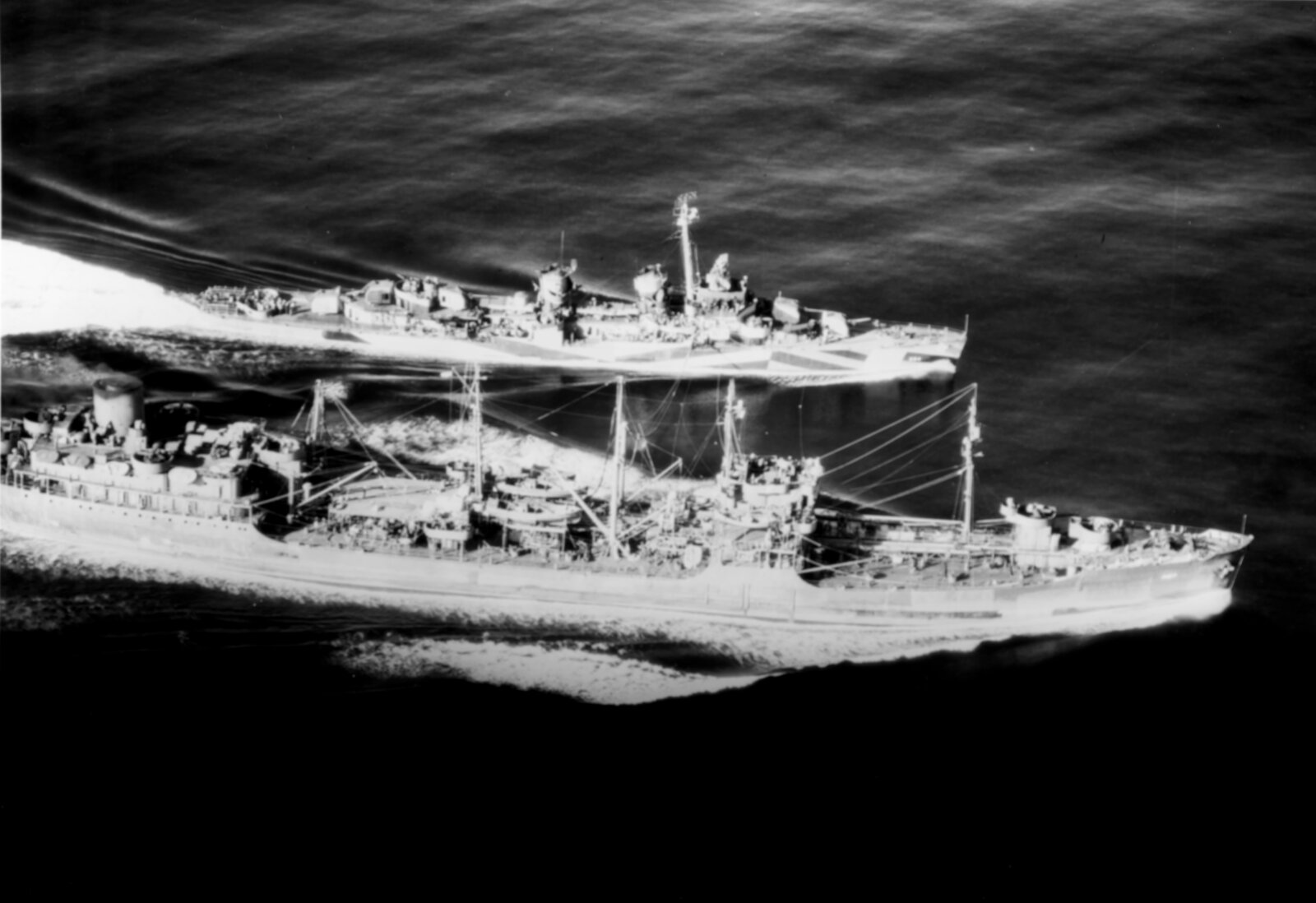
Commander Walter Lucian Taylor had relieved Gregory on 9 June 1941. She sailed from San Diego on 6 January 1942, fueled ships on the way, and reached Pago Pago on 20 January. Through the months that followed she refueled the ships engaged against the Japanese advance in the South Pacific. For the Guadalcanal and Tulagi landings she was in the Fueling Group of Task Force 61, with Platte, Cimarron, Sabine, and Kanawha. Morison names her commanding officer as Commander Walter L. Taylor, and the combat narrative of the landing does the same. On 18 August 1942, eleven days after the landing, she took green water over the deck while refueling Enterprise in the Solomon Islands area. Navy photograph 80-G-14166 shows the hose ready to go across. On 28 September 1942 she was near Mare Island, and the 5-inch/51 and 3-inch/50 guns that had first been mounted on the bow had been changed. Late in March 1943 she was at Noumea again. From there she supplied many ships during the campaigns in the South Pacific, and she returned to San Pedro on 28 July 1943 for repairs. Taylor was relieved on 28 August 1943.
Captain Jasper Terry Acuff had her from 28 August 1943 to 22 May 1944. She resumed duties at Pearl Harbor on 21 September and transported oil between California and Hawaii until 25 November, when she sailed to support the Gilberts. She was back at Pearl Harbor on 10 December and resumed the San Pedro run. On 16 January 1944 she left Pearl Harbor for the Marshalls. After Kwajalein and Majuro, occupied from 29 January to 8 February, she supported the carrier task forces in the raid on Truk on 16 and 17 February, the raid on the Marianas on 21 and 22 February, the occupation of Eniwetok from 17 February to 2 March, and the raid on Palau, Yap, Ulithi, and Woleai from 30 March to 1 April. She continued fueling in the Marshalls into the spring. Acuff was relieved on 22 May 1944.
Lieutenant Commander William F. Patten had her from that day until 30 April 1945. He took her out of Majuro on 6 June to fuel destroyers and destroyer escorts for the invasion of Saipan. Through June and July she remained on hand for Saipan, Guam, and Tinian, fueling destroyers and destroyer escorts and the ships taking those islands. She is credited with the capture and occupation of Saipan from 11 June to 10 August, the raid on the Bonins on 3 and 4 July, the capture and occupation of Guam from 12 July to 15 August, and the capture and occupation of Tinian from 20 July to 10 August. For the Palaus she left Manus on 4 September with a task group bound for the assault on Peleliu, operated there until 8 October, and sailed on 10 October for Leyte. The southern Palaus were taken between 6 September and 14 October. She fueled units of the fleet before the Leyte landings and until a beachhead had been established, returned to Ulithi on 23 October, and made another fueling run to the Philippines early in November. An overhaul at San Diego ran from December 1944 through February 1945. She reached Kwajalein on 11 March, cleared Ulithi on 30 March for the fueling area off Okinawa, and was still in that work when Patten was relieved. The Okinawa fueling is dated from 31 March, and the assault and occupation of the island from 13 to 21 June.
Lieutenant Thelbert D. Arthur had her from 30 April 1945 to 31 December 1945. She was relieved of fueling off Okinawa and then summoned again. She left Ulithi on 3 July to refuel the carrier task forces raiding Honshu and Hokkaido. Those Third Fleet operations against Japan ran from 10 to 20 July and from 26 July to 14 August 1945. When Japan capitulated she entered Tokyo Bay on 10 September with the occupation force. She continued refueling in Japan, China, and Formosa for a year, until San Pedro on 28 September 1946. Arthur's tour ended on 31 December 1945. Commander Frederic C. Rice had her from 27 January 1946 to 16 June 1946, through part of that last year in the western Pacific. She drew occupation service from 2 to 10 November 1945 and China service from 11 November 1945 to 27 April 1946, with further occupation and China service in 1946 and again between 1947 and 1954.
Between 1947 and 1950 she ferried oil and aviation gasoline from the West Coast to the Far East and to bases in the mid-Pacific. She cleared San Diego on 16 September 1950 for Sasebo after the invasion of South Korea. In October she entered the mined waters off Wonsan and fueled the ships blockading and bombarding that port. The North Korean Aggression campaign for her is dated 19 October to 2 November 1950, and the Communist China Aggression campaign 3 November to 24 December. In December she was off Hungnam during the evacuation. She kept fueling between Japan and Korea through the winter and stood by during the United Nations counteroffensive in the spring of 1951, including 10 to 14 March and 24 to 30 March. She returned to Long Beach on 27 August. A second Korean tour began in January 1952. She arrived at Sasebo on the 22nd, supplied ships in Korea, Japan, Okinawa, and Formosa, and was back at Long Beach on 31 July. A third deployment ran from 27 December 1952 to July 1953. On that tour she supported ships engaged in fire-support operations, and the campaign dates run through the Third Korean Winter and into June 1953. She returned home on 17 August. After an overhaul she sailed again on 4 January 1954, operated out of Sasebo, and reached San Francisco on 12 October. Following coastal operations she was placed out of commission in reserve on 8 April 1955.
She was recommissioned on 8 January 1957 for service with the Military Sea Transportation Service. Commander Lyttleton Brockenbrough Ensey, Naval Academy class of 1931, had her until 21 October 1957, when she was decommissioned again. She was transferred to the Maritime Administration on 2 December 1957 for lay-up in the National Defense Reserve Fleet at Beaumont, Texas, and she was struck on 2 January 1959. She was withdrawn from Beaumont for reactivation on 10 August 1961 and reinstated on the Naval Register on 8 September 1961, during the Berlin crisis. She was recommissioned at Hoboken on 6 December 1961, Captain John David Howell in command. After shakedown in the Caribbean she arrived at Mayport, Florida, on 1 May 1962. Through the summer she exercised off Florida and sailed to the Azores for Project Mercury. On 3 October 1962 she was in company with Kearsarge for the recovery of astronaut Walter Schirra. She returned to Mayport on 22 October and two days later sailed for the Cuban quarantine. She was back to operations out of Mayport on 21 November. She cleared Mayport on 5 February 1963 for a six-month cruise with the Sixth Fleet in the Mediterranean, then resumed fueling exercises off Florida. On 6 January 1965 she sailed for another Sixth Fleet deployment. In the Mediterranean her crew delivered more than 19,000,000 gallons of fuel to 169 ships. She returned to Mayport on 7 June. She operated chiefly on the Atlantic and in the Caribbean into 1967, serving ships off Santo Domingo in the summer of 1965 and joining the recovery of an unmanned Apollo flight in February 1966. She was decommissioned in December 1969, transferred to the Maritime Administration at Philadelphia on 17 April 1970, and sold for scrap on 3 August 1970 to the Tung Ho Steel Enterprise Corporation of Taiwan for $282,667, under contract PD-X-877. She was delivered on 9 December 1970.
A note on sources. The narrative follows the Dictionary of American Naval Fighting Ships entry for Kaskaskia as transcribed on HyperWar. The Naval History and Heritage Command history page for the name returned no entry. Commanding officers, hull data, campaign dates, the 1957 to 1970 disposition, and the photographs are NavSource's page for AO-27. The Fueling Group is Morison, volume IV, pages 270 to 274, and the combat narrative, chapter 5. Photograph 80-G-14166 shows the 18 August 1942 fueling of Enterprise. Photograph 19-N-26317 is the 15 December 1941 Mare Island view. The Dictionary names the commissioning officer as Commander U.S. Gregory and gives 7,256 tons light, a complement of 272, and two 5-inch and two 3-inch guns. NavSource names Commander Joseph Wesley Gregory and gives 7,470 tons light and 25,440 full, 18.3 knots on trial, 24 officers and 248 enlisted, one 5-inch/38, and four 3-inch/50 mounts. The Dictionary places her at Kodiak on 3 July 1942 with oil for the Aleutian campaign, and on runs from Wilmington to Alaskan ports until she reached Noumea late in March 1943. Morison, the combat narrative, and photograph 80-G-14166 put her with the Task Force 61 Fueling Group in the Solomons in August 1942, and a NavSource frame shows her near Mare Island on 28 September 1942. The body follows those. The Dictionary sails her for the Gilberts on 25 November 1943 and has her back at Pearl Harbor on 10 December. NavSource dates the Gilbert Islands operation 20 to 25 November. NavSource also credits Formosa, Luzon, China coast, and Nansei Shoto attacks in January 1945, while the Dictionary has her in overhaul at San Diego from December 1944 through February 1945 and at Kwajalein on 11 March. The Dictionary's Leyte account is the one used here. NavSource's Leyte line does not give a clean set of dates. The Dictionary gives nine battle stars for the Second World War and seven for Korea. NavSource gives ten and eight. On the later career the Dictionary transfers her to the Military Sea Transportation Service on 8 January 1957, has her operating with a Navy crew until a decommissioning on 21 October 1967 and a turnover to the Maritime Administration on 10 December, and also strikes her on 2 January 1959. NavSource recommissions her for that service on 8 January 1957 under Commander Ensey, decommissions her on 21 October 1957, transfers her to Beaumont on 2 December 1957, strikes her on 2 January 1959, and after the 1961 recommissioning decommissions her in December 1969, with a later striking date not recorded, and records the 1970 sale. Both recommission her at Hoboken on 6 December 1961 under Captain John D. Howell.