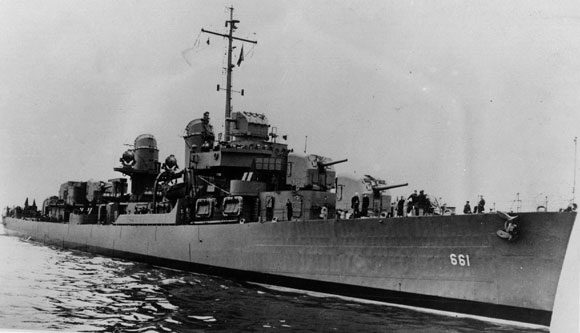
Kidd (DD-661) was a Fletcher-class destroyer named for Rear Admiral Isaac Campbell Kidd. He was born in Cleveland on 26 March 1884, went to the Naval Academy in 1902, and graduated in 1906. The midshipmen called him Cap, from Captain Kidd. In December 1941 he commanded Battleship Division 1 and was chief of staff to the battleship force, with his flag in Arizona (BB-39). On 7 December he was on her bridge, the senior officer present afloat, when a bomb struck the bridge and the forward magazines blew up. He was the first flag officer the United States lost in the war, and the first American admiral killed in action. The Medal of Honor was awarded after his death.
Federal Shipbuilding at Kearny laid her down on 16 October 1942. She went into the water on 28 February 1943, one of four destroyers launched that morning in fourteen minutes, with Bullard (DD-660), Thorn (DD-647), and the destroyer Turner. Mrs. Inez Kidd, the admiral's widow, sponsored her. Commander Allan B. Roby commissioned her on 23 April 1943. Crossing New York Harbor to the Brooklyn yard she flew a Jolly Roger. The papers treated it as the first pirate flag in that harbor in about a century. The crew took the seventeenth-century William Kidd as mascot, paid a New York artist $400 to paint him on the forward stack, and got written leave from Mrs. Kidd and from the Navy to keep the picture and the flag. That written leave is the one later ships of the name were given. Rescued carrier pilots were held to ransom in ice cream. She was among the first destroyers with a machine aboard to make it. The Pacific fleet got to calling her the Pirate of the Pacific.
Shakedown was out of Casco Bay in June 1943, then escort work in the Atlantic and the Caribbean. In August she went through the Panama Canal with Alabama (BB-60) and South Dakota (BB-57). On 12 September, in a practice torpedo attack, two star shells from North Carolina (BB-55) went through her. Nobody was hurt, and the damage was small. She reached Pearl Harbor on 17 September. Late that month she went out with the carriers for the strikes on Wake on 5 and 6 October and was back at Pearl on 11 October. In the middle of the month she went south with the fast carriers for the strike on Rabaul and the Bougainville landings. On the morning of 11 November, south of Rabaul, she dropped astern to pick up the crew of a plane from Essex (CV-9). Dive bombers found her while the rescue was still going. Her report credits three planes shot down and one probable. She finished the pickup. Roby received the Silver Star. She was at Espiritu Santo on 13 November, then screened the carriers for the Tarawa landings from 19 to 23 November. On 24 November a raid of about fifteen low bombers came in, and she shot down two. She was back at Pearl on 9 December. Christmas at Mare Island that year was a short turnaround. The long yard period came a year later.
Commander Harry G. Moore relieved Roby on 28 August 1944. She was in Destroyer Division 96 of Destroyer Squadron 48, doing the ordinary Fletcher work: antisubmarine screen, fighter direction, shore bombardment, and pilot rescue. In the Marshalls, from late January into February, she followed the minesweepers into Majuro lagoon ahead of the rest of the formation, bombarded Roi and Wotje, and anchored at Kwajalein. She guarded the new strip at Emirau from 20 March to 14 April, then Aitape and Hollandia from 16 April to 7 May. Off Saipan in June, she shifted to shore bombardment at Guam from 8 July to 10 August. The crew's count of carrier airmen taken out of the water that year ran to about thirty-five. A refit at Pearl Harbor filled late August into the middle of September. She entered Leyte Gulf on 20 October with the invasion fleet, screened the landings, fired in support of the troops, and left on 14 November for Humboldt Bay. On 9 December she sailed for Mare Island and moored there on Christmas Day for the overhaul.
She sailed on 19 February 1945 to join Task Force 58 for Okinawa. Through March she screened battleships, bombarded the beach, picked up pilots, sank mines, and stood radar guard. On 19 March she was one of the ships that stood by Franklin (CV-13) after the bomb that killed 724 of that carrier's crew. On 11 April she was on picket station about ninety miles east of Okinawa with Black (DD-666), Bullard (DD-660), and Chauncey (DD-667). The afternoon was already a fight. A little after 1345 one plane went for Black and was knocked down. A second dove on Bullard, and Bullard and Kidd shot it down together. About ten minutes later a plane broke out of the cloud on Kidd's port bow, strafed, and the bow 20 mm crews fired. Off the starboard quarter two aircraft looked like a dogfight. The action report reads that as a trick. One of them dropped to the water and ran at Black, 1,500 yards off Kidd's starboard beam. At 1409 it hopped over Black and came at Kidd. Neither ship could fire its heaviest guns without hitting the other. The 20 mm and 40 mm hit the plane and did not stop it. It struck amidships at the main deck, about five feet above the water, went through the forward fireroom, and destroyed the number-one boiler. The bomb was delayed. It kept going and burst just outside the hull. The blast wrecked the radar room, the combat information center, and the port side up to the bridge.
Thirty-eight men were killed. Fifty-five were wounded. The chief engineer, Lieutenant (junior grade) George P. Grieshaber, died in the forward fireroom. Commander Moore and the medical officer, Broox C. Garrett Jr., were among the wounded. Lieutenant Burdick H. Brittin, the executive officer, had been in the combat information center. He got to the bridge wounded and took the ship because Moore could not stand. She made about twenty-two knots on the boiler she still had. Smoke drew more planes. She and Hale (DD-642) fought them off, and a doctor came across from Hale. After dark another plane came in and was driven off. Brittin did not know whether it had been shot down. The dead were buried at sea the next morning, 12 April, the same day Franklin D. Roosevelt died. A brass plaque with the thirty-eight names was later set on the quarterdeck. After the burial Brittin fainted from loss of blood and woke on a hospital ship. He later said they had recovered what remained of the Japanese pilot and buried him with military honors. Lieutenant Richard L. Kenney had her from 12 April to 29 April. McNair (DD-679) screened her in to Ulithi. Temporary repairs were done alongside the tender Hamul.
Lieutenant Commander Fred M. Bush took her on 29 April. He had not fought the afternoon of the 11th. The pirate on the stack had been ordered painted off late in 1944. In the yard he had it put back on the number-one stack. She reached Hunter's Point, San Francisco, on 25 May. The yard rebuilt her and added the late-war anti-aircraft fit. She was repaired for an invasion of Japan that did not come. Ready again in early August, she sailed for Pearl Harbor on 1 August and missed the end of the war. She was back at San Diego on 24 September and was decommissioned on 10 December 1946 into the Pacific Reserve Fleet. Bush stayed with her into August 1946. For the Pacific war she received eight battle stars on the Asiatic-Pacific medal, the Philippine Presidential Unit Citation, and the Philippine Liberation Medal.
She was recommissioned on 28 March 1951 under Commander Robert E. Jeffery, reached Yokosuka on 15 July, and joined Task Force 77. She patrolled the Korean coast through 21 September. From 21 October to 22 January 1952 she bombarded from Wan-do south toward Koje, and she was back in San Diego on 6 February. A second tour began on 8 September 1952: screening a hunter-killer group near Kojo, bombardments in November, and patrols while the truce talks went on. In December, during Operation War Dance, she steamed at ten knots through Wonsan harbor to draw fire and silence the shore batteries. She left the Far East on 3 March 1953. On 21 April, in Long Beach, the Swedish freighter Hainan hit her and opened a fifteen-foot V that flooded the sonar room. No one was hurt. The repairs were finished by 11 May. WestPac cruises ran through 1959: Midway, Yokosuka, Sasebo, Okinawa, Hong Kong, a precautionary deployment during the 1956 Suez crisis, and Taiwan Strait patrols in the 1958 Quemoy-Matsu crisis. In September 1957 she and the submarine Redfish stood in for the film Run Silent, Run Deep off San Diego. Four battle stars came from Korea, twelve in all with the eight from the Pacific war.
In 1959 she moved to the Atlantic. She was called out for the Berlin crisis in October 1961 and showed the flag off the Dominican Republic that December. From 24 April 1962 she served the Naval Destroyer School at Newport, training reservists. She was decommissioned for the last time on 19 June 1964 and stricken on 1 December 1974. She was never given the FRAM modernization, which is why she could be put back into a 1945 fit. Towed from Philadelphia, she arrived at Baton Rouge on 23 May 1982 and opened on 27 August 1983 as the centerpiece of the Louisiana Naval War Memorial. She went on the National Register on 9 August 1983 and became a National Historic Landmark on 14 January 1986. She is one of four Fletchers still in existence, and the one kept in her wartime form. The destroyer escort Slater is the other American ship of that size preserved that way. Her berth is built for the Mississippi. She floats when the river rises and sits on keel blocks when it falls, a swing of up to about forty feet. Leaks found in the hull in 2019 forced a docking. She left the cradle on 25 April 2024, was towed to Thoma-Sea at Houma, and entered dry dock on 13 August 2024. Louisiana put up about $14 million. She left the dock on Veterans Day 2025. The move back to the downtown berth still waits on the river. The museum ashore stayed open. Two later destroyers took the name. They inherited the battle record and the written permission to fly the pirate flag. This is the ship that earned both.