Ships
- USS Kidd (DD-661) Captain from 29 April 1945
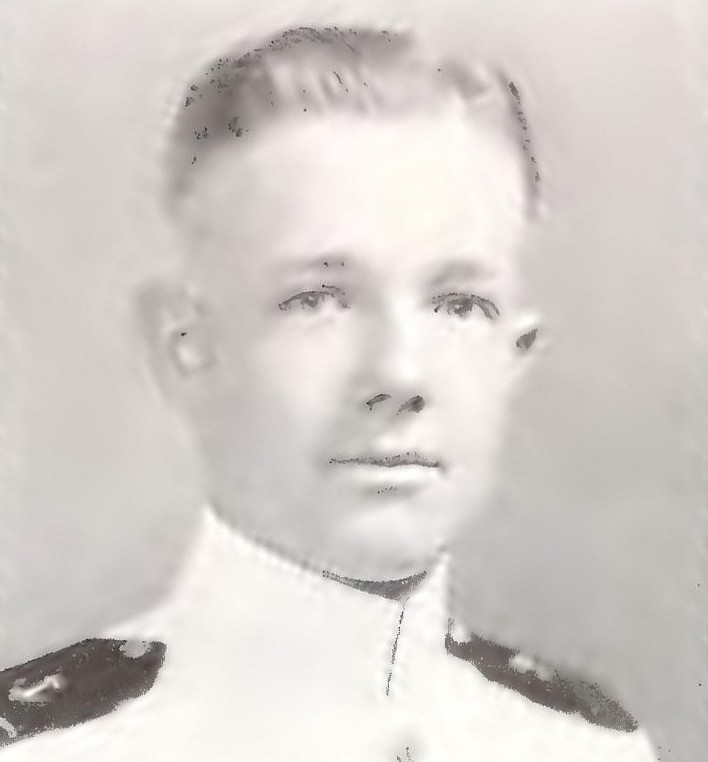
The Navy’s lists, from his midshipman year through the summer of 1945, know him as Fred Marshall Bush, Jr., of Mississippi, Naval Academy class of 1939. The notice his family published when he died says he was baptized Frederick Marshall Bush, Jr., and that as a boy he was called Fred Marshall, the name he used for life. He is not George H. W. Bush, not Hospital Apprentice Robert Eugene Bush, who won the Medal of Honor on Okinawa, and not the other Bushes who fill the wartime Registers—William Jack, William Whiteley, Howard Underwood, Frederick Elijah, Stone Elkin, Rufus Harrison. The destroyer Bush (DD-529) was not his ship and was not named for him.
Origins
He was born on 25 January 1917 in Mississippi. The Registers print that date beside his name from 1941 through 1945, and they give Mississippi both as the state of his birth and as the state from which he was appointed. The obituary prepared by his family places the birth at New Hebron and names the parents: Fred M. Bush, a lawyer, a farmer, and a state senator, and Elizabeth Buck Bush, a school teacher. His sister’s funeral notice, eight years after his death, gives the mother more fully as Elizabeth Stewart Buck Bush and the father as Fred Marshall Bush, and it names the other children: Charles Buck Bush, Hamilton Carl Bush, and Ann, born at New Hebron on 24 March 1925. He was baptized, the family said, at St. Andrews Episcopal Cathedral. The same notice says he finished New Hebron High School and Hinds Junior College before the Academy. The schools, and the father’s seat in the state senate, are the family’s account. They are not in the Navy Registers.
Formation
He entered the Naval Academy on 13 June 1935. That is the date of admission the Registers of 1941, 1942, and 1944 print beside his name. The Register of 1 July 1936 already lists him in the third class, which is where the class of 1939 stood once plebe year was over. The 1939 Lucky Bag calls him Freddie, of New Hebron, and says he came up from Mississippi in the summer of 1935 to look the place over, liked it, and stayed. Classmates remembered a tall, lanky Southerner whose interest in law, politics, the social life of the Yard, and the world in general survived the Academic Department. They credited him with judgment and with an unruffled calm through four years, and they predicted the same weather for the naval career ahead. The yearbook pictures him with the Ninth Company. The activity line that belongs to his half of the page—not to the three-striper who shares it—records boxing in his plebe year, wrestling in his third-, second-, and first-class years and in 1939, the Quarterdeck Society, the German Club, the Radio Club, and one petty-officer stripe. A mark after the boxing numeral did not read cleanly in the copy used here. In first-class year he sat on the governing board of the Naval Academy Christian Association; the Lucky Bag names F. M. Bush among the members under chairman Corwin Mendenhall.
He was commissioned ensign on 1 June 1939. The Registers say so in a footnote to his class. The Register of 1 July 1940 still carries him as an ensign with that date of rank, signal number 6608, present duty USS Gridley.
War years as lived
The first ship a Register actually names under him is USS Gridley (DD-380). On 1 July 1940, Ensign Fred Marshall Bush, Jr., was aboard her. The Register of 1 July 1941, which no longer prints the ship, still dates the start of his present cruise to 24 June 1939, and the end of the tour before that to August 1938. That is the pattern of a new ensign whose first sea duty had not yet been broken. The Dictionary of American Naval Fighting Ships, in the text carried by the destroyer-history project, has Gridley back at San Diego on 13 July 1939 as flagship of Destroyer Division 11, exercising off California until April 1940, then in Hawaiian waters for Fleet Problem XXI, and afterward operating out of Hawaii. If an unbroken cruise date means what it usually means, he joined her at the beginning of that Pacific tour, not after a separate year in another ship.
He was still on that cruise when the war opened, so far as these Registers can show. They do not give him a new ship in the 1941 volume. DANFS has Gridley clearing Pearl Harbor on 28 November 1941 in the antisubmarine screen of Enterprise, Admiral Halsey’s flagship, stopping at Wake, and turning back. On the morning of 7 December the task force was approaching Oahu when the message came: “Air raid on Pearl Harbor, this is no drill.” Gridley entered the harbor the next day. For the next five months the same history has her escorting transports and repair ships between Pearl Harbor and ports in the South Pacific. The Register of 1 July 1942 then closes his sea tour in March 1942 and opens another in May. If he was still in Gridley, he left during those escort months, before the ship’s later work off Alaska. The Registers never say the words “detached.” They show a cruise begun in June 1939, a ship named Gridley in the middle of it, and an ending in March 1942. That is the evidence. It is strong, and it is not a muster roll.
What the family later published differs in the details. Those differences are in the gaps. What the Registers and DANFS will support is an ensign on a destroyer that spent the last years of peace in Hawaiian exercises and was at sea with Halsey, short of Pearl Harbor, on the morning the war began.
Between March and May 1942 the Register shows him between cruises. On 8 May 1942, in the Naval Academy chapel, he married Katie Ruth Field. His funeral notice and hers both give that day, and both say he called it the happiest of his life. She had been born on 24 August 1916 in Centerville, Mississippi, daughter of Catherine Byrne Field and Jennings Pemble Field, a graduate of the University of Southern Mississippi and, in 1940, of a master’s course at the University of Tennessee. He had met her, his own notice says, on a blind date while he was a midshipman, and had told his roommate she was the girl he would marry. Sea duty had stretched the courtship. The wedding fell in the only interval the 1942 Register records between his first cruise and the next. On the Navy’s dates he was still an ensign that week. Permanent lieutenant (junior grade) is dated 1 June 1942, temporary lieutenant 15 June 1942. Her obituary remembers the bridegroom as a lieutenant (junior grade). The Register is the better clock.
The cruise that began in May 1942 is not given a ship’s name. Wartime Registers stopped printing stations. Her obituary says that while his ship operated out of New York she lived in an apartment in the East Thirties and walked each day to Harlem to teach nursery school. His own notice, drawing on a memoir he dictated in 1999, says the ship was Knight, that he was gunnery officer, and that the work included the landing of Patton’s troops in North Africa, then Sicily and Italy, and that from 1943, as executive officer, he made convoy trips across the Atlantic. None of that naming is in the Registers read for this essay. It is what he wanted remembered. A new duty in May 1942, a wife in New York, and a destroyer war in the Atlantic can sit together. They do not, by themselves, identify the hull.
The same family account sends him in the summer of 1944 to Maddox as executive officer, back to the Pacific with Halsey’s fast carriers, through a typhoon that cost the force three destroyers, and through a kamikaze in the Okinawa campaign. The Register of 1 July 1944 shows the rank and almost nothing else: temporary lieutenant commander from 15 March 1944, permanent rank still lieutenant (junior grade) from 1 June 1942, file number 82483, signal number 6074. Birth and entry are unchanged. No ship.
The ship’s museum history says that on 30 April “Cdr. Fred M. Bush” assumed command at Ulithi, after temporary repairs, and that she then went to Hunter’s Point in San Francisco. The Register of 1 July 1945 still lists Fred Marshall Bush among the lieutenant commanders, temporary rank still dating from March 1944. He was twenty-eight. He was not a commander on the lineal list that summer, whatever title the museum used.
He had not fought Kidd’s war. The museum history, a veterans’ narrative and not a deck log, places the kamikaze on 11 April 1945, about ninety miles east of Okinawa: a suicide plane into the forward boiler room, thirty-eight killed, fifty-five wounded, the commanding officer and the doctor among the badly hurt, the executive officer taking her south, the dead buried at sea on 12 April, Ulithi, and flags at half-mast for Roosevelt, who had died the same day. Bush came aboard after that. The museum says that in the shipyard he kept a promise made when he took command: the pirate figure, ordered painted off the stack in late 1944, went back on the number-one stack, and morale rose. Repaired for an invasion of Japan that did not come, Kidd was, on that same account, headed for Japan by way of Pearl Harbor in the days after Hiroshima, then returned to San Diego and was decommissioned on 10 December 1946. His obituary says he had thirty officers and three hundred men, that he called the command the most responsible, most challenging, most important, and most fun job he ever had, and that he stayed until August 1946. The museum does not name the day he was relieved. That difference is not settled here.
What can be said about him in the billet, without inventing a mood, is structural. A lieutenant commander of the class of 1939 was given a Fletcher that had just lost a boiler room and thirty-eight men. He took her to a yard and, on the museum’s account, gave the crew back a mark they had been ordered to paint out. The fighting for which Kidd is remembered was already over when he read his orders. His war as commanding officer was the damaged ship, the yard, the invasion that the bomb cancelled, and the long unwinding toward reserve.
Cost
The 1945 Register does not print beside his name the award symbols it prints for some of his classmates, and no citation turned up in this search. That is a fact about a printed page, not a proof that he was never decorated. The cost that can be documented is mostly other people’s, and the shape of his own life around it.
If he was in Gridley on 7 December 1941, he heard the war start from seaward of a burning base and entered the harbor the next day. The Register evidence says he was still on the cruise that had begun in her. It does not say what he did on that morning.
He married in the interval between sea tours, then went back to sea while his wife taught in Harlem and lived in a wartime apartment. The family notice says long separations had already marked the years before the wedding. There is no letter here, and no claim about how either of them bore it, beyond the fact that the marriage lasted until her death.
Kidd’s dead were not men he lost in action under his own command. They were his ship’s dead when he took her. Thirty-eight names were already on a brass plaque the tender’s crew had cast at Ulithi, if the museum history is right about that plaque. He inherited the hole in the side and a crew his own later account put at thirty officers and three hundred men. He was twenty-eight. The family said he found that weight the most serious work of his life and also the most enjoyable. Both sentences are his, as his children printed them. They are not a citation, and they are not a confession.
No child of the marriage appears in the wartime papers used here. The three sons belong to the years after.
After
His obituary says that shore duty after the war was two years with the NROTC unit at the University of Mississippi and a short tour in the Bureau of Naval Personnel, and that he resigned on 11 November 1948 to attend law school. He is not in the Register of 1 July 1949 under Fred Marshall Bush or Fred M. Bush. That fits a resignation from the regular Navy before that date. The same notice says he remained in the Naval Reserve for many years and retired a captain. Those reserve dates are not in the regular Registers read here, and they are not taken from the unofficial commander lists on the web.
He studied law at the University of Mississippi. The family said he stood first in the class. He practiced in Mississippi for about fifty years: Fant and Bush in Holly Springs from 1950 to 1960; Mitchell, McNutt, Bush, Lagrone & Sams in Tupelo from 1961 to 1989; then Phelps Dunbar in Tupelo from 1989, with an office as of counsel until he died. In 1960–61, the family said, the governor made him director of the Mississippi Agricultural and Industrial Board, predecessor of the state’s economic-development department. When he went back to the law the governor asked him to stay on the executive committee, and the notice says he kept that kind of appointment, under five governors, from 1952 to 1984. It lists the bar offices he held—president of the Mississippi State Bar, the Lee County Bar Association, the First District Bar, the Mississippi Bar Foundation, the Lamar Order, and the Mississippi Defense Lawyers Association, and years in the American Bar Association’s House of Delegates—and the civic ones: the Tennessee-Tombigbee Waterway Development Authority, Rotary, the Boy Scouts, the USO, the Community Development Foundation, and the Republican Party. He was a member of All Saints Episcopal Church in Tupelo for fifty years, vestryman and warden.
Katie Ruth Bush died at home on 15 February 2009. Cancer had been found the previous November. She was ninety-two, and he was with her. Her notice says a husband of sixty-six years, which is the count to their last anniversary in May 2008, not to a wedding in some other season. She had taught from nursery school through the university, had offered a course on marriage and the family at Ole Miss, and in Tupelo had pressed for teachers’ assistants and for a program she named Lift. The sons were Frederick Marshall Bush III, called Mike, of Jackson and New York; Carl Jennings Bush of Jackson; and Richard Stewart Bush, of Irvine, California, whose wife was Arla. Six grandchildren are named in his notice, and four great-grandchildren then living. His sister Ann Bush Dale survived him. The brothers Hamilton and Charles had died, and so had both parents.
In 1999, at eighty-two, on a trip with friends and Naval Academy classmates, he dictated what the family called Random Recollections of a Plowboy/Sailor/Lawyer and had it printed for them. The obituary says that book is where he described his own life, and that the funeral text drew on it. The book was not found in a public collection for this essay. What the public has is the children’s summary.
He died at home on 26 January 2011, the day after his ninety-fourth birthday, with family and caregivers there. One son’s line, printed in the notice, was that the cause of death was being ninety-four. The funeral was at All Saints in Tupelo on 31 January 2011. Another son’s summary, also printed there, was that he had been born good and had kept getting better. That is the family speaking. The Navy’s record stops earlier: a lieutenant commander who took a hurt destroyer home in the last spring of the war and then, on his children’s account, put the regular uniform away and became a Mississippi lawyer.