Building
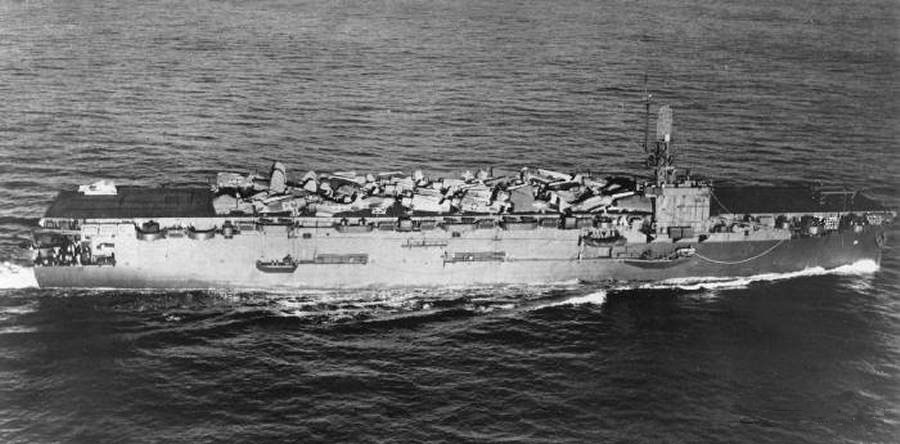
Kitkun Bay was the 17th of the fifty Casablanca-class escort carriers. Kaiser Shipbuilding was awarded her contract (Maritime Commission hull 1108) on 18 June 1942. She was laid down at Vancouver, Washington, on 3 May 1943 and named, under Navy Secretary Frank Knox's rule that escort carriers be named for "sounds, bays, and islands," for Kitkun Bay in Alaska. She was launched on 8 November 1943, sponsored by Mrs. Cruise, and commissioned at Astoria, Oregon, on 15 December 1943, Captain John Perry Whitney in command.
Ferry duty and the Marianas
Her first voyages carried Marine Torpedo Bomber Squadron 242 and cargo to Espiritu Santo and Efate in February 1944. She then trained with Composite Squadron 5 (VC-5) and became flagship of Carrier Division 26. She sailed on 31 May 1944 with the transports for Saipan, was made flagship of Task Unit 52.11.1 at Kwajalein, and on 13 June her fighters made their first kill. From 15 June she flew close support over Saipan. On the evening of 18 June, when 30 to 50 Japanese planes attacked, a twin-engine bomber dropped a torpedo within 100 yards of her. Her hard turn made it miss by about 25 feet.
The Battle off Samar
At Leyte she sailed with Clifton Sprague's Taffy 3. When Kurita's fleet attacked on 25 October 1944, she launched her Wildcats and Avengers under fire. Led by VC-5's commander, Fowler, her planes and others hit the heavy cruiser Chikuma, disabling her steering, and Kitkun Bay's planes later scored two torpedo hits on Chikuma's port side. Fowler then guided Avengers onto the cruiser Chōkai. He reported nine 500-pound bomb hits, and Chōkai was scuttled at 09:40. At 10:51 five Zeros of Lieutenant Yukio Seki's Shikishima unit, the first official kamikaze attack of the war, fell on Taffy 3. The first went for Kitkun Bay's island but at the last moment streaked just over it, perhaps because its pilot had been hit. One man was killed and sixteen wounded. St. Lo was sunk and Kalinin Bay badly damaged.
Lingayen Gulf
In January 1945 she covered the invasion force bound for Lingayen Gulf through days of kamikaze attacks that sank Ommaney Bay. At 18:57 on 8 January an Oscar crashed into her port side and tore a 7-by-15-foot hole, part of it below the waterline. Its two bombs did not explode, but its fuel tank did, and a friendly 5-inch shell burst near her bow in the same moment. Sixteen men were killed and 37 wounded. She listed 13 degrees and settled 4 feet by the stern, and her engine rooms flooded. Rear Admiral Ralph Ofstie shifted his flag to Shamrock Bay. Her crew moved planes to starboard, put out the fires by 19:10, pumped the list down to 4 degrees and got partial power back, and the fleet tug Chowanoc stood by to take her in tow.
Fate
After repairs she carried servicemen home in Operation Magic Carpet. She was decommissioned in April 1946, sold for scrap that November, and broken up in early 1947. She earned the Presidential Unit Citation as part of Taffy 3, along with battle stars for her World War II service.
Note: Wikipedia names her CarDiv 26 commander as "Harold Bushnell Salada." The officer was almost certainly Rear Admiral Harold B. Sallada. That name is left out above until it is checked.
Flag (Chōkai): The Kitkun Bay article credits Fowler's VC-5-led strike with crippling Chōkai and says she was scuttled at 09:40. The White Plains article cites Haguro's action report for a bomb hit at 08:51 and credits Ommaney Bay's Taffy 2 planes with the final sinking. Sources disagree on who should get credit.
Sources
Wikipedia, "USS Kitkun Bay" (citing DANFS, action reports, and Hornfischer, The Last Stand of the Tin Can Sailors).
NHHC/DANFS, "Kitkun Bay."