Ships
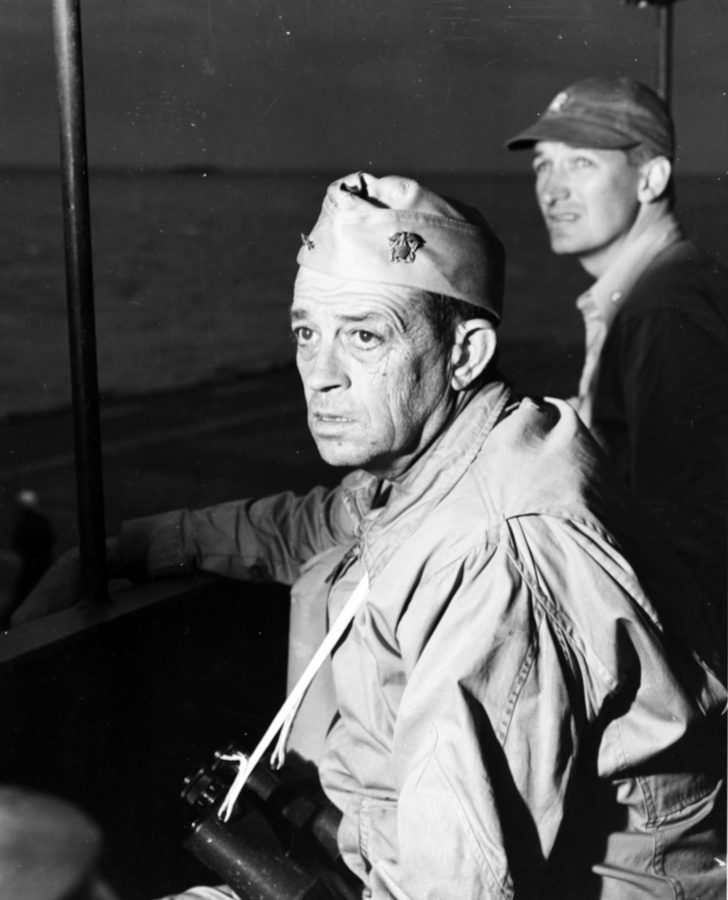
- USS Fanshaw Bay (CVE-70) Flag, 25 October 1944
Clifton Albert Frederick Sprague was born in Dorchester, Massachusetts, on 8 January 1896. Shipmates called him Ziggy. He entered the Naval Academy in 1914 and was commissioned an ensign in June 1917, with the class the First World War pushed through a year ahead of schedule. In 1920 he qualified as a naval aviator, and the air arm shaped the rest of his service.
He took command of the oiler Patoka when she returned to commission in November 1939. In 1940 he moved to the seaplane tender Tangier. He was still her commanding officer at Pearl Harbor on 7 December 1941, and the tender was among the ships that opened fire as Japanese aircraft came in over the harbor. He later served as chief of staff to the Gulf Sea Frontier, then returned to sea to place the fast carrier Wasp in commission in November 1943.
As commanding officer of Wasp he took her on the raids against Marcus and Wake in May 1944 and into the Marianas that June, covering the Saipan landings and fighting in the Battle of the Philippine Sea. He left the ship that summer as a rear admiral. On 23 July 1944 he became commander of Carrier Division 25 and hoisted his flag in the escort carrier Fanshaw Bay. In September the division supported the landing at Morotai.
By late October his division was Task Unit 77.4.3, the group that answered to the radio call Taffy 3, under the Seventh Fleet off Leyte. Rear Admiral Thomas L. Sprague held the larger escort-carrier command of which this unit was a part. On the morning of 25 October 1944 Ziggy Sprague had Taffy 3 off Samar, with his flag in Fanshaw Bay. The unit was there to cover the beachhead. Under his flag that morning were six escort carriers, three destroyers, and four destroyer escorts. He was the flag officer of the task unit. The carrier had her own captain.
A Japanese center force came out of the squall to the north: four battleships, six heavy cruisers, two light cruisers, and eleven destroyers, under Vice Admiral Takeo Kurita. Sprague turned his carriers downwind long enough to launch, then worked them away to the south while smoke was laid between them and the enemy. Pilots went off with the bombs and torpedoes already on the aircraft, and the destroyers and destroyer escorts were sent out to attack. Fanshaw Bay was hit and stayed afloat. Japanese guns sank the escort carrier Gambier Bay, the destroyers Hoel and Johnston, and the destroyer escort Samuel B. Roberts. Those sinkings stay with the gunfire of the center force and are not credited to any one Japanese ship.
The action ran through the morning. Air attacks and the torpedo runs of the screen broke up the Japanese formation, and the center force retired short of the transports and landing craft in Leyte Gulf. Later that same day a kamikaze sank another escort carrier of the unit, St. Lo. Sprague received the Navy Cross for his conduct of Taffy 3, and the task unit received a Presidential Unit Citation.
He remained with the escort carriers for the Iwo Jima operation and the opening of the Okinawa campaign, and was relieved during the fighting off Okinawa on 7 April 1945. In February 1946 he commanded a naval air group for the atomic tests at Bikini, Operation Crossroads, with his flag in Shangri-La. His last seagoing command was Carrier Division 6 in 1948, flag in Kearsarge, during a cruise in the Mediterranean. In March 1950 he became commandant of the Seventeenth Naval District at Kodiak, with additional duty as commander of the Alaskan Sea Frontier. On 12 November 1950 he became the first admiral to fly over the North Pole.
He retired on 1 November 1951 and was advanced to vice admiral on the retired list on the strength of his combat awards. Beside the Navy Cross he received the Legion of Merit four times, the later awards in the form of gold stars, for his command of Wasp, the Morotai landings, the Iwo Jima and Okinawa operations, and Operation Crossroads. He died in San Diego on 11 April 1955 and was buried at Fort Rosecrans National Cemetery. A waterfront memorial there honors him and the thirteen ships of Taffy 3, and the Navy later named the frigate Sprague for him.