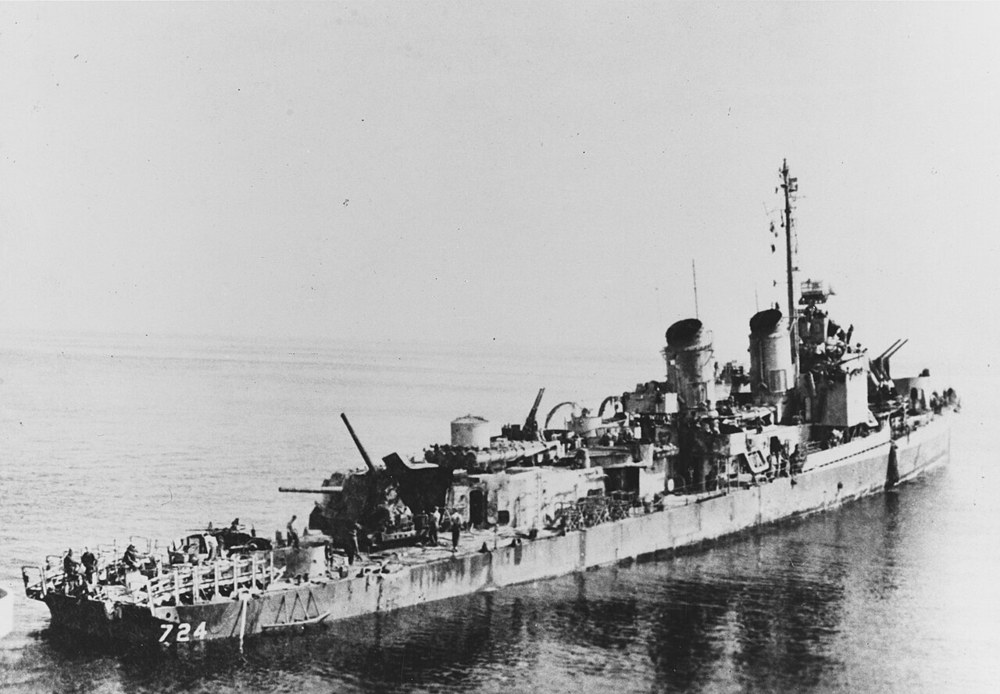
USS Laffey (DD-724) is an Allen M. Sumner-class destroyer, built by Bath Iron Works, launched on 21 November 1943 and commissioned on 8 February 1944 with Commander Frederick Becton in command. She was the second ship named for Seaman Bartlett Laffey, a Medal of Honor recipient of the Civil War. She is not the Laffey (DD-459) lost off Guadalcanal in November 1942.
Her first war service was in Europe. She screened ships to the Utah Beach area on D-Day, 6 June 1944, bombarded gun emplacements on 8 and 9 June, and on 25 June joined the bombardment of Cherbourg, where a ricocheting shell hit her above the waterline and failed to explode. She reached Pearl Harbor in September 1944, joined Task Force 38 at Ulithi on 5 November, and then covered the Ormoc Bay and Mindoro landings and the Lingayen Gulf landings. In February 1945 she supported Task Force 58 and the Marines on Iwo Jima. On 21 March she sortied with Task Force 54 for Okinawa and took part in the capture of Kerama Retto.
On 15 April 1945 Laffey took radar picket station 1, about 30 miles north of Okinawa. On 16 April about 50 Japanese aircraft attacked the picket. The ship was hit by four bombs and six kamikaze crashes and was strafed. Thirty-two of her crew were killed and 71 wounded. Fighters from the escort carrier Shamrock Bay and Marine Corsairs broke up part of the attack. Captain Becton is quoted as saying he would not abandon ship while a single gun would fire. She was taken under tow and anchored off Okinawa on 17 April, then sailed for Saipan after temporary repairs.
She survived the war and is today a National Historic Landmark and museum ship at Patriots Point, outside Charleston, South Carolina, at the same museum as the carrier Yorktown (CV-10).
Sources: Dictionary of American Naval Fighting Ships (DANFS) as reproduced on Wikipedia, NavSource Online (commanding officer list), and Wikimedia Commons (photograph record).