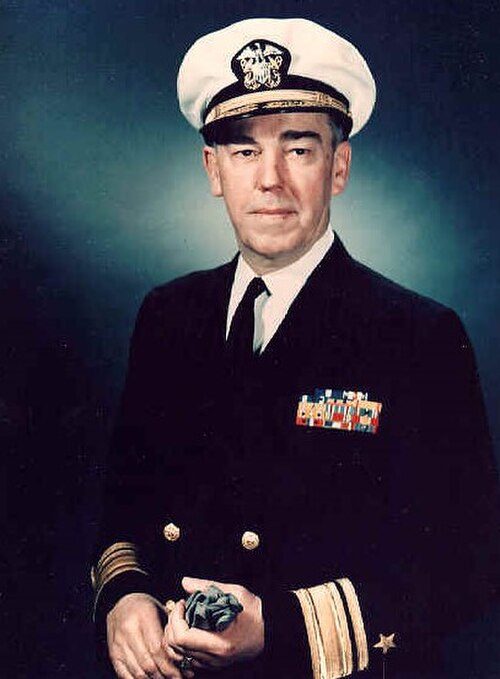
Ships
- USS Aaron Ward (DD-483) Captain, 18 February 1943 – 7 April 1943
The Register of Commissioned and Warrant Officers of 1 July 1944 prints Frederick Julian Becton, signal number 3469, in the commanders' list, and the index of that volume gives him file number 70065 on page 68. The optical character of the index reads 70005. The page image reads 70065. Hall of Valor prints the same number as NSN 0-70065.
Captain, on the command line, is the billet. His temporary rank as commander is dated 1 November 1942 at the head of the commanders' block in the 1 July 1944 Register and dittoed down to his line. His permanent rank on that line is lieutenant, from 1 July 1939, also dittoed. A Navy biographical sheet later printed by the Laffey association gives the same commander date, 1 November 1942, and lieutenant commander from 15 June 1942. The Register of 1 July 1942 already lists him as a lieutenant commander, signal 3922. If he took Aaron Ward on 18 February 1943, he was a commander, not a lieutenant commander. The dates are repeated by NavSource and by uboat.net. No deck log of the relief on 18 February 1943, or of the morning she sailed on 7 April, was read.
The same officer, by his own interview and by the citations issued to file 70065, commanded Laffey (DD-724) from her commissioning on 8 February 1944, including the radar-picket fight off Okinawa on 16 April 1945. A HyperWar transcription of the Dictionary of American Naval Fighting Ships prints the commissioning officer as "Comdr. F. J. Beston." That spelling is not his. The citations and the interview are. Laffey (DD-724) is a different ship from the earlier Laffey, DD-459, and he did not command that hull.
Origins
He was born on 15 May 1908. That day is the birth column on his line in the Register of 1 July 1944: 15 May 08. The date of entry beside it is 15 June 27. The Library of Congress authority for his book takes the same birthday from the publisher's data sheet, 15 May 1908. The register does not print a town.
The town in the later biographies is Des Arc, Arkansas. That is what the New York Times obituary says, what the Philadelphia Inquirer implies by calling him a native of Arkansas, and what two Navy-style sketches say outright, one copied on the Laffey association site and one on the Helena association site. The Lucky Bag of 1931, the class yearbook, heads his page "Hot Springs, Arkansas." The Laffey sketch says he went to high school in Hot Springs and then to the Naval Academy. Both places can be true. The register does not choose between them.
The same Laffey sketch names his parents as John E. and Ruby Brown Becton, both dead by the time the sheet was written. The Helena page says he was the son of the late Mr. and Mrs. John E. Becton. Neither page gives their dates, and the register does not mention them. John E. is as far as the initial is expanded. Nothing read here gives a fuller form.
The yearbook calls him Becky. The sketch beside the name is a classmate's, not an official life. It says Arkansas had long been famous for her travelers, that he had seen a billboard reading "Join the Navy and see the world," and that he shouldered a clarinet and went, first to Marion Institute and then to Annapolis. It says he had not lost the clarinet, that he was usually on the soccer field in the fall, that he was no great athlete, and that one would look long for a better man. The boxed list of activities on that page is set in two columns. In the optical character it is tangled with the biography of William Ross McCuddy, the man beside him, so the boxes are not used here. The prose is enough to show what his classmates chose to remember: the instrument, the school at Marion, the soccer field, Hot Springs. The billboard story is the joke they built around a fact the register also holds. He entered the Naval Academy on 15 June 1927.
Formation
He was graduated with the class of 1931 and commissioned ensign on 4 June 1931. The Register of 1 January 1932, with signal numbers effective 1 July 1932, places Ensign Frederick Julian Becton at signal 5710, date of rank dittoed as 4 June 1931 from the first line of that ensign block, present duty the battleship Texas. The Register of 1 July 1936 places him as lieutenant (junior grade), signal 4947, date of rank dittoed as 4 June 1934, present duty the Yangtze Patrol.
The Laffey sketch fills the years the registers only sample. It has him in Texas and Arkansas, then the destroyers Preston and Breckinridge, and from August 1935 until January 1938 on the Asiatic Station as engineer of the gunboat Guam and the destroyer Pope. The Helena page names the destroyer as William B. Preston. The July 1936 register's "Yangtze patrol" fits a river gunboat and does not name Guam. No Navy Directory line for Preston, Breckinridge, Guam, or Pope was opened for this essay, and no hull number is taken from memory. In June 1938, the same sketch says, he went back to the Naval Academy as an instructor in marine engineering and made the 1939 midshipmen's cruise in Texas. That tour is not in a register read here.
By 1 July 1944 the Register gives him special-course mark 18. In that volume, 18 means he had completed the Naval War College correspondence course in strategy and tactics. A later sheet also sends him to the War College in Newport for strategy and logistics in 1953. That is a second, resident course, not the correspondence mark of 1944.
The war found him in destroyers, but not yet in Aaron Ward, if his own memory is the one to follow. In an interview later held by the Operational Archives of the Naval Historical Center, and printed in adapted form by the Navy Memorial, he said he was in Gleaves when war was declared and went to Aaron Ward a short time afterward as chief engineer, then fleeted up to executive officer. He said he was in her for the night action off Guadalcanal on 12–13 November 1942. The Laffey sketch says something flatter and different: that he was already executive officer of Aaron Ward at the outbreak. The interview is his. The sketch is the smoother biography. They are not the same sentence.
The night the ship should have died, and the afternoon she did
Aaron Ward had been commissioned on 4 March 1942 under Commander Orville F. Gregor. The Dictionary account, in the transcription published by MaritimeQuest, puts her at Guadalcanal in the autumn. On the night of 12–13 November she was the leader of the four destroyers at the rear of Rear Admiral Daniel J. Callaghan's column, five cruisers and eight destroyers, standing back through Lengo Channel against Rear Admiral Hiroaki Abe's force, two battleships, a light cruiser, and fourteen destroyers. The Dictionary says two torpedoes passed beneath her. Barton, nearby, blew up. Aaron Ward fired on a ship to port and then on another, and the second target may have been the Japanese destroyer Akatsuki, which did blow up. A shell put her director out. In the minutes after that she took eight more hits. She lost steering at 0225, went dead in the water at 0235 with the forward engine room full of salt water, got steam back by pumping salt water into the tanks with a gasoline pump, and crept toward Sea Lark Channel until she stopped again. At daylight the battleship Hiei was circling between Savo and Florida Island. Four two-gun salvoes came over. The third straddled. Planes from Henderson Field drew Hiei off. Bobolink took Aaron Ward in tow. She anchored at Tulagi near Makambo Island at 0830. The Dictionary counts nine hits, fifteen dead, and fifty-seven wounded.
That is the ship's night. He was in her, by his own account, and he remembered the shells as nine, between five and fourteen inches, all of them above the waterline. He remembered being towed into Tulagi the next day and repaired later. He did not, in the interview as printed, say that he watched the first Laffey sink that morning. A museum page at Patriots Point says he did. The interview does not, and the claim is not used here. He was not her captain. Gregor still had her, on the lists, into 1943. What the night taught, if a later life is allowed to show it, is on the page already: a destroyer can be hit nine times, lie dead in the water under a battleship's guns, and still be brought in.
She reached Pearl Harbor for permanent repairs on 20 December 1942 and rejoined the fleet on 6 February 1943. The compiled list and the commanding-officer compilations date Becton's command from 18 February 1943. Nothing read here is the order that relieved Gregor.
On 7 April 1943 she was his, if those lists and the later sketches are right. The Dictionary tells the afternoon without printing his name. It says "the latter's captain." The captain's plan, in that account, was to retire east through Lengo Channel once the air-raid warning came, as other ships were doing. The movements are specific enough to belong to someone standing on that bridge. He later told the interviewer that he was on board when she sank off Guadalcanal in April 1943. The sketches say he was commanding officer before she went down. The compiled list says the same. The name is supplied from those sources, not from the Dictionary paragraph itself.
She had gone ahead of the fast transport Ward and three tank landing craft, bound from the Russells toward Savo, to give them air cover into Tulagi. About noon she was warned of a raid on Guadalcanal. About 1330 she was ordered off her own convoy to cover LST-449 off Togoma Point. She joined the landing ship at 1419, told her to follow and to zigzag when planes came, and shaped the turn east. A dogfight showed over Savo. Three planes came out of the sun. She went to flank speed, put the rudder hard left, and opened with the 20-millimeter and 40-millimeter guns and then the five-inch. The first bomb was a near miss and opened the side into the forward fireroom. The second hit in the engine room and took the electrical power off the five-inch and 40-millimeter mounts. The gunners shifted to local control and kept firing. A third bomb holed her port side near the after engine room. The rudder had no power. She kept swinging left. Three more dive bombers came. None of their bombs hit. Two landed very near the port side. The Dictionary gives the cost as twenty dead, fifty-nine wounded, and seven missing.
Ortolan and Vireo came. The crew, the Dictionary says, was determined, and it was not enough. The two ships tried to put her on a shoal near Tinete Point. At 2135 Aaron Ward sank stern first in forty fathoms, six hundred yards short of the shoal. The Dictionary text as transcribed awards her four battle stars and then, in a note by the transcriber, says the fourth star belongs to Aaron Ward (DM-34) and was copied out of a 1953 award manual. That correction was not checked against the manual.
He had had the ship for seven weeks, on the lists, and he had lost her. The interview does not linger on the afternoon. It moves him, in the next sentence, to the staff of Commander Destroyer Squadron 21.
The staff and the new ship
In May 1943, the Laffey sketch says, he became operations officer on the staff of Commander Destroyer Squadron 21, in the flagship Nicholas. The Silver Star for that duty is Commander, South Pacific, serial 002122, of 12 October 1943, as Hall of Valor prints it. The action dates are 5 to 13 July and 17–18 August 1943, night engagements in the Solomons. The citation says he understood the objectives, advised the squadron commander in controlling the vanguard destroyers of a cruiser-destroyer force in which several enemy ships were sunk and many damaged, and that in a later assault the flagship led a destroyer division and, by gun and torpedo fire, destroyed two destroyers, severely damaged a third, and annihilated a number of landing barges.
His interview puts names on those nights, and the names slip. He remembered the night of 6 July as "the First Battle of Kolombangara or Kula Gulf," with Helena sunk and Nicholas and Radford staying behind to pick up survivors and fight Japanese ships still in the gulf. A week later, he said, the same cruisers and destroyers went out again under Admiral Ainsworth, whose name he spelled Ainesworth, with the destroyers under Captain McInerney. After the occupation of Vella Lavella they fought Japanese destroyers and barges to the north of the island. The destroyers turned and ran. The barges did not. The citation's first span, 5 to 13 July, covers both Kula Gulf and Kolombangara. The second, 17–18 August, is the Vella Lavella night. He had folded the first two battles into one name. Hall of Valor prints his rank for this award as "Commander [then Lieutenant Commander]." The Register and the biographical sheet both date his temporary rank as commander from 1 November 1942, months before these nights. The bracket in the transcribed citation and the register do not agree. The original citation paper was not seen.
The sketch adds that Nicholas won a Presidential Unit Citation for the night of 5–6 July 1943, and that he received a letter of commendation from Commander South Pacific Force. The unit citation was the ship's. He was staff, not her captain. The 1 July 1945 Register records distinctions only through 1 May 1945, and on his line it shows two Silver Stars and no commendation code. A later data sheet lists a Commendation Ribbon with a bronze star and the combat "V." Whether that ribbon is the 1943 letter, recorded late, is not settled by anything read here.
Laffey (DD-724) was laid down at Bath Iron Works on 28 June 1943, launched on 21 November, and sponsored by Beatrice F. Laffey, daughter of the seaman for whom the ship was named. The Dictionary, in the HyperWar transcription, commissions her on 8 February 1944. His interview says the same day, and says the ceremony was at the Boston Navy Yard. He said he assumed command at the commissioning. The Laffey sketch says the same. From that day until he was ordered ashore in 1945, the ship's war is his war. What she did after he left is not.
She trained, crossed with a convoy in May, and reached Plymouth on 27 May 1944. On 3 June she sailed for the Normandy beaches escorting tugs, landing craft, and two Dutch gunboats. The Dictionary puts the group off Utah beach at dawn on 6 June. On the 6th and 7th she screened to seaward. On the 8th and 9th she bombarded gun emplacements. On 12 June she went after E-boats that had torpedoed the destroyer Nelson, broke their formation, and stopped a further attack. That is the Dictionary. The second Silver Star, a gold star in lieu of a second award, is Commander, Twelfth Fleet, serial 10564, of 30 October 1944. It covers the assault in June and the bombardment of Cherbourg on 25 June. The citation says he maneuvered through mined water and under accurate shore fire, protected ships of the Western Task Force from surface ships and submarines, took light damage, put Laffey between the batteries and other ships of a bombardment group, kept firing, covered the retirement of minesweepers and battleships, and later maneuvered so the battleships could get out of range.
On 25 June the Dictionary has her with Nevada in Bombardment Group 2 off Cherbourg. Shore batteries hit Barton and O'Brien. Laffey was hit above the waterline by a ricocheting shell that did not explode and did little damage. He remembered it, years later, as an eight-inch shell that fortunately did not explode. The Inquirer remembered it, from him, as an unexploded eight-inch shell lodged in the superstructure. The Dictionary does not give the caliber. She was at Belfast on 1 July and Boston on 9 July. The sketches add the French Croix de Guerre, with a star or a gold star depending on which page is read. Foreign awards are not in the distinction key of the 1945 Register, so the register neither confirms nor denies it.
After overhaul she went out again through the Canal and San Diego and reached Pearl Harbor in September. On 5 November 1944 she joined the screen of Task Force 38 at Ulithi. On 11 November she left the screen long enough to pick a badly wounded Japanese pilot out of the water and, the next day, to put him aboard Enterprise. At the end of November she went to Leyte with Destroyer Squadron 60 and the Seventh Fleet. On 7 December she was off Ormoc Bay for the landing of the 77th Division. The Dictionary says she screened the heavy ships, silenced a shore battery, and shelled troops. His interview says the convoy was under attack from about ten in the morning until dark, and that this was the ship's first day with the kamikaze. The Silver Star for Ormoc, a second gold star in lieu of a third award, is Commander, Seventh Fleet, serial 03024, of 24 May 1945. The citation speaks of shore batteries, constant air attack, gunfire against fortified beaches, and an anti-aircraft screen that covered the convoy out.
Mindoro followed on 15 December, with the close support group, and then the empty landing craft back to San Pedro Bay. No separate decoration for Mindoro turned up. In January 1945 she was in Lingayen Gulf for the landing on Luzon. The fourth Silver Star, a third gold star in lieu of a fourth award, cites that work: restricted waters, aircraft, shore batteries, screening, bombardment, and fire support for underwater demolition teams. Hall of Valor prints no serial number and no date of the order for this one. It prints the ship, again, as Laffey (DD-459). It does the same on the Normandy citation, the Ormoc citation, and the Navy Cross. DD-459 was the first Laffey, a different ship. Her loss was not read in a Dictionary entry opened for this essay, and nothing read here puts him in command of her. Every one of those four citations belongs, by date and by his own account, to DD-724. The hull number on the transcribed citations is wrong.
She was back at Ulithi on 27 January. In February she screened Task Force 58 for the strikes on Tokyo and the support of Iwo Jima. He remembered joining Admiral Mitscher, the Tokyo strikes in mid-February, the turn south for Iwo, a second Tokyo strike about 24 February, then Ulithi again until the Okinawa sortie. The Dictionary adds that late in February she carried intelligence to Admiral Nimitz at Guam, arriving 1 March. On 21 March she sailed with Task Force 54. He said they arrived off Okinawa on 24 March and screened the battleships and cruisers until the landing on 1 April. The Dictionary has her helping at Kerama Retto, bombarding, harassing the beach at night, and then, on 14 April, on a radar picket station thirty miles north of the island, where she helped beat off a raid that cost the enemy thirteen planes. His interview puts the station at about thirty-five miles and calls it station number one. The bad morning, in his telling and in the citation and in the obituary, was 16 April. The Dictionary says the severe attack came "the next day" after the 14 April raid, and it never prints the date 16 April. "The next day" can be read as the 15th. The citation cannot. The citation is followed here for the date. The Dictionary is followed for the fact that the station had already been fought over before the morning that made the ship's name.
Sixteen April
What he described, in the interview, was an attack that began about 8:27 in the morning. Four Vals split, two for the bow and two for the stern. The ship shot down three. A nearby landing craft support helped with the fourth. Two more came in from the bows and were shot down. About the seventh plane crashed amidships and set a fire large enough, he said, to mark her as a cripple. After that the planes came at the wound. Two from astern went into the after five-inch mount. The first, he said, carried a bomb that exploded on deck. The second dropped its bomb and then crashed into the mount. Two more, from the port quarter, hit the deckhouse just forward of that mount and poured gasoline into the compartments below. Fires were going in the after living spaces and around the after 40-millimeter mount. A bomb near the port propeller jammed the rudder at twenty-six degrees left. Another plane took off the yardarm. A Corsair chasing it took off the air-search radar. A bomb fragment cut the power to the number-two five-inch mount. That mount, in manual control, knocked down an Oscar at about five hundred yards. Mount one knocked down a Val at about the same distance. A strafing plane dropped a bomb just below the bridge, wiped out two 20-millimeter guns, and killed men in the wardroom dressing station. It did not crash the ship. Fighters got it after it had passed over. The last plane was hit by the Corsairs and the ship's guns, struck the water, and skidded into the side hard enough to dent it.
He also described, a little later in the same interview, keeping a low plane on the beam with left rudder so the guns could bear, watching it skid aft, and seeing it nick the number-three mount and go into the water instead of the engine room. The adapted transcript repeats and crowds the sequence. It is his memory of the morning, not a deck log. He said the action lasted an hour and twenty minutes. He said twenty-two planes attacked, that the ship shot down nine unassisted, and that eight struck her, seven of them trying to. Five of those seven, he said, did the real damage. Four of eleven 20-millimeter mounts could still fire. Eight of twelve 40-millimeter barrels could still shoot, in local control. The after five-inch mount was gone. The engines were intact. The fires were not out. She was flooding aft. The rudder stayed jammed until she reached port. He said they had lost thirty-three men killed or missing, and that about sixty were wounded, about thirty of them badly. Radar operators told him they had seen as many as fifty bogies on the way in. The combat air patrol over the ship at the start was about ten planes. When it was over, he said, there were twenty-four.
He named two men. Lieutenant T. W. Runk, USNR, the communications officer, went aft through wreckage to try to free the rudder and threw an unexploded bomb over the side on the way. Two engineers were driven by the heat into the after diesel-generator room, with no ventilation, until a man beat a hole through the bulkhead with a hammer and chisel and an air hose was passed in. Other men cut a hole in the deck with a torch and got them out. Both, he said, went back to the fires. The initial T. W. is as the transcript gives it. It is not expanded here.
The Navy Cross citation, as Hall of Valor prints it, is a different set of numbers and the same morning. It says thirty hostile planes, six of which crashed into the ship, eight shot down, two further bombs, a fight of over two hours, severe structural damage, loss of armament, heavy casualties, and a commanding officer who kept control, directed emergency repairs while the firing was still going on, and brought the ship out of it afloat and still able to fight. The phrases it spends on him are "unremitting tenacity of purpose, courageous leadership and heroic devotion to duty under fire." It does not quote him. It does not say he refused to abandon ship. That sentence comes from 1995.
The Dictionary has still another count: about fifty planes in the raid, about half of them breaking through to the ship, nine splashed by Laffey, four bombs and five kamikaze hits, 103 casualties, thirty-two dead and seventy-one wounded. It has her taken in tow and anchored off Okinawa on 17 April, patched, sailed for Saipan on a date that put her there on 27 April, and at Seattle on 24 May, in dry dock at Todd until 6 September. His interview takes the tow only as far as the story he was telling: a minesweeper about three hours after the action, then a tug, a second tug pumping, Okinawa the next morning, soft patches on four holes, about five days, then Saipan, Eniwetok, and Pearl Harbor. He speaks of that passage as "we." He does not, in the printed interview, mention Seattle.
The Inquirer, from an interview with him near the fiftieth anniversary, said seventy-nine minutes and twenty-two planes, at least eight shot down, five hits, thirty-one of the crew dead, the rudder jammed, gasoline and fire each time a plane hit. The Times said twenty-two suicide planes, six of which struck, and two bombs, one of which jammed the rudder. The Times said he escaped injury. None of these accounts was a deck log. They are not going to be averaged into a seventh number. The morning is solid. The arithmetic is not.
What he said he decided is in the Inquirer, and it is late testimony, given to Larry Fish and put into the Congressional Record by Representative Curt Weldon. Near the end, one of his officers, Frank Mason, came to him and said they were in bad shape aft and asked whether he thought he would have to abandon ship. Becton told the paper it had never entered his mind. The ship might sink under them. They might not be able to sail her. He was not going to abandon her. He said he answered, "No, Frank, I'll never abandon ship as long as a gun will fire." Patriots Point prints a harder line, with "No!" and "a single gun." The Inquirer is the one that claims to have had it from him, and it includes Mason's name. The citation does not. Whether he said it on the bridge in those words, or only remembered it that way fifty years later, is not something a 1945 log in hand would be needed to doubt. No such log was read.
He had already lost one destroyer. He knew the order to abandon was a real order, not a phrase. On Aaron Ward the fight to save her had been lost at 2135, six hundred yards from a shoal, with twenty men dead, seven missing, and fifty-nine wounded, on the Dictionary's numbers. On Laffey he would not give the order while a gun would fire. Men died anyway. The counts run from thirty-one to thirty-three dead or missing, and the wounded from about sixty to seventy-one, depending on who is believed. He was not one of them, if the Times is right that he escaped injury. The ship was afloat and not in his hands for long after that. The sketches say that before the war ended he was ordered to the Navy Department, and that on 12 August 1945 he reported to the training activity of the Bureau of Naval Personnel. In 1946 he was officer in charge of the enlisted training section. The day he left Laffey is not in any log read here. A commanding-officer compilation on uboat.net ends the tour on 26 June 1945, which would still have him in her when she reached Seattle. That date is the compilation's, and it is not treated as a fact.
Hall of Valor's hull number aside, the Navy Cross is his, for 16 April 1945, as commanding officer. The 1 July 1945 Register does not yet show it. Distinctions in that volume run only through 1 May 1945. His line there is marked (E)(E), two Silver Stars. The Ormoc award's serial is 24 May 1945, after the cutoff. The Lingayen award and the Navy Cross were for actions already fought, in January and on 16 April, and they were not yet on the page. By the end of the war the sheets credit him with the Navy Cross, four Silver Stars, the Croix de Guerre, and the two unit citations, Nicholas and Laffey. The Register of 1 July 1944, before Normandy, shows only the single (E).
What he did with the rest of it
The biographical sketch on the Laffey site is the spine of the postwar career. It is a Navy-style sheet, copied by a ship association, and it has typos. It is not a register, and no Register after 1947 was opened. The 1947 Register still prints the name BECTON FREDERICK JULIAN, and the broken columns around it contain the digits 5, 15, and 08, which match the birthday already established. The duty station and the rank line in that volume are too scrambled to quote.
The sketch sends him through the personnel course at Northwestern in June 1948. A later personal-data sheet calls the same schooling a master of science in personnel administration. Then he was executive officer of the cruiser Manchester from September 1948 to April 1949, and for fifteen months commander of Destroyer Division 202, with his pennant in A. M. Sumner. The Navy Memorial's header makes him commanding officer of Allen M. Sumner. The sketch does not. The header also gives him a birthday of 8 May 1915, which the Register contradicts, and it is not used for anything else.
He went back to the Bureau of Naval Personnel, had a short period of instruction in 1952, and commanded the transport Glynn for two years. The Dictionary entry for Glynn (APA-239) does not print his name. The sketch is the authority for the command, and the hull number is the Dictionary's for a ship of that name, not a line that ties him to it. After Glynn the sketch puts him in the Office of the Chief of Naval Operations, as assistant to the director of the surface-type warfare division and head of combined and joint training. Under orders of 20 September 1956 he commanded the battleship Iowa. In 1958 he was director of the enlisted personnel division in the Bureau. He had further instruction in the Chief of Naval Operations' office, then served as executive officer to the personnel directorate of the Joint Staff. In September 1959 he became commander of Cruiser Division Five. In July 1960 he was given additional duty as Commander Mine Force, Pacific Fleet. A month later he gave up the cruiser division and kept the mine force. From 30 September 1960 he also had the naval base at Los Angeles. In October 1964 he reported as Commander, Naval Reserve Training Command, at Omaha. The copy of the sketch ends there.
The personal-data sheet dates the later promotions: captain from 1 January 1951, rear admiral from 1 December 1959. The Inquirer says he was promoted to captain in 1951 and to rear admiral in 1959, and that he retired in 1966. No retirement order was read. Thirty-five years is what Weldon said in the House, counting from the commissioning in 1931 to 1966. The Navy Memorial header says June 1931 to July 1966. That header has already been wrong about his birthday, so the month of retirement is not taken from it. The year 1966 is the obituary's.
When he retired, the Inquirer says, he and his wife moved to her hometown, Wynnewood, Pennsylvania. She was Elizabeth Hilary Reuss. The Helena sketch, written while it could still call the daughters children, says he was married to the former Elizabeth Hilary Reuss of Wynnewood and that they had two daughters, Hilary, nine, and Julie, three. The later data sheet names them Hilary Reuss Becton and Julie Bradford Becton, and lists the wife as dead. The Inquirer in December 1995 names the survivors as the two daughters only, Hilary Becton Wagner and Julie Bradford Becton. No marriage date, no date for Elizabeth's death, and no birth dates for the daughters were found. The ages nine and three belong to whatever year that sketch was current, which the page does not give, except that it already calls him rear admiral, so it is not earlier than December 1959. Computing birth years from those ages would be a guess, and it is not done.
He wrote the crew's book. The Library of Congress cites The Ship That Would Not Die (1980), title page "Rear Admiral F. Julian Becton, USN, Ret.," and a data sheet with the birthday 15 May 1908. The Times gives the publisher as Prentice-Hall. A Naval History and Heritage Command study later cites a 1987 Pictorial Histories edition. That edition was not seen. The Inquirer says he kept in touch with former crewmen. The ship he would not leave is at Patriots Point, as a museum. That survival is the ship's, not a consolation invented for him. He had already put the story in a book and left it with the men who had been there.
He died at home in Wynnewood. The Inquirer piece reprinted in the Congressional Record, and described there as having appeared on 26 December 1995, says he died on Sunday, at eighty-seven. Weldon's own sentence says Christmas Eve. The Helena page, copying the obituary, prints Sunday, 24 December 1995. That Sunday was Christmas Eve. The Times obituary of 30 December, as the Library of Congress authority reads it, gives the death date 25 December 1995, and the Times headline in search says he died on Monday. Hall of Valor and the Navy Memorial header also say 25 December. The Laffey association page heads the sketch "1908–1996," which is the wrong year. A viewing was set for 10 a.m. on 3 January 1996 at Ardmore Presbyterian Church, a service at 11, and burial at 11 a.m. on 4 January at Arlington. Those arrangements are the Inquirer's. Which of the two December days is the true one was not settled by anything else that was read.