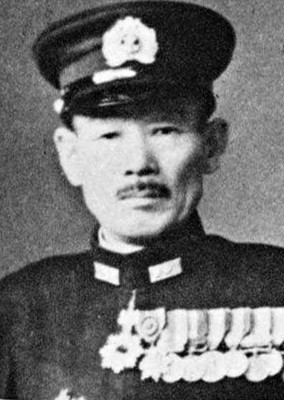
Hiroaki Abe was born on 15 March 1889. He graduated from the Imperial Japanese Naval Academy in 1911 with the 39th class, 26th of 148 cadets. He specialized in torpedo work, served as a junior officer through the First World War, and received his first destroyer command in the early 1920s. In 1925 he was captain of the destroyer Kaki. He completed the 23rd class of the Naval Staff College, became a commander in December 1928, and a captain on 1 December 1932.
As a captain he led destroyer divisions and taught at the Naval Staff College. From 1 December 1936 to 1 December 1937 he commanded the light cruiser Jintsu. He then commanded the battleship Fuso until April 1938, and afterward the 14th Naval Air Group. He was promoted to rear admiral on 15 November 1938. He served as a senior instructor at the Naval Academy, took Destroyer Squadron 6 in November 1940, and on 1 August 1941 became commander of Cruiser Division 8.
Cruiser Division 8 consisted of the heavy cruisers Tone and Chikuma. Abe commanded the division. He was not captain of either ship. The division sailed with Vice Admiral Chuichi Nagumo’s carrier striking force for the Hawaii operation. On 7 December 1941 Tone and Chikuma screened the carriers off Oahu and sent floatplanes over the island ahead of the air attack.
The first Japanese landing attempt at Wake Island was repulsed on 11 December 1941. Tone and Chikuma were not in that bombardment. For the second landing, on 23 December 1941, Tone and Chikuma joined the attack force with Abe. He was the senior officer of the detachment sent back from the Pearl Harbor force, covering the troops with those two cruisers and the carriers Soryu and Hiryu. Wake fell that day. Cruiser Division 8 remained with the carrier force through the South Pacific seizures early in 1942 and the Indian Ocean raid.
At Midway in June 1942 Abe was still commander of Cruiser Division 8 and the officer next senior to Nagumo. Tone and Chikuma screened the carriers and flew search planes on the morning the American carriers were found. The force lost four fleet carriers. On 14 July 1942 Abe left Cruiser Division 8 and took the 11th Squadron, the fast battleships Hiei and Kirishima. He led that pair as the vanguard ahead of the carriers at the Battle of the Eastern Solomons, from 23 to 25 August 1942, and at the Battle of the Santa Cruz Islands, from 26 to 28 October 1942. At both battles his superiors pressed him to close, judging that he was holding the vanguard back. On 1 November 1942 he was promoted to vice admiral.
On the night of 12–13 November 1942 he took Hiei, his flagship, with Kirishima, the light cruiser Nagara, and eleven destroyers in toward Guadalcanal to shell Henderson Field ahead of a troop convoy. Off Lunga Point the force met Rear Admiral Daniel Callaghan’s cruisers and destroyers in a close-range night action of about forty minutes. Hiei was left unable to maneuver, Abe was wounded, and his chief of staff was killed. Two Japanese destroyers were lost. The American cruiser Atlanta was sunk in the fight, and the cruiser Juneau went down the next day. Callaghan was killed. Abe turned away without bombarding the airfield. He ordered the crippled Hiei scuttled on 13 November after further air attack. She was the first Japanese battleship lost in the Pacific War. Kirishima was sunk two nights later under another commander.
Henderson Field was still operating the next morning, and the reinforcement convoy was turned back. Abe was relieved of the 11th Squadron on 20 December 1942. A naval inquiry held that he should have taken time to replace shore-bombardment shells with armor-piercing shells, and that he had broken off while Kirishima was still able to shell the field. He went to the Navy General Staff and left active service in March 1943. His younger brother, Toshio Abe, a career officer, was lost as captain of the carrier Shinano on 29 November 1944. Hiroaki Abe died on 6 February 1949.