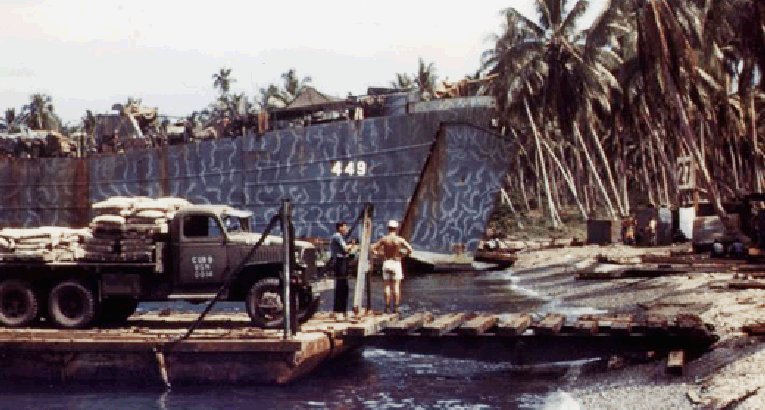
LST-449 was a tank landing ship built by Kaiser at Vancouver, Washington. She was laid down on 10 July 1942, launched on 30 September 1942, and commissioned on 31 December 1942. Lieutenant Carlton Stanley Livingston, of the Naval Reserve, was her first commanding officer and had her through June 1943.
Her first campaign was the consolidation of the southern Solomons, from April to June 1943. On 7 April she was off Togoma Point, Guadalcanal. Aaron Ward, which had been covering a convoy in from the Russell Islands, was ordered off that convoy about 1330 and joined her at 1419. The destroyer told her to follow and to zigzag when planes came. Lieutenant (junior grade) John F. Kennedy was a passenger on the landing ship that day. He was not her commanding officer, and he was not in command of the destroyer. Dive bombers came out of the sun at the destroyer and hit her. The landing ship's sailors, with the gunners of the small ships nearby, drove off the planes that turned on her. She was not hit. Aaron Ward went down that evening under tow for a shoal she did not reach.
Lieutenant L. Lisle, of the Naval Reserve, had her from June 1943 until 26 December. Cape Torokina, on Bougainville, in November and December 1943, falls in his tour. In November she loaded on a Guadalcanal beach for the run north. Lieutenant Roy G. Parlier had her from 26 December 1943 into November 1944, including the Guam operation in July 1944. Lieutenant Jack E. Britain, of the Naval Reserve, had her from November 1944 until 1 October 1945, including Iwo Jima in February and Okinawa in April. Lieutenant S. W. Kerr had her from 1 October 1945 through occupation duty and the decommissioning.
She stayed in the Far East on occupation duty into early November 1945. She was decommissioned on 16 March 1946, struck on 28 March 1946, and sold for scrap on 27 January 1947. She earned five battle stars and the Navy Unit Commendation. The stars match the Solomons, Cape Torokina, Guam, Iwo Jima, and Okinawa.
A note on sources. The builder, the dates, the campaigns, the stars, and the Navy Unit Commendation are the Dictionary of American Naval Fighting Ships, which does not name 7 April or Kennedy. The afternoon off Togoma Point, the 1419 junction, and the passenger are Aaron Ward's history. The five commanding officers are NavSource. NavSource dates Lisle's tour from June 1643, a typographical error for June 1943. Lisle's given name is only the initial L., and Kerr's names are only initials. The November 1943 Guadalcanal photograph is a Navy photograph by way of NavSource, of the beach loading for the run north, not of the raid of 7 April.