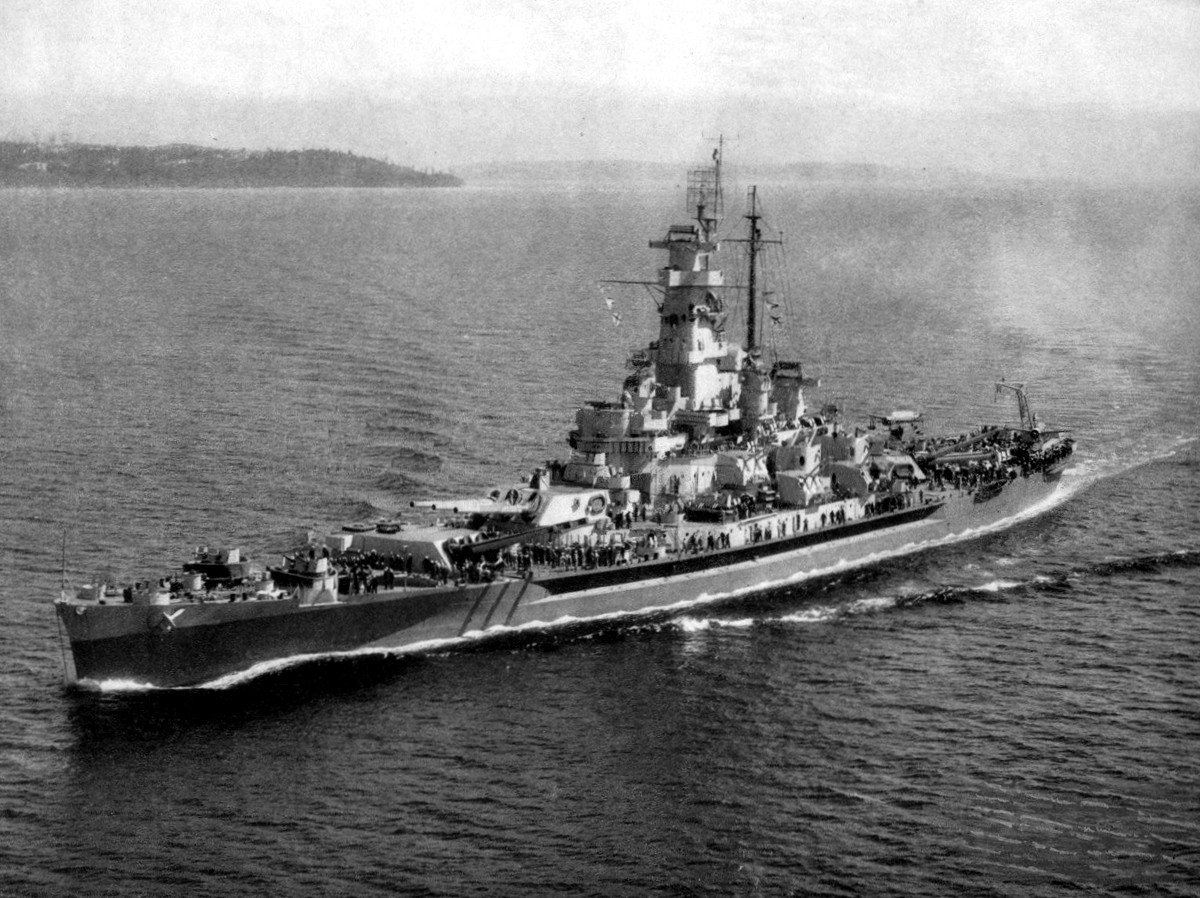
Building
Massachusetts was the third of the four South Dakota-class fast battleships. She was a compact treaty design with nine 16-inch guns, armored against guns of her own caliber, and her crew grew crowded as wartime antiaircraft guns were added. Bethlehem Steel's Fore River Shipyard at Quincy, Massachusetts, laid her down on 20 July 1939. She was launched on 23 September 1941 and commissioned on 12 May 1942.
Casablanca
Her first action was in the Atlantic, during Operation Torch. On the morning of 8 November 1942, off Casablanca, she was assigned to neutralize the El Hank coastal guns, the French submarines, and the unfinished battleship Jean Bart, which lay in harbor with only half her main battery installed. She opened fire at 07:04 at about 22,000 meters and came under Jean Bart's fire that morning. Wichita and Tuscaloosa took on El Hank and the submarine pens while Massachusetts dueled the French battleship. She broke up French destroyer attacks and scored five hits on Jean Bart, putting her turret out of action. She then turned on the coastal batteries, an ammunition dump, and merchant ships in the harbor.
The Pacific, 1943–1944
She reached Nouméa on 4 March 1943 and escorted convoys to the Solomons for months. On 19 November she sailed with carrier group TG 50.2, alongside Indiana and North Carolina, for the strikes on Makin, Tarawa and Abemama that covered the Gilberts landings. On 8 December she bombarded Nauru. In January 1944, assigned to Task Force 58, she screened the carriers striking the Marshalls to isolate Kwajalein. She escorted the carriers in Operation Hailstone, the great raid on Truk on 17 February, and supported the Hollandia landing on 22 April, striking Truk again on the way back. She was then overhauled at Puget Sound, where her worn-out guns were relined.
She returned for the October 1944 campaign. She screened the carriers striking Okinawa on 10 October and Formosa from 12 to 14 October, then Luzon in support of the Leyte landings. In the Battle of Leyte Gulf she was with Halsey's carriers in the north when Kurita came through the San Bernardino Strait. She escaped serious harm when Typhoon Cobra battered the fleet after the Manila strikes of 14 December 1944 and sank three destroyers.
1945
From 30 December 1944 to 23 January 1945 she screened Task Force 38's raids on Formosa and Okinawa for the Lingayen landing. She supported the Iwo Jima strikes, the raid on Okinawa on 1 March, and the Kyūshū strikes from mid-March. From 23 March she joined the preliminary attacks on Okinawa, and she was detached with Indiana, New Jersey and Wisconsin as Task Force 59 to shell the island. On 14 July she was detached to form Task Group 34 for the first bombardment of the Japanese home islands. The target was the industrial complex at Kamaishi, home of the Japan Iron Company and the Kamaishi Steel Works and Japan's second-largest iron and steel center. Two weeks later she shelled the industrial plants at Hamamatsu, and on 9 August she bombarded Kamaishi again.
Fate
She left Japanese waters on 1 September 1945 for overhaul at Puget Sound. She was decommissioned at Norfolk on 27 March 1947 and stayed in the Atlantic Reserve Fleet until she was struck in 1962. The Massachusetts Memorial Committee raised the money to save her, partly through a campaign in which schoolchildren across the state donated. On 8 June 1965 the Navy transferred her to the state, and she became the museum ship at Battleship Cove in Fall River. Some of her equipment was removed in the 1980s to reactivate the Iowa-class battleships, but otherwise she remains in her wartime configuration.
Sources
Wikipedia, "USS Massachusetts (BB-59)" (citing Garzke & Dulin, Friedman, Morison, DANFS).
NHHC/DANFS, "Massachusetts VII."