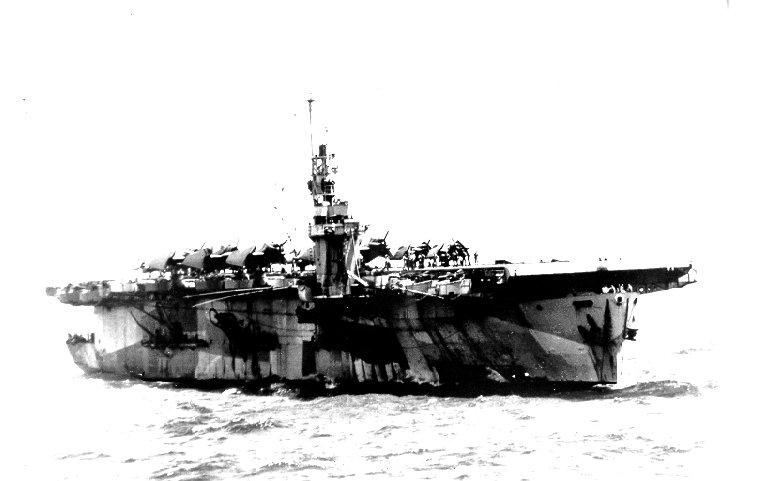
Natoma Bay (CVE-62) was laid down as Begum (MC hull 1099), 17 January 1943, by the Kaiser Shipbuilding Co., Inc., Vancouver, Washington, under Maritime Commission contract; renamed Natoma Bay 22 January 1943; launched 20 July 1943; sponsored by Lady Halifax, wife of the United Kingdom's ambassador to the United States, and commissioned 14 October 1943, Captain Harold L. Meadow in command.
After shakedown off the California coast, Natoma Bay performed aircraft and personnel ferrying duties between San Diego and Hawaii for Commander, Fleet Air, West Coast, until 3 January 1944. Then, with VC-63 embarked, she departed San Diego for Pearl Harbor, reporting to ComCarDiv 24, 5th Amphibious Force, 10 January. On 23 January, she sortied with TG-51.2 for the invasion of the Marshalls. Between 31 January and 7 February, as positions on Majuro Atoll were consolidated, CVE-62 furnished anti-submarine and combat air patrols and area searches for the attack force. On 8 February, she extended her operations to Wotje and Maloelap, alternating for the remainder of the month between those islands and Majuro.
Departing Majuro, 7 March, Natoma Bay reached Espiritu Santo on the 12th. Three days later, she joined TF-37 for air strikes and surface bombardments against Kavieng, New Ireland, 19-20 March. She then cruised to the north of the Solomons and New Ireland, providing air cover for convoys to and from Emirau, where an air base and a limited naval base were being established. During the next three weeks, she continued to cruise in the Solomons-Bismarck Archipelago area in support of the protracted offensive to neutralize the latter and seal off the Japanese fortress at Rabaul.
On 19 April, she rendezvoused with TF-78 and then steamed toward New Guinea where her planes pounded enemy positions in support of a three-pronged attack by Allied land and naval forces against Aitape, Hollandia, and Tanahmerah Bay, 22 April. During and after the landings, Natoma Bay launched protective air patrols and sent fighters and bombers to destroy Japanese installations in the Aitape area. Returning to Manus for engine repairs, 28 April, she sailed 7 May for Pearl Harbor, arriving 18 May.
After loading 37 Thunderbolt (P-47D) fighters of the 7th Air Force, Natoma Bay departed Pearl Harbor 5 June enroute to the Marianas. Steaming via Eniwetok, she arrived off Saipan 19 June and was ordered to retire eastward until the Battle of the Philippine Sea was decided. On the 22nd, she steamed westward and commenced catapulting the Army planes toward their destination, Aslito Air Field, Saipan. She dispatched 25 on the 22nd and the remainder early on the 23rd, then retired to a refueling area 45 miles east of Saipan.
There, the formation came under enemy air attack. Intensive anti-aircraft fire prevented damage to the main targets, Natoma Bay and Manila Bay (CVE-61). The latter ship, with Army fighters still on board, then catapulted those aircraft to provide protective CAP until the radar screens were clear of contacts.
Natoma Bay returned to Eniwetok, 27 June, embarked casualties, and sailed for San Diego, arriving 16 July for availability, logistics and ferry duty. Between 5 and 14 September, she conducted qualification and training exercises for composite squadron 81 off Pearl Harbor, and on the 15th, got underway for Manus as a unit of the 3rd Fleet. On 3 October, she reached Seeadler Harbor and began final preparations for the invasion of the Philippines.
Assigned to the Escort Carrier Group (TG-77.4), Natoma Bay departed the Admiralties, 12 October, for waters east of the Philippines. After weathering stormy seas, 14th-17th, she commenced offensive flight operations on the 18th. Prior to the invasion, her planes bombed Japanese positions and conducted strafing runs against enemy vehicles and small craft on and around Leyte and Negros. During the amphibious assault on the 20th, she launched ground support, spotting and air cover strikes. Then, during the critical days following the landings, she sent bombers and fighters to support the ground forces.
On 25 October, as Natoma Bay, flagship of Rear Admiral Stump, CTU 77.4.2 ("Taffy 2"), cruised off the eastern entrance to Leyte Gulf, the Japanese launched a tri-force offensive to drive the Allies from Leyte, and from the Philippines. During the early morning hours, the enemy's Southern Force was soundly defeated in Surigao Strait. Surviving Japanese ships retreated into the Mindanao Sea pursued by destroyers, PT boats, and after sunrise, by carrier based aircraft.
At 0658, "Taffy 3," (6 CVEs, 3 DDs, and 4 DEs) cruising off Samar under Rear Admiral C. Sprague, was attacked by the vastly more powerful Japanese Center Force (4 BBs, 6 CAs, 2 CLs, 12 DDs) under Admiral Kurita. At 0701, having ordered all operational planes launched, Adm. Sprague requested any available assistance. Admiral Ozawa's Northern Force, however, had already accomplished its mission--Admiral Halsey's TF-38 had been drawn off to the north. The cruisers and battleships under Admiral Oldendorf were replenishing after their battle in Surigao Strait. Help could only come from the south. At 0702, "Taffy 2," 20 miles to the south-southeast, responded and by 0708 all available planes were enroute. Those already dispatched on routine missions were recalled.
In the running battle which ensued, the determination of self-sacrificing destroyers and destroyer escorts of "Taffy 3" and fighters and bombers of the three Taffies resulted in an almost unbelievable, but necessary, victory in the Battle off Samar.
Ordered not to concentrate on any particular ship, but to cripple as many as possible, planes from Natoma Bay conducted two strikes against the enemy within an hour and a half. At 0926, a third strike with 500 pound SAP bombs in lieu of torpedoes, was launched. At 1118, a fourth strike was sent off to push the maneuvering enemy away from Leyte Gulf but with neither torpedoes nor armor piercing bombs aboard, the planes took off carrying only general purpose bombs and depth charges. At noon, Natoma Bay's fighters, launched previously for CAP, were landed, rearmed and sent up again. At 1256 and at 1508, the 5th and 6th strikes were launched to further pursue the enemy as it retreated toward San Bernardino Strait. Fighter planes, armed with 250 pound general purpose bombs, were among those dispatched with the last strike.
At the end of that fateful day's operations, TG 77.4, with "Taffy 3" bearing the brunt of the damage, had turned back the Japanese Force. Praise for the escort carrier group was unbounded. They had ". . . accomplished a task that only a large carrier task force should be expected to undertake . . ." Natoma Bay's contribution to the earning of this praise included 1 heavy cruiser sunk, 1 torpedo plane shot down, and hits on 1 battleship, 3 heavy cruisers, 2 light cruisers and 1 destroyer.
The following morning, 26 October, Natoma Bay's planes, continuing to pound the enemy, assisted in the sinking of a light cruiser and her accompanying destroyer in the Visayan Sea and then resumed support of ground forces on Leyte. On the 27th, her fighters strafed Japanese vessels in Ormoc Bay and then swung over Samar where they downed a "Tony." A "Nell" was bagged on the 28th and on the 30th the CVE sailed for Seeadler Harbor, arriving 4 November.
Natoma Bay got underway for Kossol Roads 27 November and departed from there 10 December to provide air cover for the Mindoro invasion convoys as they transited the Mindanao and Sulu Seas. On the 13th, kamikazes from Negros attacked the formation. Eleven were shot down, but three pressed home the attack. Two were downed by anti-aircraft fire, but the third scored on the destroyer Haraden (DD-585). Japanese aerial attacks continued on the 14th and Natoma Bay's fighters added 7 "Zekes" to their total.
During and after the Mindoro landings, 15 December, Natoma Bay provided air cover and ground support, protecting screening vessels from kamikazes and strafing Japanese positions. After recovering her planes on the 16th, she retired to Kossol Roads, thence to Manus, returning to the Palaus at the end of the month.
On 1 January 1945, Natoma Bay, reassigned to CarDiv 25, sortied once again with ships of an attack force, the target this time, Luzon. There, after battling enemy nuisance and suicide raiders enroute, she, with 5 other CVEs, provided air cover for the Bombardment and Fire Support Group prior to the landings, and direct air support ahead of the amphibious troops after the assault in the San Fabian area. Between the 10th and the 17th, her continuous direct air support missions resulted in the damage and destruction of bridges, fuel and ammunition dumps, barracks, roads and vehicles.
After replenishment at Mindoro, Natoma Bay cruised west of Mindoro until the 29th. She then moved into position to support amphibious landings on the west coast of Zambales Province and at Subic Bay, remaining there until 1 February. Her task group, 77.4, then retired, reaching Ulithi on the 5th.
Her wartime commanding officers, from NavSource: Captain Harold Letcher Meadow, 14 October 1943 to 7 August 1944; Captain Albert Kellogg Morehouse, 7 August 1944 to 1 March 1945; Captain Bromfield Bradford Nichol, 1 March 1945 to 22 March 1946.
Sources: Dictionary of American Naval Fighting Ships (DANFS), Wikipedia, NavSource Online (commanding officers) and Wikimedia Commons (photograph records).