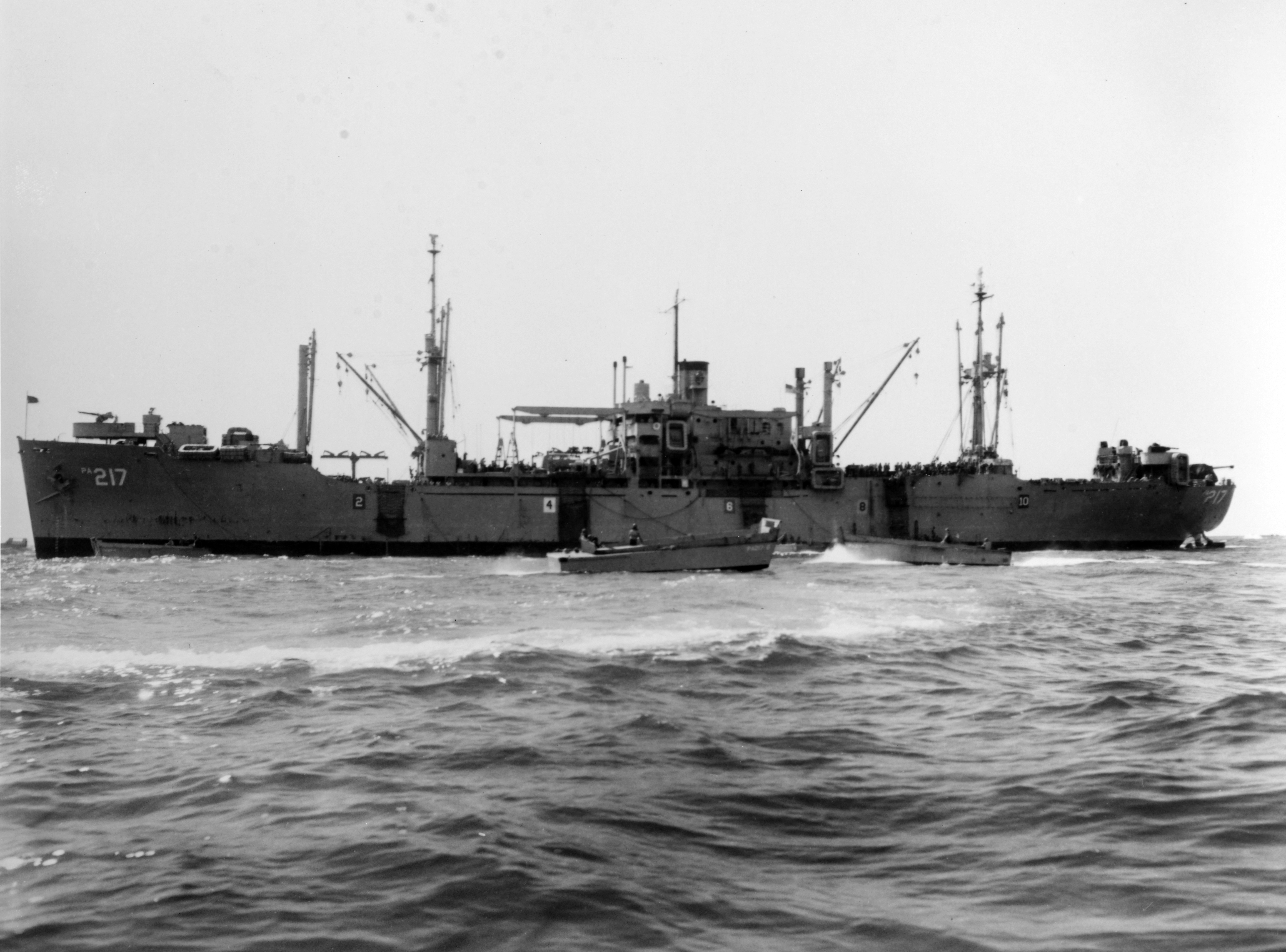
A Virginia county provided the name, and New Kent (APA-217) was the first ship to carry it. Permanente Metals, Yard No. 2, at Richmond laid the keel on 11 July 1944 under a Maritime Commission contract. The launch on 12 October 1944 was sponsored by Mrs. W. J. Maher. Commissioning followed on 22 November 1944 with Captain Frank Monroe, Jr., in command.
Shakedown was off California. On 20 January 1945 she left San Diego, called at Pearl Harbor, and shaped for the Marshalls carrying men to fill out the 4th Marine Aircraft Wing. She arrived on 4 February, unloaded at Majuro and Kwajalein, and on 10 February cleared for Guadalcanal to train for the Okinawa invasion. The combat sailing was 15 March. On the morning of 1 April, D-day, she was off the western beaches. The troops went ashore that afternoon. A beach party followed the next day. She stayed in the transport area, under frequent enemy air attack, until 7 April, then left for Guam and continued to Pearl Harbor, arriving 23 April.
A month in the Hawaiian Islands ended on 29 May, when she sailed for the west coast. Seattle received her on 6 June. An overhaul lasted until 26 June. She then went to Honolulu, embarked 300 Japanese prisoners, and brought them to San Francisco on 11 July 1945. Berthing spaces were enlarged. On 28 July she sailed for Eniwetok and the Philippines with cargo. Japan's acceptance of the surrender terms found her still at sea. She entered San Pedro Bay at Leyte on 17 August.
Army troops moved under her between positions on Luzon until 20 September, when she left Lingayen Gulf with occupation troops for Wakayama. She arrived on 25 September, finished unloading the next day, and sailed that afternoon for Subic Bay, which she reached on 1 October. A second occupation run to Japan lasted from 15 to 28 October. Manus came next, on 5 November, and 2,000 passengers boarded for her first Magic Carpet voyage. San Pedro, California, saw them ashore on 19 November. A second lift, to Guam, ran from 5 to 21 December. She met New Year's Day 1946 at San Francisco.
The Panama Canal was behind her in mid-March, and Norfolk was the arrival on 20 March. For the following year she drilled along the Atlantic seaboard, the Gulf, and among the Caribbean islands. Decommissioning came on 29 July 1949. She berthed with the Orange, Texas, group of the Atlantic Reserve Fleet until she recommissioned on 10 October 1951 and went back to training along the western Atlantic. A voyage to Casablanca in July 1952 was the exception. In the spring of 1954 she was inactivated again and returned to Orange on 12 July. She stayed there until her name was struck on 1 October 1958. One battle star was credited for the war.