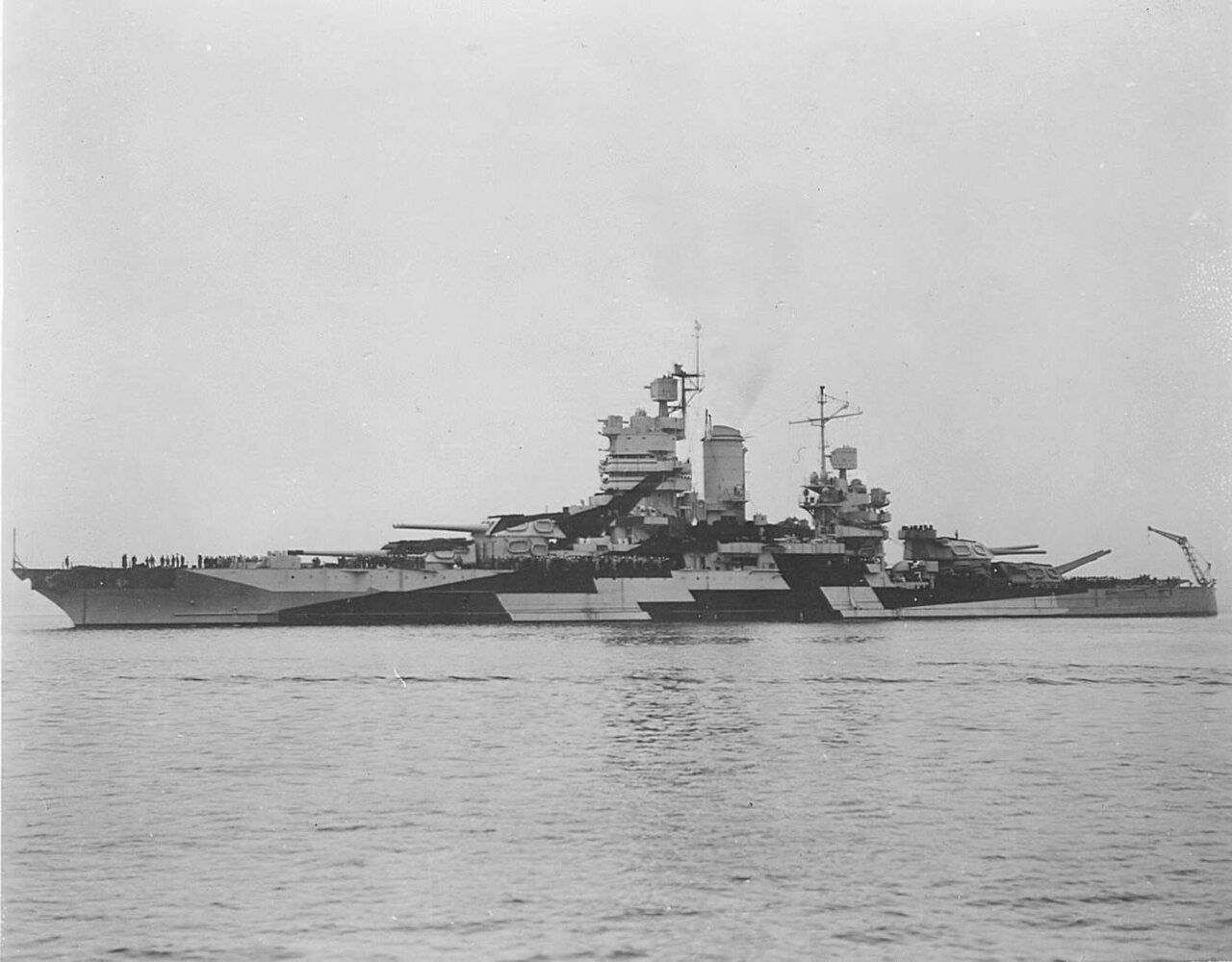
Building the "Queen of the Fleet"
Congress authorized the ship on 30 June 1914. She was to have been named California, but was renamed while still on the ways, the first Navy ship named for the young state of New Mexico. Her keel was laid at the New York Navy Yard on 14 October 1915. She was launched in April 1917 and commissioned on 20 May 1918, with Captain Ashley Herman Robertson in command. She was the lead ship of a class of three. Her sisters Mississippi and Idaho had conventional machinery, but New Mexico was the Navy's first battleship with turbo-electric drive: General Electric turbines turned generators, which powered motors on her four shafts. That made her the most advanced warship in the fleet. She carried twelve 14-inch/50 guns in four triple turrets, a 13.5-inch armor belt, and a crew of 1,084, and she could make 21 knots.
Between the wars
In January 1919 she escorted the liner George Washington, carrying President Woodrow Wilson to France for the Versailles peace conference. On the way home she took the crew off a foundering schooner and then sank the derelict with her secondary guns. On 16 July 1919 she became flagship of the newly created Pacific Fleet and arrived at San Pedro that August. For the next decade she trained with both fleets, cruised to South American ports and, in 1925, to Australia and New Zealand. She was also used in the first trials of Nicolas Minorsky's PID controller for automatic steering, an idea now used throughout control engineering. From March 1931 to January 1933 the Philadelphia Navy Yard modernized her. Her turbo-electric drive was replaced with geared turbines, and she received eight 5-inch/25 antiaircraft guns. She won so many gunnery, engineering and battle-efficiency awards that her crew called her the "Queen of the Fleet." Fleet Problem XVII in 1936 also showed that her 21 knots was barely faster than Japan's slowest battleships, a lesson that led to the fast North Carolina and South Dakota classes.
Atlantic, 1941
She was based at Pearl Harbor from December 1940 to May 1941. On 16 June 1941 she joined the Atlantic Fleet at Norfolk for neutrality patrol and convoy escort. On 10 December 1941, heading south after Pearl Harbor, she accidentally rammed and sank the freighter Oregon near the Nantucket Lightship. The courts later found her blameless. She went through the Panama Canal by 17 January 1942.
The Pacific war
After an overhaul at Puget Sound that traded secondary guns for antiaircraft weapons, she escorted convoys to Fiji from December 1942 to March 1943. She then went north for the Aleutians. Operating from Adak, she supported the attack on Attu in May 1943, and she shelled Kiska on 21 July, a week before the Japanese slipped away. On 20 November 1943 she bombarded Makin in the Gilberts and guarded the transports at night.
In 1944 she shelled Kwajalein and Ebeye (31 January – 1 February), Wotje (20 February), and Kavieng on New Ireland in March. In mid-June she bombarded Tinian, Saipan and Guam and helped drive off two air attacks on 18 June while the carriers fought the Battle of the Philippine Sea. She returned to pound Guam from 21 to 30 July. After an overhaul at Bremerton she escorted convoys into Leyte Gulf under daily air attack.
On 6 January 1945, during the pre-invasion bombardment of Lingayen Gulf on Luzon, a kamikaze crashed into her bridge. It killed her captain, Robert Walton Fleming, and 29 others, and wounded 87. Among the dead was Lieutenant General Herbert Lumsden, the British representative to General MacArthur and the most senior British Army officer killed in combat in the war. Admiral Sir Bruce Fraser, commander of the British Pacific Fleet, was on the bridge and narrowly escaped, though his secretary was killed. Her guns kept firing while the crew repaired the damage. After repairs at Pearl Harbor she joined the Okinawa fire-support group and opened fire on 26 March. On 11 May she destroyed eight Shinyo suicide boats. Just after sunset on 12 May, entering the Hagushi anchorage, she was hit by two kamikazes, one crashing aboard and the other hitting her with its bomb. Fifty-four men died and 119 were wounded, but the fires were out within 30 minutes.
She was at Saipan when news of the surrender came. She entered Sagami Wan on 27 August to support the airborne landing at Atsugi, and on 2 September 1945 she was in Tokyo Bay for the surrender. She earned six battle stars.
The "Battle of Newark Bay"
She reached Boston on 17 October 1945, was decommissioned there on 19 July 1946, and was struck on 25 February 1947. On 9 November 1947 she was sold for $381,600 to the Lipsett Division of Luria Brothers for scrap. On the tow south, heavy weather forced the tugs to cut her loose on 12 November, and she drifted as a derelict with three men aboard until a Coast Guard plane found her 35 miles offshore. Newark, which was beautifying its waterfront, then refused to let her in and sent fireboats to block her. The press called it the "Battle of Newark Bay," and the Santa Fe Chamber of Commerce protested the "slur" on her namesake state. Under Secretary of the Navy W. John Kenney worked out a settlement: New Mexico, Idaho and Wyoming could be broken up at Newark, but there would be no permanent scrapyard, and Lipsett had nine months to finish. The Queen of the Fleet was scrapped at Newark under that deal.
Date flag: Wikipedia gives her launch as 23 April 1917 in its lead and 13 April 1917 in its service history. Check DANFS.
Sources
Wikipedia, "USS New Mexico (BB-40)" (drawing on DANFS and NavSource).
NHHC/DANFS, "New Mexico I."