Ships
- USS Enterprise (CV-6) Flag, not her captain, 4 June 1942
- USS Indianapolis (CA-35) Flag, not her captain, Philippine Sea and Iwo Jima
- USS New Mexico (BB-40) Flag, not her captain, 12 May 1945
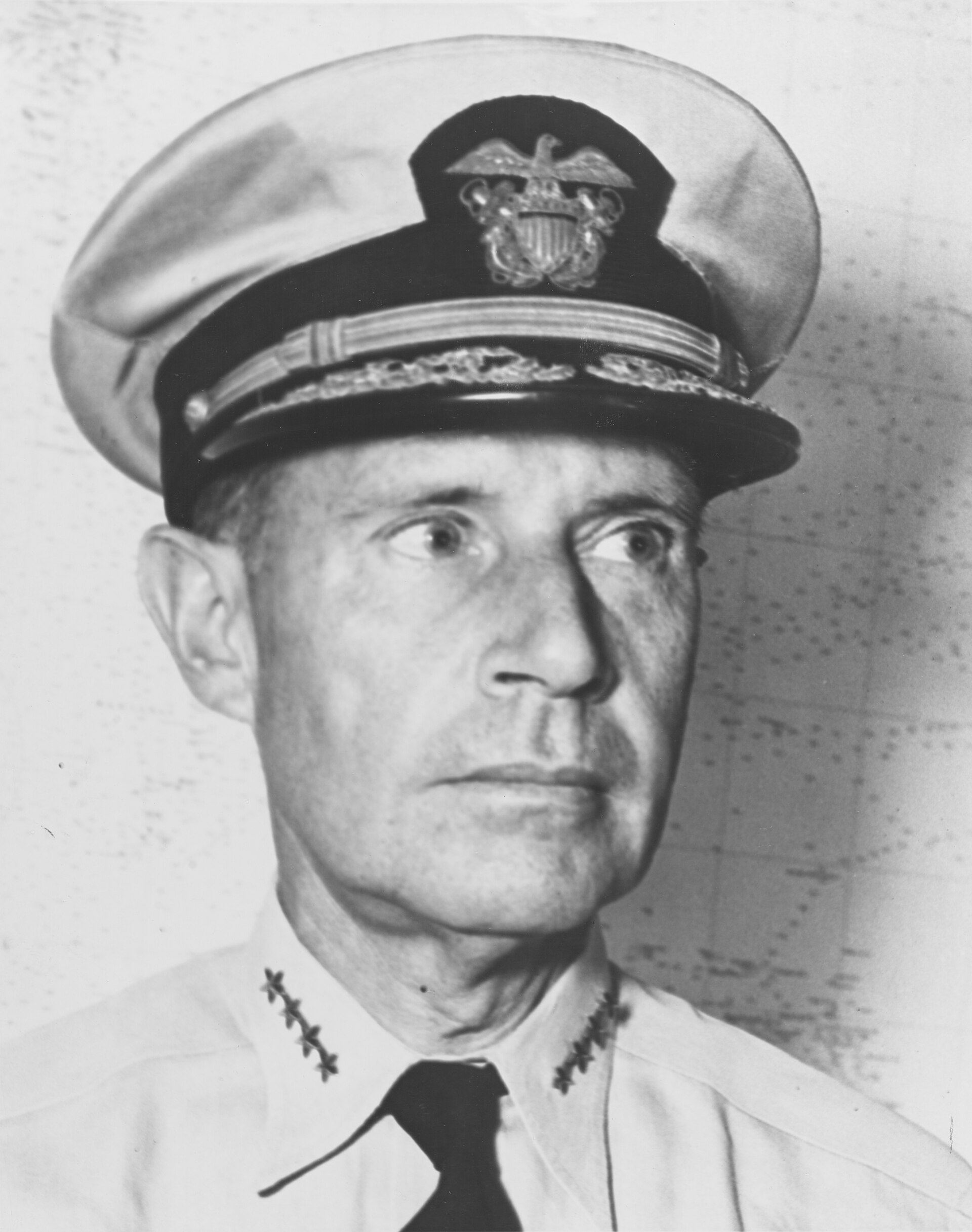
Raymond Ames Spruance was born in Baltimore, Maryland, on 3 July 1886, and grew up largely in Indianapolis, Indiana. He entered the United States Naval Academy in 1903 and graduated in September 1906. Commissioned an ensign in 1908, he circled the world in the battleship Minnesota with the Great White Fleet and afterward studied electrical engineering. His early commands were destroyers, including Bainbridge with the Asiatic Fleet. Between the wars he returned often to the Naval War College, served in engineering and staff assignments, and from 1938 commanded the battleship Mississippi. Promoted to rear admiral in October 1940, he took charge of the Tenth Naval District at San Juan and, in 1941, the Caribbean Sea Frontier as well.
On 17 September 1941 he assumed command of Cruiser Division Five and placed his flag in the heavy cruiser Northampton. His cruisers were at sea with William F. Halsey's task force, in company with the carrier Enterprise (CV-6), when Japan attacked Pearl Harbor. Through the first months of 1942 he remained Halsey's second in command for the carrier raids on the Marshall Islands, Wake, and Marcus.
Halsey was too ill to command at Midway, and Spruance took Task Force 16 in his place, with the carriers Enterprise and Hornet. On 4 June 1942 he had tactical command of the American carriers. His flag was in Enterprise. He was not her captain. Japanese aircraft put Yorktown out of action, but Enterprise was not hit. Dive bombers from the American carriers sank four Japanese fleet carriers, and the balance of the Pacific war shifted. That night he turned his force east, clear of Japanese battleships that could fight in the dark, and stayed within supporting distance of Midway. The Navy awarded him the Distinguished Service Medal for his conduct of the battle.
After Midway he went to Pearl Harbor as chief of staff to Admiral Chester W. Nimitz, and in 1943 he became deputy commander in chief of the Pacific Fleet. Promoted to vice admiral, he returned to sea in August 1943 at the head of the Central Pacific Force. That force seized the Gilbert Islands in November 1943, including Tarawa and Makin, and the Marshall Islands in the first months of 1944. He was made a full admiral early in 1944. On 29 April 1944 the command was designated the Fifth Fleet.
At the Philippine Sea his flag was in the heavy cruiser Indianapolis (CA-35). He was not her captain, and the cruiser was not lost. The battle was fought on 19 and 20 June 1944 while American troops were taking Saipan. Marc A. Mitscher commanded the fast carriers of Task Force 58 and proposed a night run west so those ships could strike the Japanese fleet at dawn. Spruance held the carriers where they could protect the transports and the troops ashore. On 19 June American fighters and shipboard guns destroyed the greater part of the Japanese carrier air groups. Submarines sank two large enemy carriers, and aircraft sank a third the next day. The rest of the Japanese surface force withdrew.
Indianapolis was still his flagship for the assault on Iwo Jima in February 1945. He was not her captain, and she was not lost in that operation. On 31 March 1945, while the fleet was preparing the Okinawa landings, a bomb from a Japanese aircraft exploded beneath her and opened her hull. Nine men were killed. She left the operating area for repairs at the Mare Island Navy Yard, and Spruance shifted his flag. After the yard period the cruiser sailed again. On 30 July 1945 the Japanese submarine I-58 sank her. He was not aboard.
During the Okinawa campaign his flag was in the battleship New Mexico (BB-40). He was not her captain. On 12 May 1945 two kamikazes struck her. Fifty-four men were killed and 119 were wounded. The battleship was not sunk. In the first minutes after the hits, his staff found him on a fire hose with the sailors and Marines fighting the blaze. He kept his flag in her. Near the end of May, William F. Halsey relieved him on board, and Spruance turned to plans for an invasion of Japan. For his command of the Fifth Fleet at Iwo Jima and Okinawa he received the Navy Cross.
In November 1945 he left the Fifth Fleet and succeeded Nimitz as Commander in Chief of the Pacific Fleet and Pacific Ocean Areas. He gave up that post in February 1946 to become president of the Naval War College. He retired from the Navy on 1 July 1948. President Truman appointed him ambassador to the Philippines in January 1952, and he served until 1955. Spruance died at his home in Pebble Beach, California, on 13 December 1969.