Ships
- USS Hornet (CV-8) Captain from 20 October 1941
- USS Lexington (CV-16) Flag, not her captain, from 8 March 1944
- USS Bunker Hill (CV-17) Flag, not her captain, from 1 April 1945
- USS Enterprise (CV-6) Flag, not her captain, after Bunker Hill was hit on 11 May 1945
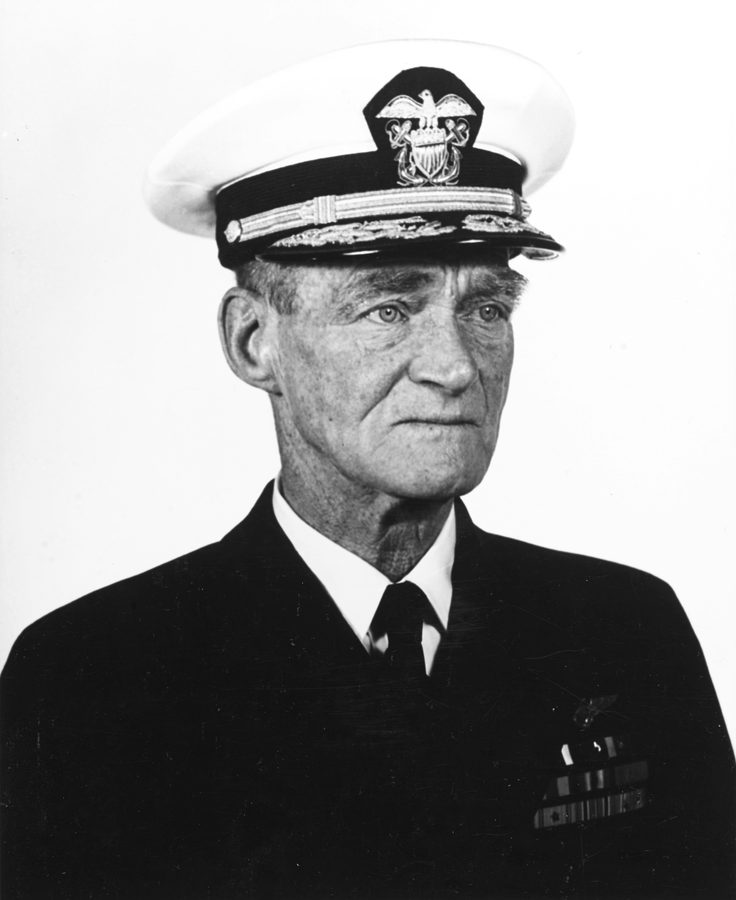
Marc Andrew Mitscher was born 26 January 1887 in Hillsboro, Wisconsin, son of Oscar A. Mitscher and Myrta V. Shear. The family moved to Oklahoma Territory. His father ran a store, was elected mayor of Oklahoma City in 1891, and later served as Osage agent at Pawhuska. The boy was sent to school in Washington. Friends called him Pete.
Academy and the air
Representative Bird S. McGuire of Oklahoma appointed him to Annapolis. He was a poor midshipman: 159 demerits in one year, weak academics, forced out after two years. His father got him reappointed. He entered again as a plebe and graduated 3 June 1910, 113th of 131. The nickname “Oklahoma Pete” stayed.
He served two years at sea in Colorado before the ensign’s commission of 7 March 1912, then South Dakota, Vicksburg, Annapolis, and California (renamed San Diego) in the Mexican campaign. On 16 January 1913 he married Frances Eulalia Smalley of Tacoma. The official biographies name no children.
In September 1915 he reported for aviation training in North Carolina, one of the first ships to carry an airplane. Designated Naval Aviator No. 33 on 2 June 1916. World War I kept him at air stations and in the Office of the Chief of Naval Operations, not in combat over France.
NC-1
On 16 May 1919 he took off from Newfoundland as a pilot of seaplane NC-1 on the Navy’s attempt to cross the Atlantic. NC-1 came down short of the Azores and the crew was picked up. He received the Navy Cross for the flight.
Between the wars he stayed in aviation: Langley, Saratoga (he flew the first plane to land on her), seaplane tender Wright, Patrol Wing 1, and from June 1939 to July 1941 assistant chief of the Bureau of Aeronautics. He fitted out the new carrier Hornet and took command at her commissioning, 20 October 1941.
Hornet
Pearl Harbor found him still her captain. On 18 April 1942 he launched sixteen Army B-25s under Lieutenant Colonel James H. Doolittle toward Japan. The ship became “Shangri-La” in the public story. Roosevelt would not name the carrier.
At Midway, 4–6 June 1942, Hornet was under his command. Torpedo Squadron 8 found the Japanese carriers and was destroyed. Her dive bombers missed the morning strike. Enterprise and Yorktown sank three carriers that day. He was promoted rear admiral in late May, commanded Task Force 17 as well as the ship, and was detached 30 June—four months before Hornet went down at Santa Cruz. Midway left a mark on his reputation that later commands had to outrun.
Solomons to the fast carriers
Patrol Wing 2, then Commander Fleet Air Nouméa, then in April 1943 Commander Air, Solomon Islands—the air war over Guadalcanal and the slot after the worst of the surface nights. From August 1943 to January 1944 he had Fleet Air, West Coast. He came back as Commander Carrier Division 3.
On 21 March 1944 he was appointed vice admiral and given Task Force 58, the fast carriers (the same force ran as TF 38 when Halsey had Third Fleet). From then until the late spring of 1945 that force was the striking arm of the Central Pacific: Truk, the Palaus, the New Guinea coast, the Marianas, the Philippine Sea in June 1944, Leyte Gulf in October, Iwo Jima and Okinawa, and repeated runs to the home islands.
At the Philippine Sea his fighters and the battle line’s guns broke the Japanese carrier air groups in what the fleet called the Marianas Turkey Shoot. Off Okinawa the force stayed at sea through kamikaze weather for weeks on end. When Bunker Hill and Enterprise were hit in May 1945 he shifted his flag and kept the schedule. Two more Navy Crosses and Distinguished Service Medals stacked on the 1919 cross.
In July 1945 he came home as Deputy Chief of Naval Operations for Air.
Last command
He had a brief tour as Commander Eighth Fleet, then on 1 March 1946 became Commander in Chief, U.S. Atlantic Fleet, with four stars dating from that day. He died at the Naval Hospital, Norfolk, on 3 February 1947, of coronary thrombosis after a heart attack the week before. He was sixty. Buried at Arlington. Frances survived him by decades and sponsored the destroyer leader Mitscher.
He was a short, quiet officer who sat in a wicker chair on the flag bridge and let the air groups fight. The record that can be written without invention is this: a midshipman who almost did not finish, Naval Aviator 33, a failed Atlantic crossing that still earned a cross, the captain who launched Doolittle and left Hornet before she sank, and the admiral who took the fast carriers from Truk to Tokyo. The private cost of Midway, of the Solomons, and of the months off Okinawa is not in a letter that these sources print.