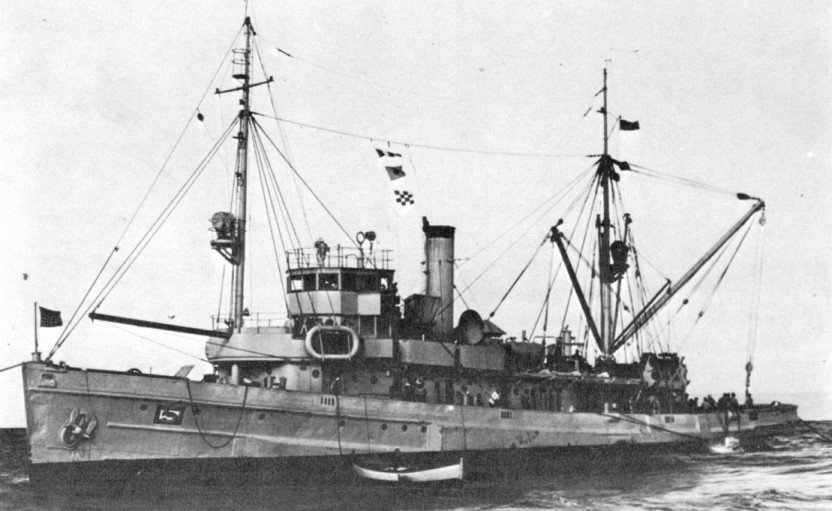
The first Ortolan was a Lapwing-class minesweeper, hull AM-45, built by the Staten Island Shipbuilding Company. She was laid down on 9 July 1918, launched on 30 January 1919 with Miss Theresa M. Finn as sponsor, and commissioned on 17 September 1919 under Lieutenant William Alexander James. She went to the Pacific Fleet, reached San Diego on 13 June 1920, lay in caretaker status at Bremerton until 23 March 1921, worked as a tug, and was decommissioned at Mare Island on 3 May 1922. She was recommissioned on 11 July 1922 as a tender at the submarine base at San Pedro.
From 9 June to 25 August 1923 she was flagship of the composite submarine squadrons on an Alaska cruise. In September 1923 she helped salvage seven destroyers wrecked on Honda Point. In July 1927 she went to Pearl Harbor with the tender Holland and a division of S-boats, and in August she searched for fliers in the Dole race. On 12 September 1929 she was redesignated the submarine rescue vessel ASR-5. Robert Lee Dennison had her in 1935 and 1936 and into 1937. Lowell Thornton Stone had her from 28 April 1938 until July 1941, and Frank DeVere Latta from then until 8 April 1942.
On 10 December 1941 she sailed west and reached Pearl Harbor on 21 December. For half a year she worked on the minelayer Oglala, capsized in the attack, and at last floated her. From 18 July 1942 she spent a year with the Pearl Harbor submarines, picking up practice torpedoes and preparing boats for patrol. In October she was given new sound gear, two 3-inch guns, and two 20 mm guns. Lieutenant Commander Ashley L. Holland had taken her on 8 April 1942. On 1 November she left for the South Pacific and reached Espiritu Santo on the 20th. For ten days she salvaged stores from the Army transport President Coolidge. At Tulagi she helped repair cruisers damaged at Tassafaronga. Those ships sailed twelve days later. Through the next two months she assisted everything from motor torpedo boats to destroyers and transports, and she surveyed sunken Japanese craft.
On 7 April 1943 Aaron Ward, covering a landing ship off Togoma Point, took a bomb in the engine room and lost steering. Ortolan and the minesweeper Vireo took her in tow and tried to put her on a shoal near Tinete Point, on Florida Island. At 2135 the destroyer went down about six hundred yards short of the beach. Ortolan was not hit. Into that spring she also worked on two Japanese submarines off Guadalcanal's north coast, a two-man midget and a large supply boat. In May she raised the midget and towed it to Kukum Bay. In June she delivered it to Noumea.
She went to Auckland for overhaul and was back in the Solomons in October 1943. Lieutenant Ernest Maltby had her from December 1943. On 17 January 1944 she headed east and reached San Pedro on 4 March. From the end of April, for about eighteen months, she did escort duty and torpedo recovery for the Western Sea Frontier. After the surrender she trained divers at Pearl Harbor until April 1946, then joined the Seventh Fleet. She reached Tsingtao on 18 May and stayed until November. She sailed on 13 November and reached San Francisco on 24 December. She was decommissioned on 18 March 1947, struck on 10 June 1947, and sold on 20 August 1947 to the Bay Cities Transportation Company. She earned one battle star. A later Ortolan, ASR-22, was a different ship.
A note on sources. The life is the Dictionary of American Naval Fighting Ships entry for Ortolan I, which does not mention 7 April. The tow that afternoon is Aaron Ward's entry. The commanding officers, from James in 1919 through Maltby in 1946, are NavSource, compiled by Hechler, Reeves, and Radigan. Dennison's years in command are that compilation. His later career is a separate biographical account. Stone's Navy Cross and two Silver Stars, and Latta's Navy Cross, Silver Star, and posthumous Legion of Merit, are given there. Holland's Legion of Merit is dated 1943 in that compilation and is not tied to the tow. The photograph is a Navy photograph of ASR-5 on NavSource. It carries no date. It is not a photograph of ASR-22.